


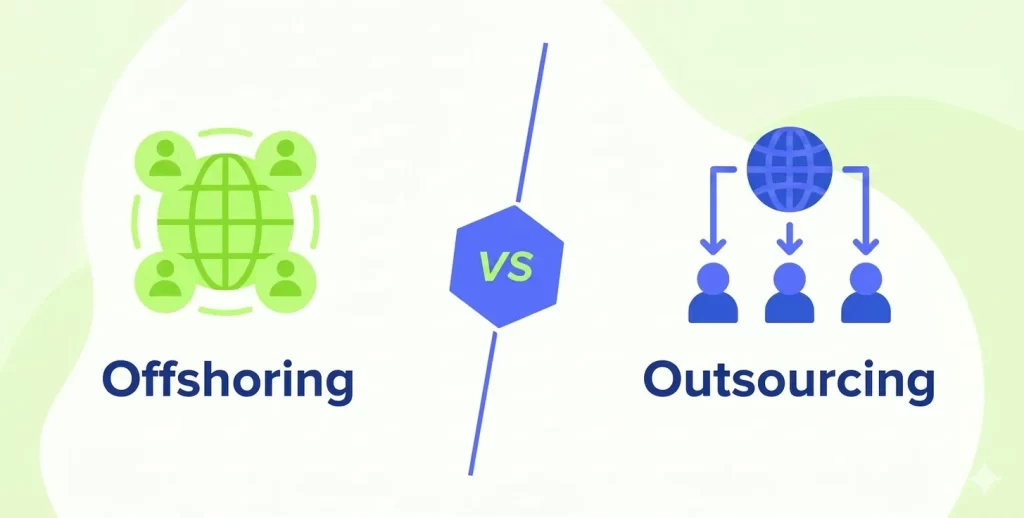
Businesses today want to grow faster, reduce costs, and stay flexible. That is why many companies compare offshoring vs outsourcing when planning how to scale.
At first glance, the two sound similar. Both involve getting work done outside your core in-house setup. Because of that, people often mix them up. Still, there is a real difference between offshoring and outsourcing, and that difference matters when you are making a business decision.
Choosing the wrong model can create delays, confusion, and extra costs. Choosing the right one can improve efficiency, reduce pressure on internal teams, and open the door to long-term growth. So before you decide, it helps to understand the basics clearly.
In simple terms, outsourcing means hiring a third-party company or external team to handle certain tasks or services. Offshoring means moving work or operations to another country, usually to reduce costs or access talent. Sometimes a company does both at once. That is one reason the offshoring and outsourcing difference can feel unclear.
This blog breaks it down in a practical way. We will look at the meaning of each model, the main differences, the benefits, the risks, and how to decide which one fits your business better.
What Is Outsourcing?
Outsourcing means giving specific work to an outside company, agency, or service provider. Instead of building everything in-house, a business hires an external partner to handle certain functions.
These functions can include:
- customer support
- IT support
- accounting
- payroll
- content writing
- software development
- digital marketing
The main goal is usually efficiency. A business wants better results, lower costs, or more flexibility without hiring full internal teams for every task.
For example, a startup may outsource customer support to a specialized support company. A growing agency may outsource content writing or design work to an outside team. In these cases, the work stays external, but the business still benefits from the results.
That is why many companies see outsourcing as a smart way to stay lean. It helps them focus on core work while someone else handles routine or specialized tasks. This is a major reason why the topic of outsourcing benefits and risks matters so much for growing businesses.
What Is Offshoring?
Offshoring means moving business work, functions, or operations to another country. This is often done to reduce costs, access talent, or build a larger support structure.
A company can offshore work in two ways. It can set up its own team in another country, or it can work with a partner based in another country. That is where the line between offshoring and outsourcing sometimes overlaps.
For example, a business may build a software development team in India, customer support operations in the Philippines, or back-office support in another low-cost market. The work is still part of the business function, but it is being handled in another location.
Offshoring is often about geography. The work is moved to a different country. Outsourcing is more about who handles the work. This is the core difference between offshoring and outsourcing that many businesses need to understand before choosing a model.
Offshoring vs Outsourcing: The Core Difference
When comparing offshoring vs outsourcing, the biggest difference is this:
- Outsourcing is about giving work to an outside provider
- Offshoring is about moving work to another country
That means outsourcing does not always involve another country. A company can outsource work locally within the same country. Offshoring, on the other hand, always involves a different country.
A business can also combine the two. For example, if a US company hires a third-party support agency in India, that is both outsourcing and offshoring.
This is why the offshoring and outsourcing difference can feel confusing. They are separate ideas, but they can exist together in the same business setup.
A simple way to think about it
Ask two questions:
- Is the work being handled by an external provider?
- Is the work being moved to another country?
If the answer to the first is yes, that is outsourcing.
If the answer to the second is yes, that is offshoring.
If both answers are yes, then you are using both models together.
Business Process Outsourcing vs Offshoring
The comparison of business process outsourcing vs offshoring becomes clearer when you look at common examples.
Business process outsourcing usually covers functions like support, payroll, HR tasks, data entry, admin work, and customer service. These are ongoing tasks that can be handled by an outside provider.
Offshoring is broader. It can include full teams, departments, production work, back-office operations, or technical support moved to another country.
So if you hire an outside agency to manage payroll, that is outsourcing. If you open a finance operations team in another country, that is offshoring. If you hire an offshore payroll company in another country, that is both.
This matters because each model has a different level of control, cost, complexity, and long-term commitment.
Offshoring vs Outsourcing Pros and Cons
Both models can help businesses grow. Both can also create problems if used in the wrong way. That is why it is important to look at offshoring vs outsourcing pros and cons before making a decision.
Outsourcing Pros
Lower upfront costs
You do not need to build a full internal team for every function.
Faster access to specialists
You can work with experts who already know the job.
More flexibility
You can scale support up or down as needed.
Less management burden
The service provider often handles hiring, training, and process management.
Outsourcing Cons
Less direct control
An outside team may not follow your style unless expectations are clear.
Quality can vary
Some providers are strong. Others are not. The wrong partner can create problems.
Communication gaps
External teams may need time to understand your workflows and standards.
Dependency risk
If you rely too much on one provider, switching later can be difficult.
Offshoring Pros
Lower labor costs
Many businesses offshore to access talent at a lower cost.
Larger talent pools
You may find skilled professionals in markets with strong technical or support talent.
Long-term scale
Offshoring can support bigger operations as the business grows.
More operational capacity
A business can expand support without growing local overhead too fast.
Offshoring Cons
Setup complexity
Offshoring often takes more planning, structure, and management.
Time zone challenges
Working across different hours can create delays if not managed well.
Cultural and communication differences
Teams may need better onboarding and process clarity.
Compliance and legal issues
Employment laws, data privacy, and local regulations can add complexity.
Outsourcing Benefits and Risks
Let us look more closely at outsourcing benefits and risks because outsourcing is often the first step for many businesses.
Key benefits of outsourcing
Outsourcing helps businesses move quickly. Instead of spending weeks hiring, training, and managing a new team, they can work with an existing provider that already has people, tools, and processes in place.
It also gives access to specialized talent. A company may not need a full-time content writer, support team, or IT team in-house. Outsourcing gives access to these skills without long-term staffing costs.
Another big benefit is focus. When repeated or support-heavy work is handled externally, internal teams can spend more time on core business goals.
Main risks of outsourcing
The biggest risk is choosing the wrong partner. If quality is poor, deadlines slip, communication breaks down, and customers may feel the impact.
There is also the risk of poor alignment. An outsourced team may be efficient, but if it does not understand your brand, standards, or business goals, the results may feel disconnected.
That is why outsourcing works best when roles, expectations, reporting, and quality checks are clear from the start.
Offshoring Benefits and Risks
Now let us look at offshoring benefits and risks, because offshoring can be a strong long-term growth move when done well.
Key benefits of offshoring
One major benefit is cost control. Businesses can build teams in markets where skilled talent is available at lower cost than local hiring.
Another benefit is scale. Offshoring can support bigger workloads and larger teams without pushing local hiring costs too high.
Offshoring can also improve business continuity. Some companies use offshore teams to support round-the-clock operations, faster turnaround, or wider coverage across time zones.
Main risks of offshoring
The setup can be harder. Building a team in another country takes planning, oversight, and strong systems.
Culture also matters. If communication styles, expectations, or workflows are not aligned, productivity can suffer.
Then there is compliance. Depending on the country and type of setup, businesses may need legal, payroll, tax, and HR support to operate smoothly.
This is why offshoring often works best for businesses that are ready for a bigger and more structured growth model.
Offshore Team vs Outsourced Team
Another useful comparison is offshore team vs outsourced team.
An outsourced team is usually managed by an external provider. You define the outcomes, but the provider often handles the staffing and day-to-day team structure.
An offshore team may feel more like an extension of your business. In some cases, it is fully dedicated to your company. You may have more control over workflows, priorities, and communication.
So the real question is not just cost. It is also about control, ownership, and how closely the team needs to operate with your business.
If you need quick support for a function like content, support, or admin tasks, outsourcing may be enough. If you want a more dedicated team that grows with your business, offshoring may make more sense.
Offshoring vs Outsourcing: Real-World Examples
The easiest way to understand this topic is through real-world style examples. These outsourcing vs offshoring examples make the difference much clearer.
Example 1: Local outsourcing
A business hires a marketing agency in the same country to run paid ads.
This is outsourcing, not offshoring.
Example 2: Offshore development team
A company builds its own development team in another country to reduce hiring costs and scale faster.
This is offshoring, not outsourcing.
Example 3: Offshore outsourced support
A startup hires a third-party customer support company in another country.
This is both offshoring and outsourcing.
Example 4: Outsourced accounting
A business hires an external accounting firm in the same country to manage payroll and bookkeeping.
This is outsourcing.
Example 5: Offshore operations center
A company opens a support operations unit in another country for long-term growth.
This is offshoring.
These examples show why people confuse the two. In practice, businesses often combine them depending on their goals.
How to Choose Between Offshoring and Outsourcing
The best choice depends on your business stage, budget, goals, and the kind of work you need help with.
Choose outsourcing if:
- you need support quickly
- you want lower management pressure
- you need specialized skills without building a full team
- your workload changes often
- you want flexibility with lower commitment
Outsourcing is often a better fit for startups, agencies, and businesses that need fast support without a heavy setup.
Choose offshoring if:
- you want a more dedicated long-term team
- you need to scale operations in a cost-effective way
- you want stronger control over processes
- you are ready to invest in structure and management
- you expect ongoing growth in one function or department
Offshoring is often a stronger fit for companies that are scaling steadily and need a more stable operational foundation.
Key Questions Before Choosing Offshoring vs Outsourcing
Before choosing between offshoring vs outsourcing, ask yourself:
- Do I need flexibility or long-term structure?
- Is this work core to my business or support work?
- How much control do I need?
- Do I have the systems to manage an offshore setup?
- Would an external provider solve the problem faster?
- Is my priority cost, speed, quality, or scale?
The answers usually point you in the right direction.
Common Mistakes Businesses Make
Many businesses do not fail because offshoring or outsourcing is bad. They struggle because the setup is weak.
Here are a few common mistakes:
Choosing based on cost alone
Low cost looks attractive, but poor quality can cost more later.
Not defining expectations clearly
If goals, deadlines, and workflows are vague, results will suffer.
Ignoring communication structure
Good support needs good reporting, updates, and ownership.
Using the wrong model for the wrong task
Some tasks are better outsourced. Others need a more dedicated offshore approach.
Expecting instant success
Both models need onboarding, process clarity, and adjustment time.
Final Thoughts
The debate around offshoring vs outsourcing is not really about which one is better in every situation. It is about which one fits your business better right now.
If you need speed, flexibility, and outside expertise, outsourcing may be the smarter move. If you need a long-term team in another country and want to scale operations with more control, offshoring may be the better path.
The most important thing is understanding the difference between offshoring and outsourcing before making a decision. Once that is clear, you can weigh the costs, benefits, risks, and level of control you need.
A lot of growing businesses end up using both at different stages. They may start with outsourcing because it is faster and simpler. Later, they may move toward offshoring when they need deeper support and larger team capacity.
There is no one-size-fits-all answer here. But if you choose with clarity, the right model can reduce pressure, improve efficiency, and support growth in a more sustainable way.
Build Smarter Remote Support with Next Hire Inc
At Next Hire Inc, we help businesses build flexible remote support through skilled professionals across development, support, marketing, content, and operations. If you are exploring the right model for growth, the right team setup can make a big difference.
FAQs
What is the main difference between offshoring and outsourcing?
The main difference is that outsourcing means handing work to an outside provider, while offshoring means moving work to another country.
Can offshoring and outsourcing happen together?
Yes. If you hire an external provider in another country, that setup includes both offshoring and outsourcing.
Which is better for startups, offshoring or outsourcing?
In many cases, outsourcing is easier for startups because it is faster and more flexible. Still, the right choice depends on the work and growth plan.
What are the main risks of offshoring?
The main risks include setup complexity, time zone issues, communication challenges, and compliance concerns.
What are the main risks of outsourcing?
The main risks include lower control, quality variation, communication gaps, and dependence on the provider.



