



If you are running a business in today’s digital landscape and trying to handle every single piece of your digital marketing on your own, you already know how exhausting that gets. Between posting on social media, writing blogs, managing email campaigns, tracking analytics, optimizing for SEO, and keeping up with trends that change every other week, it feels less like marketing and more like spinning plates while someone keeps adding more.
The businesses that are growing consistently online are not doing it all themselves. They are delegating smartly. And one of the most effective ways to do that right now is by bringing in a digital marketing virtual assistant.
This guide is going to walk you through everything you need to know, what a digital marketing VA actually is, what tasks they handle, what skills to look for, how much it costs, how to hire the right one, and how to measure whether they are actually delivering results for your business. By the end, you will have a clear picture of whether this is the right move for you and exactly how to make it work.
What Is a Digital Marketing Virtual Assistant?
A digital marketing virtual assistant is a remote professional hired externally to manage various digital marketing tasks within a specified timeframe. Unlike a traditional in-house employee, they work independently and often remotely, bringing their own access to essential tools and platforms needed to get the job done. Think online calendars, project management software, scheduling tools, analytics dashboards, and content creation platforms.
What separates a virtual digital marketing assistant from a general virtual assistant is specialization. A general VA might handle your inbox, book your travel, or manage your calendar. A digital marketing VA focuses specifically on tasks that build your online presence, drive traffic, generate leads, and grow your brand across digital channels.
They are not just task executors either. A skilled virtual assistant for digital marketing understands strategy well enough to execute it intelligently. They know why a certain type of content works on LinkedIn but not on Instagram. They understand why a blog post needs proper header structure and internal links to rank on Google. They can look at an email campaign’s open rate and know whether it is a subject line problem or an audience segmentation problem.
In short, they bring real marketing knowledge to the table, just without the full-time salary, office space, benefits package, and long onboarding process that comes with hiring someone in-house.
What Is Digital Marketing and Why Does It Matter for Your Business?
Before diving deeper into the VA side of things, it helps to understand the full scope of what digital marketing actually covers, because it is a lot broader than most people realize.
Digital marketing encompasses every online channel a business uses to connect with its existing and potential customers. These channels include:
- Social media platforms like Instagram, LinkedIn, Facebook, TikTok, and Pinterest
- Blog writing and content marketing
- Search engine optimization (SEO)
- Content management systems (CMS) like WordPress or Webflow
- Display advertising and paid online campaigns
- Video content on YouTube, Instagram Reels, and TikTok
- Web design and landing page optimization
- Email marketing and automated sequences
- Influencer collaborations and affiliate partnerships
- Online reputation management and brand monitoring
The primary goal of digital marketing is to promote a company’s brand, products, or services to a targeted audience online. But beyond visibility, it drives lead generation, increases website traffic, improves conversion rates, and helps businesses expand their reach to audiences they could never access through traditional marketing alone.
Digital marketing also gives you something traditional marketing never could: real data. You can see exactly how many people visited your website, where they came from, how long they stayed, what they clicked on, and whether they converted into a customer. That kind of insight is gold for making better business decisions.
Now imagine trying to manage all of that yourself while also running your actual business. That is where a digital marketing virtual assistant becomes not just helpful but genuinely essential.
How Is a Digital Marketing VA Different from a General Virtual Assistant?
This is a question that comes up often, and it is worth answering clearly because the difference matters when you are deciding who to hire.
A general virtual assistant handles administrative and operational tasks. They are great for things like managing your inbox, scheduling meetings, data entry, travel bookings, and customer service responses. These are important tasks, but they do not directly move the needle on your online marketing.
A virtual assistant digital marketing professional, on the other hand, is trained and experienced specifically in marketing functions. Here is a side-by-side breakdown of how they differ:
| Area | General Virtual Assistant | Digital Marketing Virtual Assistant |
| Primary Focus | Administrative and operational tasks | Online marketing strategy and execution |
| Skills | Organization, communication, data entry | SEO, content creation, social media, analytics |
| Tools Used | Email, calendar, spreadsheets | Canva, SEMrush, Google Analytics, Mailchimp, Buffer |
| Output | Operational efficiency | Brand visibility, traffic, leads, conversions |
| Strategic Input | Minimal | Moderate to high, depending on experience |
| Best For | Day-to-day business operations | Growing online presence and marketing performance |
| Cost Range | $8 to $20 per hour | $15 to $50 per hour, depending on specialization |
When your goal is to grow your business online, attract more customers, and build a recognizable brand presence across digital channels, a digital marketing virtual assistant is the right hire, not a general VA.
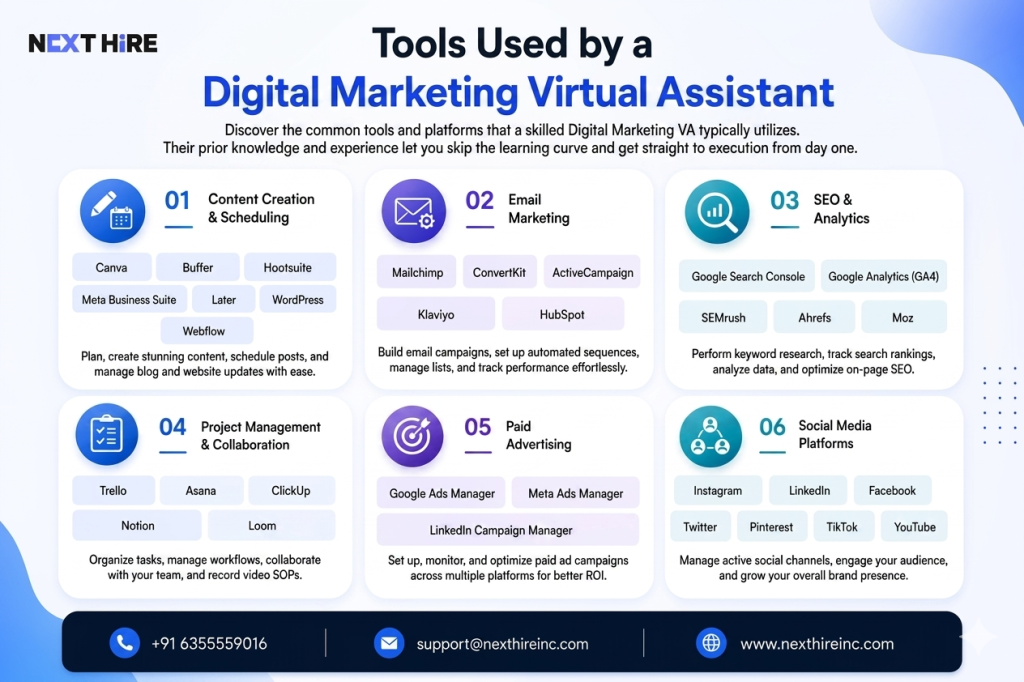
Common Tools and Platforms a Digital Marketing Virtual Assistant Uses
One of the practical advantages of hiring a skilled virtual assistant for digital marketing is that they already know how to use the tools. You do not need to spend time and money training them on the software. They come equipped with hands-on experience across a range of marketing platforms.
Here are the tools a competent digital marketing VA typically works with:
Content Creation and Scheduling:
Canva for graphic design, Buffer or Hootsuite for social media scheduling, Meta Business Suite for Facebook and Instagram management, Later for visual content planning, WordPress or Webflow for blog publishing and website updates.
Email Marketing:
Mailchimp, ConvertKit, ActiveCampaign, Klaviyo, or HubSpot for building email campaigns, setting up automated sequences, managing subscriber lists, and tracking performance.
SEO and Analytics:
Google Search Console, Google Analytics (GA4), SEMrush, Ahrefs, or Moz for keyword research, rank tracking, on-page optimization, and competitor analysis.
Project Management and Collaboration:
Trello, Asana, ClickUp, or Notion for task management and workflow organization. Loom for recording video instructions and SOPs.
Paid Advertising:
Google Ads Manager, Meta Ads Manager, and LinkedIn Campaign Manager for setting up, monitoring, and optimizing paid campaigns.
Social Media Platforms:
Instagram, LinkedIn, Facebook, Twitter, Pinterest, TikTok, and YouTube, depending on where your audience is most active.
The fact that your VA already knows these platforms means you can skip the learning curve and get straight to execution from day one.
Digital Marketing Virtual Assistant Tasks You Can Delegate
This is where things get really practical. Understanding the full scope of a virtual assistant for digital marketing tasks gives you a clear picture of how much you can actually hand off. Here is a comprehensive breakdown of every major task category:
Social Media Management
Your VA can manage your social media presence end-to-end. This includes creating a content calendar, writing captions, designing graphics using Canva, scheduling posts across multiple platforms, responding to comments and direct messages, monitoring tagged posts, researching trending hashtags, analyzing engagement metrics, and adjusting the strategy based on what is performing well.
For businesses with active and growing social channels, this alone can easily consume 15 to 20 hours per week. Handing it off to a virtual assistant means your brand stays consistent and active even when you are deep in the work of running your business.
Content Creation and Blog Management
Content is still the most powerful long-term driver of organic traffic and brand authority. Your digital marketing virtual assistant can handle topic research, keyword targeting, blog writing, editing, formatting, and publishing directly to your website. They can also repurpose a single blog post into social media content, email snippets, infographics, and short-form video scripts, getting more mileage out of every piece of content you create.
They can maintain your brand voice consistently across all content formats, proofread for clarity and grammar, and optimize every piece for SEO before it goes live.
Search Engine Optimization (SEO)
SEO is one of the highest-value but most time-consuming areas of digital marketing. A skilled VA can conduct keyword research to identify what your audience is searching for, optimize on-page elements like meta titles, descriptions, and header structure, build internal linking frameworks, update older blog posts with fresh keywords and improved formatting, manage image alt text, and track your search rankings over time.
They can also conduct competitor analysis to understand what other businesses in your space are ranking for and identify gaps you can fill with new content.
Email Marketing
Email consistently delivers one of the highest returns on investment of any digital marketing channel. Your virtual assistant can build and segment your email list, design branded email templates, write compelling subject lines and body copy, set up automated welcome sequences and drip campaigns, manage your subscriber database, run A/B tests on subject lines and content, and track open rates, click-through rates, and conversions.
Whether you use Mailchimp, ConvertKit, ActiveCampaign, or another platform, your VA can keep your email marketing running smoothly and strategically.
Paid Advertising Support
While high-level ad strategy might require a specialist, a digital marketing VA with paid advertising experience can handle significant portions of your campaign management. This includes setting up campaigns on Google Ads, Facebook Ads, or LinkedIn Ads, writing ad copy, building audience targeting parameters, monitoring daily performance, adjusting bids and budgets, running A/B tests on creatives, and compiling weekly performance reports so you always know where your money is going.
Website Management and Landing Page Updates
Your VA can handle the ongoing maintenance and content updates your website needs to stay fresh and functional. This includes publishing new blog posts, updating landing pages, adding new product or service information, fixing broken links, optimizing page load performance, creating lead capture forms, and building new landing pages for campaigns or promotions.
Brand and Reputation Management
Your online reputation affects everything from customer trust to search rankings. A digital marketing VA can monitor your brand mentions across social media and the web, respond to reviews on Google and other platforms, analyze customer feedback to identify recurring issues or opportunities, and maintain the visual and tonal consistency of your brand across all channels.
Analytics and Reporting
Data without interpretation is just noise. Your VA can pull performance data from Google Analytics, social media dashboards, email platforms, and ad managers, then compile it into clear, actionable reports. These reports highlight what is working, what needs adjustment, and where you should focus your marketing investment in the coming weeks.
Instead of spending hours sifting through dashboards yourself, you get a clean summary with key takeaways delivered on a regular schedule.
Market and Competitor Research
Staying ahead in digital marketing requires knowing what your competitors are doing and where the market is heading. Your VA can conduct regular competitor analysis, track industry trends, identify new keyword opportunities, research your target audience’s behavior and preferences, and provide insights that inform your overall marketing strategy.
Project Management and Campaign Coordination
For businesses running multiple marketing campaigns simultaneously, a VA can serve as the coordinator who keeps everything on track. They can build project timelines, manage task assignments, follow up on deadlines, maintain campaign documentation, and ensure that all moving pieces of a launch or campaign come together on schedule.
Full Task Overview Table
Here is a consolidated view of everything you can delegate to a digital marketing virtual assistant for hire:
| Category | Specific Tasks | Tools Used |
| Social Media Management | Content creation, scheduling, community engagement, hashtag research, and analytics tracking | Buffer, Hootsuite, Canva, Meta Business Suite |
| Content and Blog | Blog writing, SEO optimization, repurposing, publishing, proofreading | WordPress, Google Docs, Grammarly, Surfer SEO |
| Email Marketing | Campaign creation, list segmentation, automation setup, A/B testing, performance tracking | Mailchimp, ConvertKit, ActiveCampaign, Klaviyo |
| SEO | Keyword research, on-page optimization, rank tracking, competitor analysis, backlink outreach | SEMrush, Ahrefs, Google Search Console, GA4 |
| Paid Advertising | Campaign setup, ad copy, audience targeting, bid management, performance reporting | Google Ads, Meta Ads Manager, LinkedIn Ads |
| Website Management | Blog publishing, landing page updates, broken link fixes, lead form setup | WordPress, Webflow, Elementor |
| Analytics and Reporting | Performance dashboards, monthly reports, conversion tracking, and insight summaries | Google Analytics, Data Studio, social insights |
| Brand Management | Review monitoring, reputation tracking, brand voice consistency, and visual consistency | Google Alerts, Mention, Canva |
| Market Research | Competitor analysis, trend identification, audience research, and keyword gap analysis | SEMrush, BuzzSumo, SparkToro |
| Project Management | Timeline creation, campaign coordination, task tracking, and deadline management | Trello, Asana, ClickUp, Notion |
Skills to Look for in a Digital Marketing Virtual Assistant
Not every virtual assistant who claims marketing experience is ready to handle your brand. Knowing what skills to prioritize will save you time, money, and frustration during the hiring process.
Copywriting and Content Editing: Your VA needs to write clearly, engagingly, and in a way that matches your brand voice. They should be able to craft social media captions, email subject lines, blog introductions, and calls to action that actually motivate people to take the next step. Even if they are not your primary writer, they are often the last person reviewing content before it goes live, so quality matters.
SEO Knowledge: They do not need to be an SEO expert, but they should understand the basics. This means knowing how to use keywords naturally, how to structure content with proper headers, how to write meta descriptions, how to add image alt text, and how to build internal links. These fundamentals make a significant difference in whether your content ranks or gets ignored by search engines.
Familiarity with Scheduling and Publishing Tools: Your VA should be comfortable with platforms like Buffer, Hootsuite, Later, or Meta Business Suite for social media scheduling, and with WordPress or Webflow for publishing blog content. Efficiency with these tools directly affects how consistently and reliably your content gets published.
Graphic Design Basics: Marketing content needs visuals, and your VA should be able to create social graphics, email headers, blog featured images, and simple infographics using tools like Canva. They should understand brand consistency and be able to apply your colors, fonts, and visual style across all designed assets.
Analytics and Reporting: A strong digital marketing VA does not just execute tasks blindly. They should be able to log into Google Analytics, review social media insights, export email campaign data, and compile findings into clear summaries that help you make informed decisions about where to invest your marketing resources.
Trend Awareness: Digital marketing moves fast. Platform algorithms change, new content formats emerge, and audience behaviors shift. A great VA stays current with what is working across platforms and proactively suggests adjustments to your strategy based on what the data and trends are showing.
Communication and Reliability: Since your VA works remotely, strong communication is non-negotiable. They should be responsive, proactive about asking questions when something is unclear, and consistent about providing progress updates. A VA who goes quiet for days at a time is a liability, not an asset.
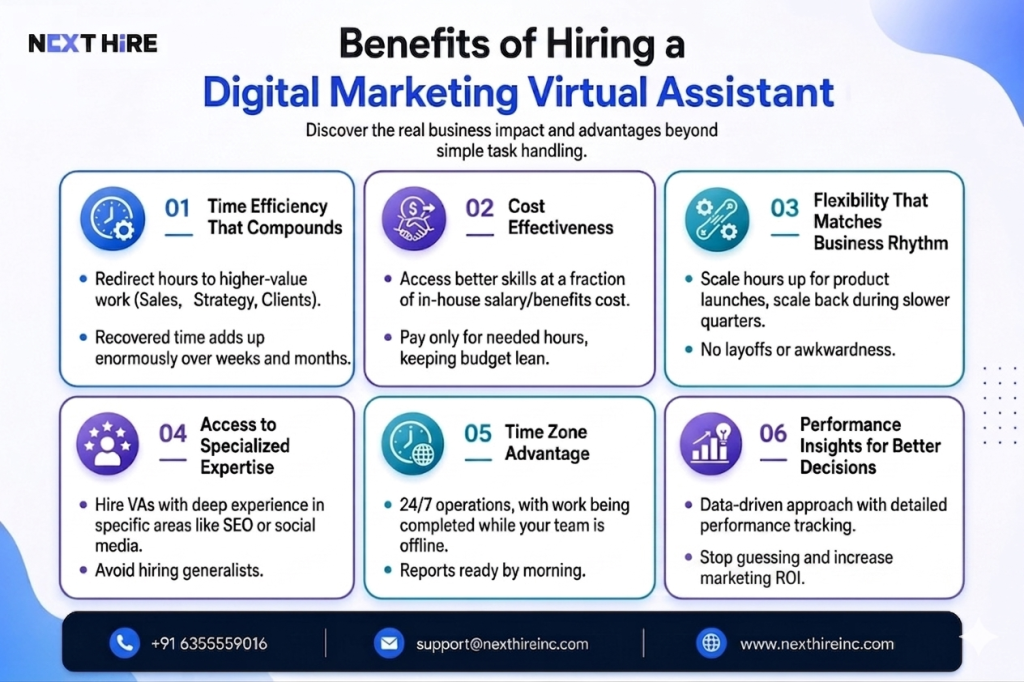
The advantages of working with a virtual digital marketing assistant go well beyond simply having someone to handle tasks. Here is a deeper look at the real business impact:
Time Efficiency That Compounds Over Time: Every hour you hand off to a VA is an hour you redirect toward higher-value work. Over weeks and months, that adds up to an enormous amount of recovered time that you can invest in sales, product development, client relationships, and strategic growth.
Cost Effectiveness Compared to In-House Hiring: Hiring a full-time in-house marketer means paying a salary, contributing to benefits, covering equipment and software costs, and investing significant time in onboarding and training. A digital marketing virtual assistant gives you access to equivalent or better skills at a fraction of that cost. You pay only for the hours or tasks you need, which keeps your marketing budget lean and focused.
Flexibility That Matches Your Business Rhythm: Need more marketing output during a product launch? Scale up your VA’s hours. Going through a slower quarter? Scale back without the awkwardness of layoffs or reduced salaries. This kind of flexibility is one of the defining advantages of the VA model and something traditional hiring simply cannot offer.
Access to Specialized Expertise: Rather than hiring one generalist who knows a little about everything, you can work with a VA who has deep experience in the specific areas your business needs most. Whether that is SEO, social media, email marketing, or paid advertising, you get targeted expertise without assembling an entire in-house team.
Time Zone Advantage: Hiring a digital marketing virtual assistant from a different time zone can be a genuine strategic advantage. While your team is offline, your VA can be scheduling tomorrow’s social posts, preparing your weekly email campaign, or compiling the analytics report that will be waiting in your inbox when you log in the next morning. Your marketing operation essentially runs around the clock.
Access to Current Tools and Technology: Skilled digital marketing VAs stay current with the latest marketing platforms, tools, and software. They bring that knowledge directly to your business without requiring you to invest in additional training or expensive software subscriptions. You get the benefit of cutting-edge marketing tools through their expertise.
Consistent Brand Presence: One of the biggest challenges for small and mid-sized businesses is maintaining consistency across all their digital channels. A dedicated VA ensures your social media stays active, your blog gets updated regularly, your emails go out on schedule, and your brand voice remains consistent everywhere your audience encounters you.
Performance Insights That Drive Better Decisions: Rather than guessing what is working in your marketing, a VA who tracks and reports on performance gives you the data to make smarter decisions. Over time, this data-driven approach leads to better ROI on every marketing dollar you spend.
How Much Does It Cost to Hire a Digital Marketing Virtual Assistant?
Pricing varies based on experience level, geographic location, specialization, and whether you hire independently or through an agency. Here is a realistic breakdown of what to expect:
| Experience Level | Hourly Rate | Monthly Cost (20 hrs/week) | Best For |
| Entry Level | $8 to $15 per hour | $640 to $1,200 per month | Basic social media, scheduling, and formatting |
| Mid Level | $15 to $30 per hour | $1,200 to $2,400 per month | Content creation, email marketing, SEO basics |
| Senior Level | $30 to $50 per hour | $2,400 to $4,000 per month | Strategy, paid ads, analytics, full campaign management |
| Agency Packages | Varies by scope | $1,500 to $5,000+ per month | Fully managed, vetted, and supported VA placement |
Compare these numbers to the cost of a full-time in-house digital marketing hire, which typically runs between $50,000 and $80,000 per year in salary alone before you factor in benefits, equipment, software, and training. The cost difference is substantial, and for most small to mid-sized businesses, the VA model delivers comparable or better results at a fraction of the investment.
Signs Your Business Needs a Digital Marketing Virtual Assistant Right Now
Sometimes the need is obvious. Other times, it creeps up on you gradually until the marketing side of your business has quietly fallen apart. Here are the clearest signs it is time to hire a virtual assistant for digital marketing:
Your social media accounts have gone quiet or are posting inconsistently because you cannot find the time. Your blog has not been updated in months. You know email marketing would help your business, but you have never set up a single campaign. You are running paid ads but not monitoring them closely, so you have no real idea if your budget is being spent wisely. You keep meaning to work on your SEO, but it always gets pushed to the bottom of the list. You feel like you are always behind on marketing, and it creates a constant low-level stress that follows you everywhere.
Any one of these is a clear signal. All of them together mean you needed a digital marketing VA yesterday.
How to Hire the Right Digital Marketing Virtual Assistant
Finding the right person requires more than posting a job and picking whoever responds first. Here is a structured process that will help you make the right hire:
Step 1: Define Your Needs Clearly
Before you start looking, take time to map out exactly what you need help with. List every marketing task that is currently not getting done, or not getting done well. Prioritize them by impact on your business growth. This becomes the foundation of your job description and ensures you attract candidates with the right skills.
Step 2: Write a Detailed Job Description
A vague job description attracts vague candidates. Be specific about the tasks involved, the platforms and tools required, the number of hours per week, the communication expectations, and what success looks like in this role. The more specific you are upfront, the better the quality of candidates you will attract.
Step 3: Look for Relevant Proven Experience
When reviewing candidates, prioritize those who have actually done the specific tasks you need, not just claimed familiarity with them. Ask for work samples, portfolio links, case studies, or references from previous clients. Someone who has grown a brand’s Instagram following from 2,000 to 15,000 in six months is a very different candidate from someone who has only taken courses about social media.
Step 4: Conduct Structured Interviews
Ask targeted questions that reveal both skills and work style. Good questions include: Can you walk me through how you would create a one-month social media content plan from scratch? How do you handle a situation where a campaign is not performing as expected? What tools do you use to track and report on marketing performance? What does your communication process look like when working with a remote client?
Step 5: Set Clear Expectations and Goals
Once you hire someone, do not assume they know exactly what you want. Communicate your brand guidelines, your tone of voice, your target audience, your business goals, and your expectations around deadlines and reporting. Work together to establish measurable goals and milestones so both of you have a shared definition of what success looks like.
Step 6: Start with a Trial Period
Before committing to a long-term arrangement, consider starting with a two to four-week paid trial where you assign real tasks and evaluate performance. This gives you a clear picture of their work quality, communication style, and reliability before you fully integrate them into your workflow.
Red Flags to Watch Out for When Hiring
This is a section none of the other guides talk about, but it matters a great deal.
Watch out for candidates who cannot provide specific examples of past work or results. Vague answers like “I manage social media for clients” without any specifics about what platforms, what kind of content, or what results were achieved should raise questions.
Be cautious of VAs who overpromise. If someone guarantees they will get you to the first page of Google in 30 days or promises a specific number of leads without knowing anything about your business, that is a serious red flag.
Avoid candidates who are slow to respond during the hiring process itself. If they take three days to reply to your initial message before they are even hired, imagine what communication will look like once they have the job.
Be wary of anyone who is not asking you questions. A good VA wants to understand your business, your audience, your goals, and your brand. If they are not curious about these things during the interview, they are probably not thinking strategically enough to serve you well.
How to Onboard Your Digital Marketing Virtual Assistant for Success
Hiring the right person is only half the battle. How you onboard them determines how quickly they can start contributing meaningfully.
Share your brand guidelines immediately. Give your VA access to your brand style guide, including your logo files, brand colors, typography, tone of voice, and examples of content you love. The sooner they internalize your brand identity, the more consistent their output will be.
Create a content calendar or recurring task list. Map out the first 30 days of work, so your VA knows exactly what is expected and when. This eliminates ambiguity and gives them a clear runway to hit the ground running.
Record video walkthroughs using Loom. Rather than writing lengthy instruction documents, record short screen-share videos showing your VA how you want specific tasks done. This is faster for you and easier for them to follow and reference later.
Set up shared access to all necessary tools and platforms. Make sure your VA has everything they need from day one, including access to your social media accounts, website backend, email marketing platform, analytics tools, and any shared project management spaces.
Establish a regular check-in rhythm. Weekly or bi-weekly calls to review progress, discuss results, and plan the next period of work keep the relationship on track and ensure small issues get addressed before they become big problems.
Define your reporting expectations clearly. Let your VA know exactly what metrics you want tracked, how often you want reports, and what format works best for you. This ensures you always have visibility into performance without having to chase down information.
How to Measure Whether Your Digital Marketing VA Is Delivering Results
This is another area that most guides completely skip over, but it is critically important. Hiring a VA without measuring their impact means you have no way of knowing whether the investment is working.
Here are the key performance indicators (KPIs) to track depending on what tasks your VA is handling:
For Social Media Management: Follower growth rate, engagement rate (likes, comments, shares per post), reach, click-through rate on posts with links, and direct message response time.
For Content and Blog Management: Organic traffic to blog pages, average time on page, keyword rankings for target search terms, and number of new articles published per month.
For Email Marketing: Open rate, click-through rate, unsubscribe rate, list growth rate, and revenue attributed to email campaigns.
For SEO: Organic search traffic growth, keyword ranking improvements, number of pages ranking on page one, domain authority growth over time, and backlinks acquired.
For Paid Advertising: Cost per click, cost per lead, conversion rate, return on ad spend (ROAS), and overall campaign ROI.
For Overall Marketing Performance: Website traffic growth month over month, lead volume, conversion rate from visitor to lead, and customer acquisition cost.
Review these metrics on a monthly basis with your VA and use the data to make informed decisions about where to double down and where to adjust strategy.
Freelancer vs Agency vs In-House: Which Model Is Right for You?
When you decide to hire a virtual assistant for digital marketing support, you have three main paths to consider. Each has its advantages and trade-offs.
| Hiring Model | Cost | Quality Control | Flexibility | Risk Level | Best For |
| Independent Freelancer | Lowest | You manage it | High | Higher, you vet them yourself | Businesses with clear needs and time to manage hiring |
| VA Agency (like NextHire) | Moderate | Agency pre-vets | High | Lower, the agency handles replacement | Businesses want reliability without the hiring hassle |
| In-House Employee | Highest | Direct management | Low | Medium | Large businesses with consistent full-time marketing needs |
For most small to mid-sized businesses, working with a specialized VA agency offers the best balance of cost, quality, and reliability. You get pre-vetted talent, faster placement, and the security of knowing that if something does not work out, the agency helps you find a replacement without starting from scratch.
Real-World Example: What Working with a Digital Marketing VA Actually Looks Like
To make this tangible, here is a realistic example of how a business transformation can unfold when you bring in a skilled digital marketing virtual assistant.
Imagine you run a boutique fitness brand that sells online coaching programs and workout guides. You have a website, an Instagram account, and an email list, but all three are inconsistent and underperforming. Your Instagram posts sporadically when you remember to do it. Your blog has three posts from eight months ago. Your email list is 800 people, but you have never sent a campaign.
You bring in a virtual assistant for digital marketing with experience in the health and wellness space. Here is what the first 60 days look like:
Days 1 to 7: Your VA audits your entire digital presence, reviews competitor accounts, researches your target audience’s content preferences, and builds a 30-day content plan. They set up a shared content calendar in Notion and request access to all your platforms.
Days 8 to 21: They begin posting consistently on Instagram six times per week using a mix of educational content, client results, behind-the-scenes content, and promotional posts. Engagement starts climbing within the first two weeks because the content is more strategic and consistent than anything posted before. They also write and publish two SEO-optimized blog posts targeting search terms your potential customers are actively searching.
Days 22 to 35: They set up your email marketing platform properly, segment your 800 subscribers, and launch a welcome sequence for new subscribers plus a nurture sequence for existing ones. They send the first email newsletter to your list, which gets a 34% open rate because the subject line and content are actually relevant and engaging.
Days 36 to 60: They launch a small paid campaign on Instagram promoting your flagship online coaching program, monitor it daily, and optimize based on performance data. They deliver your first monthly marketing report showing a 40% increase in Instagram reach, a 22% increase in website traffic from blog content, and three new coaching program sign-ups directly attributed to the email campaign.
That is two months of real, measurable progress. And you spent that time working with clients, refining your programs, and doing the things only you can do.
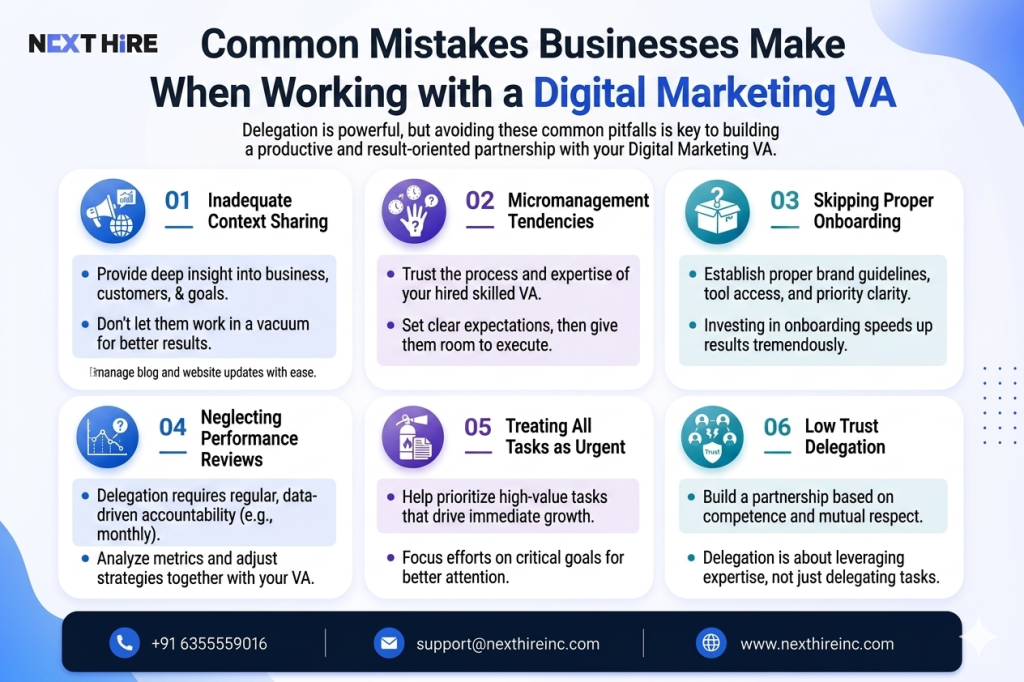
Common Mistakes Businesses Make When Working with a Digital Marketing VA
Even when you hire the right person, certain mistakes can undermine the relationship and limit results. Here are the ones to avoid:
Not providing enough context about your business and audience. Your VA cannot create great content or make smart marketing decisions in a vacuum. The more they understand about your business, your customers, and your goals, the better their work will be.
Micromanaging instead of trusting the process. If you hired someone with real skills and then second-guess every caption and question every decision, you undermine the whole point of delegation. Set clear expectations, then give them room to execute.
Skipping the onboarding process. Throwing a VA into the deep end without proper brand guidelines, access to tools, or clarity on priorities leads to wasted time and frustrating output. Invest in proper onboarding, and you will see results much faster.
Not reviewing performance data regularly. Delegation without accountability becomes disconnection. Review the metrics monthly, have real conversations about what the numbers are showing, and adjust strategy together. This keeps the relationship focused on results.
Treating every task as equally urgent. Help your VA understand which tasks are the highest priority for your business right now. When everything is marked urgent, nothing gets the focused attention it deserves.
Why NextHire Inc. Is the Right Partner for Finding Your Digital Marketing VA
When you are ready to hire a virtual assistant for digital marketing, the question becomes where to find someone you can actually trust. Going through general freelance platforms means spending hours reviewing profiles, conducting interviews, running test projects, and hoping the person you choose turns out to be reliable. That process takes time you probably do not have, and the risk of a bad hire is real.
NextHire Inc. takes a different approach. Every digital marketing virtual assistant in our network is pre-vetted for skills, communication ability, work ethic, and reliability. We match you with candidates who fit your specific business needs, industry, and marketing goals rather than sending you a generic list of profiles to sort through yourself.
Our placement process is fast, the talent is proven, and if something ever does not work out, we are here to help you find the right replacement quickly so your marketing never loses momentum. We handle the hard part of finding, vetting, and matching so you can skip straight to the part where your marketing actually starts growing.
Whether you need someone for 10 hours a week to handle your social media and blog, or a dedicated full-time virtual assistant who runs your entire digital marketing operation, we have the talent and the process to make it happen.
Frequently Asked Questions
How quickly can a digital marketing virtual assistant start delivering results?
It depends on the tasks involved and how well the onboarding process is handled. For tasks like social media posting and email campaigns, you can see activity within the first week. For SEO and content marketing, meaningful results typically develop over two to four months because organic growth takes time to build. Paid advertising can show data-driven results within the first two to four weeks.
Do I need to provide the tools and software, or does the VA bring their own?
Most experienced digital marketing VAs already have access to and proficiency with common tools like Canva, Buffer, and Google Analytics. However, for platform-specific tools like your email marketing account, social media accounts, and website backend, you will need to provide access. Some VAs prefer to use their own project management tools, while others adapt to whatever you already use.
How many hours per week do I actually need a digital marketing VA?
This depends entirely on the scope of tasks you want handled. Even 10 to 15 hours per week can make a significant difference if those hours are focused on high-impact tasks. For businesses that want comprehensive marketing coverage across social media, content, email, and SEO, 25 to 40 hours per week gives your VA enough runway to execute consistently and strategically.
What is the difference between hiring a freelancer and going through an agency like NextHire Inc.?
When you hire a freelancer independently, you handle the entire vetting, hiring, and management process yourself. If it does not work out, you start over. When you work with NextHire Inc., the vetting is already done. You get matched with pre-qualified candidates, the placement process is faster, and you have support if something does not work as expected. For most businesses, the reduced risk and time savings make the agency route the smarter choice.
Can a digital marketing virtual assistant work across different time zones?
Absolutely, and in many cases it is a strategic advantage. A VA working in a different time zone can handle tasks like scheduling, reporting, and content preparation outside of your business hours, so everything is ready and waiting for you each morning. Clear communication systems and shared project management tools make cross-timezone collaboration smooth and effective.
How do I know if my digital marketing VA is actually performing well?
Set clear KPIs at the start of the engagement and review them monthly. Track metrics relevant to the tasks your VA handles, whether that is social media engagement, website traffic, email open rates, or keyword rankings. Consistent improvement in these metrics over time is the clearest signal that your VA is delivering real value.
Final Thoughts
Digital marketing is not optional anymore. It is the primary way businesses build brand awareness, attract new customers, and drive sustainable growth in today’s online-first world. But trying to handle all of it yourself while also running a business is a recipe for burnout and inconsistency.
A skilled digital marketing virtual assistant gives you a way out of that trap. They bring the expertise, the tools, the time, and the focus that your marketing deserves, all without the overhead and commitment of a full-time hire. The tasks get done consistently, the strategy stays on track, and you get your time back to focus on the work that actually needs you.
Whether you are just starting to explore the idea or you are ready to move forward today, NextHire Inc. is here to make the process simple. We match you with a pre-vetted virtual assistant digital marketing professional who fits your business, your goals, and your budget.
Reach out to NextHire Inc. today and let us help you find the digital marketing virtual assistant who will help take your online presence to the next level.



