



Key Takeaways
- Professionals lose up to 2.5 hours per day just to email management. A virtual assistant handles this without missing a beat.
- The smartest delegation starts with your highest-time-drain, lowest-value tasks – not your most complex ones.
- Marketing managers get the most immediate ROI from a VA because content, scheduling, and reporting are time-heavy and highly delegable.
- Virtual assistant services for small businesses are now affordable starting from $5/hour, with no recruitment or onboarding fees when you hire through the right platform.
- A marketing VA does more than post on social media – they can manage ad campaigns, write content, handle SEO tasks, and pull analytics reports.
Most founders don’t run out of ideas. They run out of time. At some point, your calendar fills up with tasks that feel urgent but aren’t actually moving the business forward: answering routine emails, scheduling calls, updating spreadsheets, posting on LinkedIn.
You know you should delegate, but building a full in-house team feels premature and expensive. That’s exactly where virtual assistant tasks come in.
A virtual assistant isn’t just a scheduling helper. The range of virtual assistant tasks available today covers everything from back-office administration and customer support to content creation, research, bookkeeping, and full marketing execution.
For a startup founder or marketing manager, this is one of the most practical ways to reclaim working hours without adding headcount or office space.
This guide breaks down the full scope of what you can hand off, which tasks deliver the fastest ROI, and how to decide where to start. Whether you’re running a lean startup or managing a growing marketing function, there’s a category of virtual assistant tasks here that applies directly to your situation.
What Virtual Assistant Tasks Actually Cover
The term “virtual assistant” gets used loosely, so it’s worth being specific. A VA is a remote professional who handles defined tasks on your behalf, typically working asynchronously from a different time zone or location.
The tasks can be general and administrative or highly specialized, depending on the person you hire.
What’s changed in recent years is the skill ceiling. According to Zippia, 54% of virtual assistants hold a bachelor’s degree, and a growing number have backgrounds in digital marketing, content strategy, project management, and technical fields. The days of VAs only answering phones and booking flights are long gone.
That shift matters because it means the scope of virtual assistant tasks has expanded significantly. You’re not just outsourcing busywork – you can delegate genuine output-producing work that moves projects forward.
To understand how this compares to bringing someone in-house, it’s worth reading this breakdown of the key differences between a virtual assistant and a full-time employee.
Why Founders and Managers Are Outsourcing These Tasks Now
The numbers make the case better than any pitch. Professionals lose up to 2.5 hours per day to email management alone, according to Forbes. UC Irvine research shows it takes an average of 23 minutes to mentally refocus after a single interruption. And Deskpass found that businesses waste over 30 hours per month in unproductive meetings.
Add those up across a week and you start to see how much high-value thinking time gets eroded by low-value operational work. For a marketing manager trying to run campaigns and hit quarterly goals, or a startup founder who needs to be selling and building relationships, this math is brutal.
The appeal of virtual assistant tasks isn’t just cost savings – though those matter too, with average VA rates around $15 per hour compared to the cost of a full-time local hire. It’s about protecting the time you need for the work only you can do.
Virtual Assistant Services
Virtual assistant services cover a broad spectrum, from one-off task support to embedded team members who handle entire functional areas. At the entry level, you might hire a VA to manage your inbox and calendar.
At the more specialized end, you might have a VA running your content pipeline, handling customer support tickets, managing vendor relationships, or pulling weekly analytics reports.
Most VA services fall into a few broad categories: administrative support, research and data tasks, customer communication, content and marketing work, technical and ecommerce support, and financial or bookkeeping assistance. The right mix depends entirely on where your biggest time drain sits.
One thing worth understanding upfront: virtual assistant services are not one-size-fits-all. A general VA excels at high-volume, repeatable tasks. A specialist VA – like a marketing or technical VA – brings domain knowledge that allows them to own more complex workflows.
Knowing which type you need shapes everything from the hiring conversation to the onboarding process. If you’re still weighing your options, this comparison of offshoring vs. outsourcing can help clarify the right model for your business.
Tasks to Outsource to a Virtual Assistant
This is the section that actually changes how people think about delegation. The list of tasks to outsource to a virtual assistant is longer than most people expect – and more impactful than most people realize when they first start.
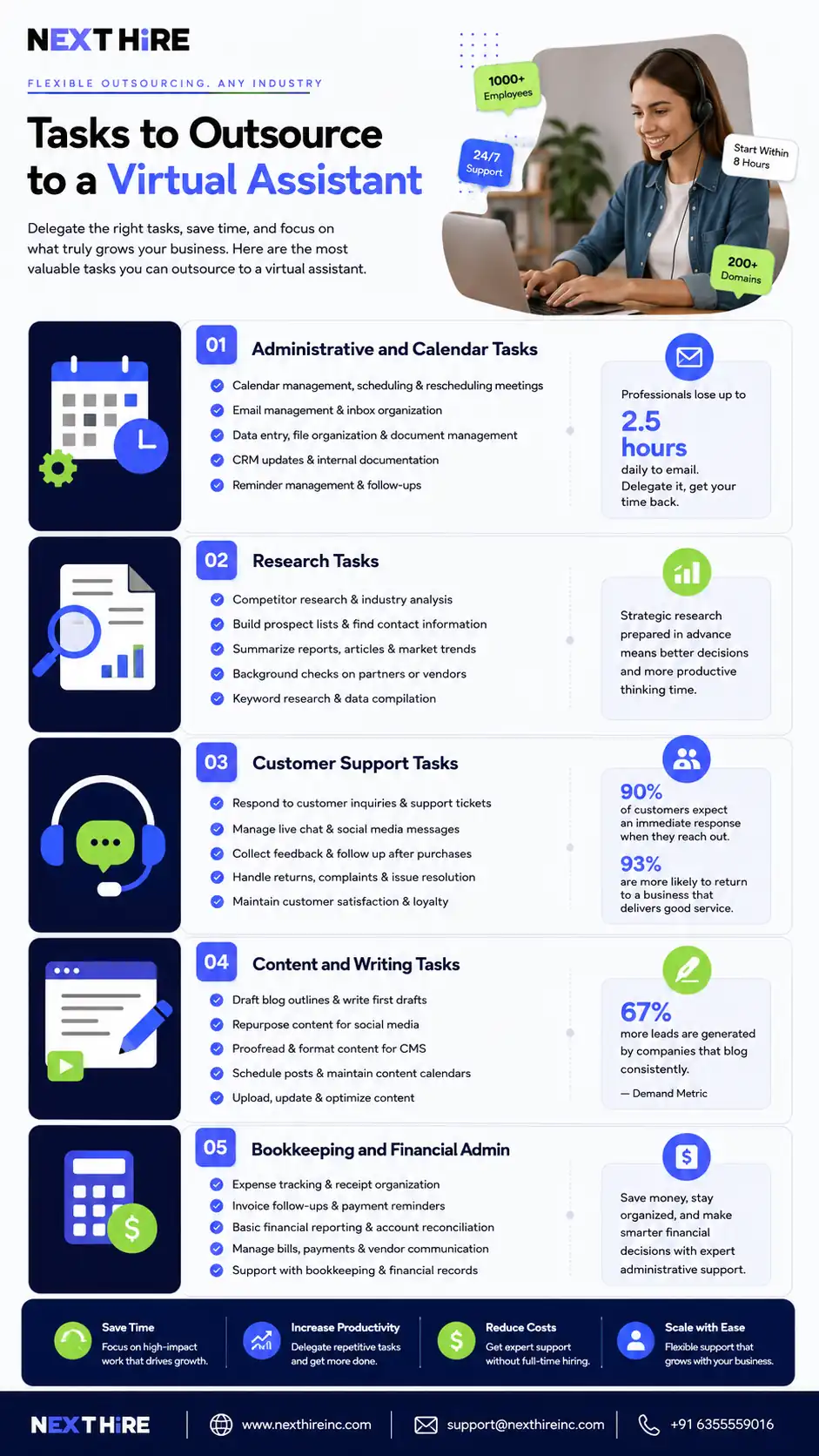
Administrative and Calendar Tasks
Calendar management is the classic starting point, and for good reason. Scheduling meetings, managing time zones, sending reminders, rescheduling conflicts – these are tasks that eat into your day in small, constant bites. A VA handles the entire back-and-forth so you never have to.
Email management goes even deeper. A good VA can filter your inbox, draft responses for your review, flag priority items, unsubscribe from clutter, and keep your inbox at a functional level. Given that professionals lose up to 2.5 hours daily to email, this single delegation alone can change your workday.
Data entry, file organization, CRM updates, and maintaining internal documents all belong in this category too. Not glamorous, but constantly necessary. A CRM automation specialist can take this a step further by systematizing the entire workflow.
Research Tasks
Research is one of the most underrated categories of virtual assistant tasks. A VA can compile competitor research, build prospect lists, gather industry data, find contact information for outreach, summarize articles or reports, and run background checks on potential partners or vendors.
For a marketing manager, this is especially valuable. Briefing documents, keyword research support, trend reports, influencer lists – all of this can be prepared by a VA before you sit down to make decisions, which means your strategic thinking time goes further.
If you need campaign-level research and performance tracking, a dedicated performance marketing expert can add another layer of strategic depth.
Customer Support Tasks
Responding to customer inquiries, handling basic support tickets, managing live chat, collecting feedback, and following up after purchases are all solid virtual assistant tasks for businesses that interact with customers regularly. HubSpot data shows 90% of customers expect an immediate response when they reach out, and 93% are more likely to return to a business that delivers good service.
A VA positioned in your customer support workflow helps you meet that bar without burning out your core team. Businesses handling high ticket volumes may also benefit from exploring help desk outsourcing as a complementary solution.
Content and Writing Tasks
Many VAs handle content at varying levels: drafting blog outlines, writing first drafts, repurposing existing content for social media, proofreading, formatting posts for your CMS, and scheduling content. Companies that blog consistently generate roughly 67% more leads than those that don’t, according to Demand Metric.
If content production is bottlenecking your marketing, this is one of the highest-ROI areas to delegate. You can also explore dedicated blog writers or content marketers for more specialized output, or a proofreading and editing expert to maintain quality at scale.
Bookkeeping and Financial Admin
Expense tracking, invoice follow-ups, receipt organization, basic financial reporting, and reconciling accounts are tasks many small business owners handle themselves longer than they should. A VA with bookkeeping experience – or a dedicated bookkeeper – can take these off your plate without requiring a full-time accountant. For businesses that need a higher level of financial oversight, a virtual CFO is also an option.
The question isn’t whether you can afford a virtual assistant. It’s whether you can afford to keep doing everything yourself.
If you’re reading this and realizing that several of these categories apply directly to your situation, you’re not alone. Most founders and marketing managers start with a mix of admin, research, and content tasks – and quickly expand once they see how much time comes back.
Next Hire Inc matches businesses with pre-vetted virtual assistants who are ready to start within 24 to 48 hours. There’s no recruitment fee, no long hiring process, and a 3-day free trial so you can see the fit before committing. The shortlist of matched candidates lands in your inbox within 24 hours of your request.
The right VA doesn’t just save time. They free up the mental space you need to think clearly about what your business actually needs next.
Virtual Assistant Duties
Understanding virtual assistant duties helps set expectations on both sides of the relationship. A VA’s responsibilities aren’t just a task list – they include ownership of recurring workflows, proactive communication about blockers or delays, and maintaining consistency across everything they touch.
On the day-to-day level, a VA’s duties typically include checking in at the start of their shift, working through the task queue, flagging anything that needs your input, and providing end-of-day updates.
For marketing-focused VAs, duties extend to platform monitoring, content calendar management, and performance tracking. For a broader view of how VAs fit into long-term company growth, see the role of virtual assistants in business scalability.
What separates a good VA from a great one is reliability and communication. You should know what they’re working on without having to ask. A well-scoped set of virtual assistant duties, documented clearly during onboarding, is what makes a remote working relationship run smoothly from week one.
Virtual Assistant Services List
Here’s a practical overview of VA service categories, what each covers, and the time you can expect to get back. This is designed to help you prioritize which type of support to bring in first.
| VA Service Category | What It Covers | Skill Level | Avg. Time Saved Per Week |
| Administrative Support | Email, calendar, data entry, file management | Entry to Mid | 8 to 12 hours |
| Research & Data | Competitor research, lead lists, market data, summaries | Mid | 4 to 8 hours |
| Customer Support | Live chat, ticket handling, follow-ups, feedback | Entry to Mid | 6 to 10 hours |
| Content & Writing | Blog drafts, social posts, proofreading, CMS scheduling | Mid to Senior | 5 to 10 hours |
| Marketing Execution | Campaigns, email marketing, SEO tasks, reporting | Senior | 6 to 12 hours |
| Bookkeeping & Finance | Invoicing, expense tracking, reconciliation | Mid | 3 to 6 hours |
| Ecommerce Support | Listings, order management, customer queries, returns | Mid | 4 to 8 hours |
Virtual Assistant Services for Small Businesses
Small business owners often hesitate longest before hiring a VA, and the reasons are familiar: it feels like a luxury, the setup takes time, and handing off work to someone you haven’t met feels risky. All of that is understandable. But the cost of not delegating is real too.
Virtual assistant services for small businesses are now genuinely accessible. Rates start around $5 per hour for general administrative support, with monthly plans available from around $799 per month for dedicated, part-time support. Compared to the cost of a local hire with benefits, payroll taxes, and office requirements, the math is straightforward.
The scaling concern is also solvable. You don’t need to hand off everything at once. Most small businesses start by offloading two or three high-frequency, low-complexity tasks – inbox management, appointment scheduling, and basic research are the most common first moves. Hiring an appointment setter is one of the cleanest first delegations for founders who spend too much time on scheduling. Once you see how much time returns, it becomes obvious what to delegate next.
The “I don’t have time to hire” problem is real, but it’s also self-defeating. The longer you put off finding support, the more time you spend on tasks that don’t require your expertise.
Platforms like Next Hire Inc specifically address this by handling the vetting, matching, and onboarding – you describe what you need, and a shortlist of qualified candidates arrives within 24 hours. There’s no lengthy recruitment process to manage.
Marketing Virtual Assistant Services
Marketing is where VA support delivers some of the most measurable ROI, and it’s also where the role of a VA is most frequently misunderstood. Marketing virtual assistant services go well beyond posting on Instagram.
A skilled marketing VA can manage your editorial calendar, write and schedule blog posts, repurpose content across formats, monitor social channels, engage with comments, and keep your brand presence consistent without needing daily input from you.
For a marketing manager running multiple campaigns, having someone own the operational side of content means you stay focused on strategy and performance. A dedicated social media marketer can take this even further if your brand presence is a growth priority.
On the paid side, a marketing VA with the right background can assist with ad campaign setup and monitoring, pull performance data, flag anomalies, and prepare weekly reports.
They won’t replace a media buyer, but they significantly reduce the reporting and administrative overhead that comes with managing campaigns. For more hands-on paid media support, Google Ads experts or Meta Ads experts can plug directly into your campaigns.
SEO support is another growing area. Virtual assistant tasks in the SEO space include keyword research, metadata updates, internal linking audits, competitor backlink analysis, and managing content publishing schedules. These are genuinely high-value tasks that don’t require a senior SEO strategist but do require consistency and attention to detail. For more advanced needs, a dedicated SEO expert or local and global SEO specialist can be a strong next step.
Email marketing is one of the cleanest handoffs. Building lists, segmenting audiences, drafting campaign copy from your briefs, scheduling sends, and reporting on open rates and clicks – all of this can be managed by a dedicated email marketer with minimal back-and-forth once the workflow is established.
Analytics reporting is the final piece most teams delay the longest. A marketing VA can pull weekly or monthly dashboards from Google Analytics, your social platforms, and your email tool, summarize the key numbers, and flag anything that needs your attention.
You stop flying blind without having to do the data-pulling yourself. For teams that want deeper insight, a Google Analytics expert or a performance analytics guide can help you build a more structured reporting system.
How to Decide Which Virtual Assistant Tasks to Outsource First
The most practical framework here is simple: start with the tasks that cost you the most time and require the least of your specific expertise. That combination – high time cost, low skill specificity – is where delegation delivers the fastest return.
For most founders, that means email management, calendar coordination, and basic research land in the first delegation round. For marketing managers, it’s usually content scheduling, social monitoring, and reporting prep.
After that first round, pay attention to where you still feel stretched. The second delegation wave typically includes more specialized tasks: customer support, bookkeeping, or campaign management support.
If you’re uncertain whether to bring in a VA or hire a full employee for that next layer, this guide comparing a virtual assistant vs. a full-time employee lays out the tradeoffs clearly.
Building the VA relationship through simpler tasks first makes the second wave significantly easier because communication patterns and expectations are already established.
Avoid the common mistake of starting with your most complex, judgment-heavy tasks. A VA can support those workflows eventually, but building up to them is smarter than dropping them on someone in week one.
Frequently Asked Questions
What are the most common virtual assistant tasks for small businesses?
The most common starting points are email management, calendar scheduling, data entry, customer inquiry responses, and basic research. Small businesses tend to begin with high-frequency, repeatable tasks and expand into content, bookkeeping, or marketing support once the initial VA relationship is running smoothly. You can explore virtual assistant options tailored for small businesses to find the right starting point.
How many hours can a virtual assistant save me per week?
It depends on how many tasks you delegate and how complex they are, but most founders and managers report saving between 10 and 20 hours per week once a VA is fully onboarded and running standard workflows. Administrative tasks alone – email, scheduling, data entry – can account for 8 to 12 hours of savings weekly.
What is the difference between a general VA and a marketing virtual assistant?
A general VA handles broad administrative and operational tasks: inbox management, scheduling, research, data entry, customer support. A digital marketing virtual assistant has domain-specific skills and focuses on content creation, social media management, email marketing, SEO support, campaign monitoring, and analytics reporting.The distinction matters when you’re trying to offload marketing execution, not just admin work.
How do I know which virtual assistant tasks to outsource first?
Start with the tasks that cost you the most time and require the least of your specific expertise. For most people, that’s email management, scheduling, and routine research. These are easy to hand off, fast to onboard, and immediately free up meaningful hours. Once those workflows are running, you’ll have a clearer picture of what to delegate next.
How much do virtual assistant services cost?
General VA rates average around $15 per hour, though they range from $5 per hour for basic administrative support to $100 or more per hour for highly specialized skills. Monthly retainer plans through platforms like Next Hire Inc start from $799 per month for dedicated part-time support, with no hidden recruitment or onboarding fees.
Conclusion
The scope of virtual assistant tasks has expanded far beyond what most people picture when they first hear the term. Today, a skilled VA can own entire functional workflows: managing customer communications, running content pipelines, supporting marketing campaigns, handling research operations, and keeping financial admin organized.
The businesses that grow fastest are usually the ones where the founders and managers have learned to protect their time aggressively. Delegating the right virtual assistant tasks, starting with the highest-drain and most repeatable work, is one of the clearest ways to do that without adding the overhead of a full-time hire.
If you’re ready to make the first move, Next Hire Inc can have a shortlist of pre-vetted virtual employees in your inbox within 24 hours, with onboarding starting as soon as 24 to 48 hours after that.
There’s a 3-day free trial, no hidden fees, and a dedicated account manager to help you get set up. Book a call with the Next Hire team and start getting your time back.