

Key Takeaways
- MVP app development services help businesses build the smallest functional version of an app that can be tested with real users before committing to full-scale development.
- The MVP approach reduces financial risk, accelerates time to market, and produces user feedback that shapes better product decisions.
- Startups and established businesses alike use MVP development services to validate assumptions before spending heavily on features users may not want.
- Choosing between an MVP app development company, a freelancer, or a remote development team depends on budget, timeline, and how much ongoing support you need.
- Next Hire Inc provides experienced developers who can build, test, and iterate on your MVP quickly, with talent shortlisted within 24 hours and engagements starting in 24 to 48 hours.
Most apps fail. That’s not meant to be discouraging, it’s just the reality of the market. And a significant portion of those failures happen not because the idea was bad, but because the team built too much before finding out whether anyone actually wanted what they were building.
MVP app development services exist to address exactly this problem. Instead of spending six to twelve months and a significant budget on a fully featured product, you build the smallest version that lets real users experience the core value of your idea. Then you learn. Then you adjust. Then you build more.
This isn’t a shortcut or a compromise. It’s a more intelligent way to approach product development, especially when resources are limited and the market is uncertain, which is almost always.
This blog covers what MVP development actually involves, how the build, validate, and scale process works in practice, what to look for when choosing a development partner, and how Next Hire Inc can help you get there faster.
What Are MVP App Development Services?
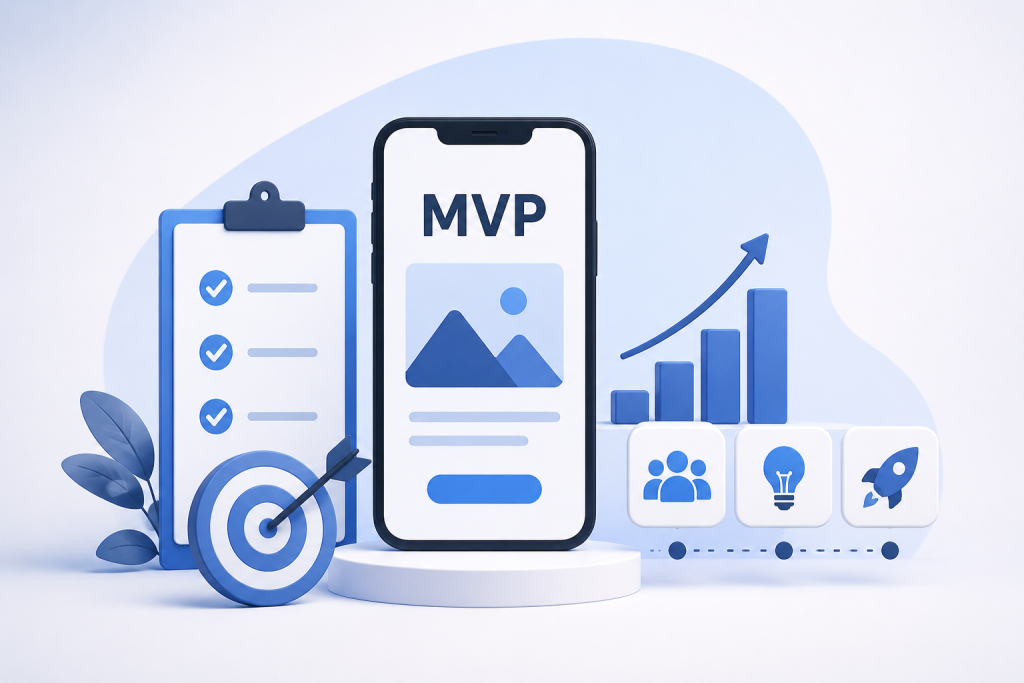
MVP app development services are specialized development offerings focused on building a Minimum Viable Product: the earliest, most stripped-down version of an application that still delivers real value to users and generates meaningful feedback.
The key word is “viable.” An MVP isn’t a broken prototype or a mock-up. It’s a functional product that real users can interact with, and that interaction teaches you things you couldn’t learn from a whiteboard.
MVP development services typically cover the full build cycle for that first version: defining scope, designing the user experience, developing the core features, testing the product, deploying it, and often helping interpret the data that comes back from early users.
What makes this different from standard app development is the constraint. MVP development is deliberately focused on the minimum. Every feature that gets added to scope should answer the question: does this help us validate our core hypothesis? If it doesn’t, it waits.
Businesses across technology, healthcare, education, retail and ecommerce, and finance all use MVP development services to reduce the risk of large product investments by getting real market feedback before committing fully.
What Is MVP in App Development?
MVP stands for Minimum Viable Product. In app development, it refers to the first functional version of an application that includes only the features necessary to test the core value proposition with real users.
The concept comes from the lean startup methodology, popularized by Eric Ries, and the underlying idea is straightforward: your assumptions about what users want are hypotheses, not facts. An MVP is how you test those hypotheses with the lowest possible investment before you know they’re correct.
A few things worth clarifying:
An MVP is not a beta with most features hidden. It’s a complete product that delivers a specific value, just a narrow one.
An MVP is not necessarily cheap or low quality. It should be built well enough that users can experience it without running into fundamental problems. Poor quality obscures whether users don’t like the product or just don’t like the bugs.
An MVP is not the final product. It’s the beginning of a feedback loop. The most successful apps, including ones you use every day, looked very different in their first version than they do now.
The goal of an MVP in app development is to answer specific questions: Do users want this? Do they use it the way we expected? What do they find confusing or frustrating? What would make them pay for it or recommend it?
You can’t answer those questions with wireframes or user interviews alone. You need a working product in real hands.
Why Startups Need MVP Development Services
The case for MVP development services is particularly strong for startups, and for a few specific reasons.
Capital is limited. Burning runway on a fully featured product that the market doesn’t want is one of the fastest ways to end a startup. MVP development services let you get to market validation with a fraction of the investment.
Assumptions are untested. Startups are, by definition, operating in conditions of high uncertainty. The founding team’s conviction about what users want is valuable, but it’s still an assumption until real users confirm it. MVP development services create the conditions to test those assumptions quickly.
Investor conversations change when you have a product. Raising capital based on a pitch deck is harder than raising capital based on a working product with early user data. An MVP built through professional MVP development services gives you something concrete to show investors.
Speed to market matters. In competitive spaces, being first to a validated product position creates advantages that are hard to replicate later. MVP development services compress the timeline between idea and market presence.
Failure is cheaper and more instructive. If the MVP shows that the idea needs significant adjustment, that’s genuinely valuable information that shapes the next iteration. Discovering the same thing after twelve months of full development is far more costly.
The role of virtual assistants in business scalability is relevant here too. Many startups use virtual support teams to handle operational work during the MVP phase so the founding team can stay focused on product and validation.
What MVP Software Development Services Include
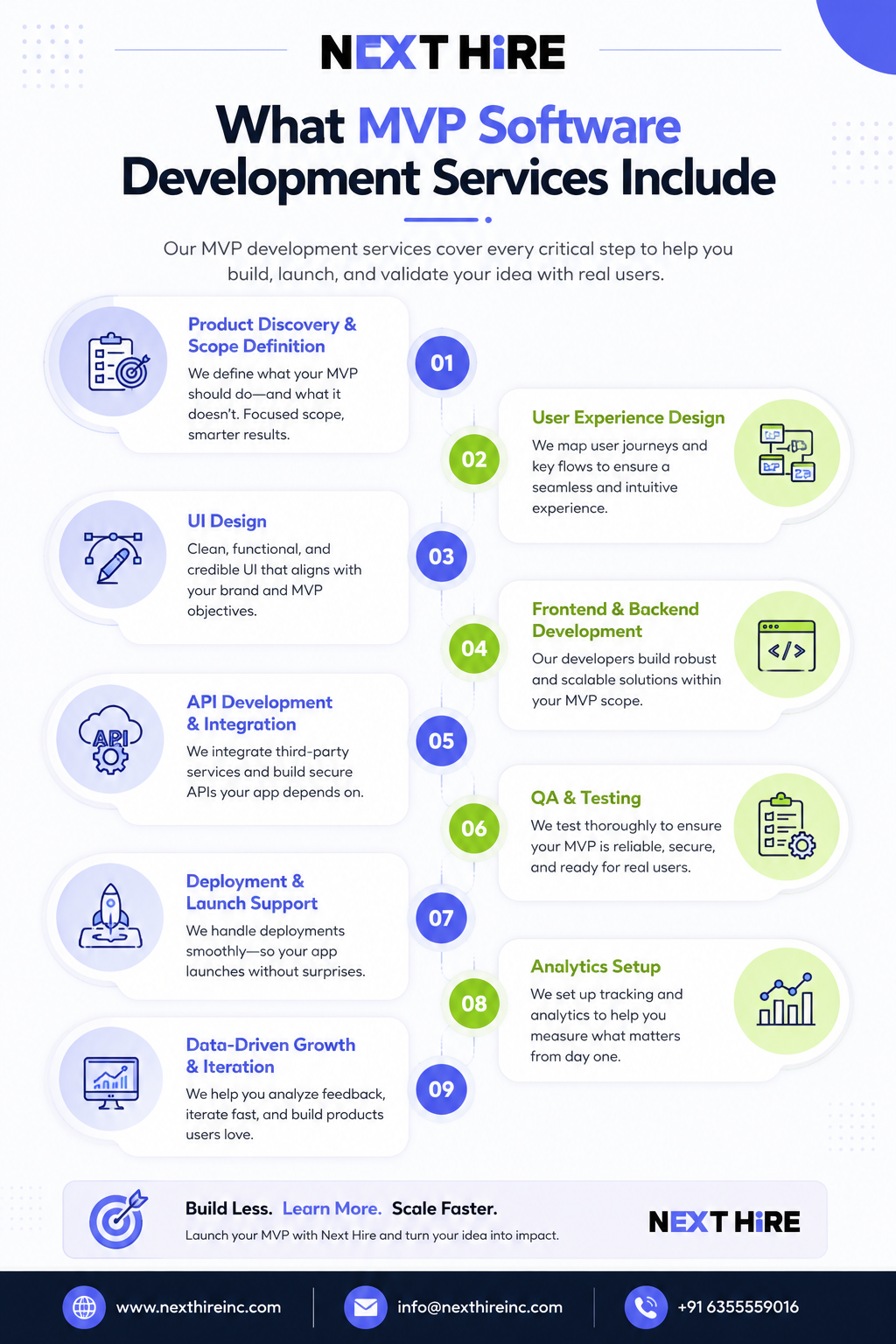
The scope of MVP software development services varies by provider and project, but a comprehensive engagement typically covers:
Product discovery and scope definition. Before any code is written, the team works with you to define what the MVP needs to do and, more importantly, what it doesn’t need to do. This scoping process is where MVP discipline is most often violated, and where a good team adds significant value by pushing back on unnecessary scope.
User experience design. Even an MVP needs to be usable. UX researchers and wireframing specialists map out the user flows and key screens before development begins, reducing rework caused by design problems discovered mid-build.
UI design. The visual layer doesn’t need to be perfect, but it needs to be functional and credible. Mobile app UI designers create the interface within the constraints of the MVP scope.
Frontend and backend development. The actual build. This is where mobile app developers, backend developers, and full-stack developers execute against the defined scope and design.
API development and integration. Most MVPs depend on third-party services for payments, authentication, notifications, or data. API developers handle these integrations and build the custom endpoints the app needs.
QA and testing. An MVP needs to work reliably enough that users can experience it without fundamental friction. QA testing catches issues before they reach real users.
Deployment and launch support. Getting the app into app stores or deployed to a server is a step that catches teams off guard more often than it should. MVP development services typically include deployment support.
Analytics setup. You can’t learn from users you can’t measure. Setting up analytics from day one, tracking the right events, and establishing the metrics that answer your core questions is part of building an MVP that generates useful feedback.
How to Build Your First MVP App Version
Building an MVP is as much a discipline problem as a technical one. The technical execution matters, but scope creep is what kills most MVP timelines and budgets. Here’s how the build process works when it’s done well.
Start With a Single Core Hypothesis
Before thinking about features, define what you’re actually testing. The core hypothesis of an MVP is a specific, falsifiable statement about user behavior. Something like: “Freelance designers will pay for a project management tool built specifically for their workflow.” Everything in the MVP either helps test that hypothesis or it doesn’t belong in this version.
Map the Critical User Journey
What does a user need to do to experience the core value of the product? Map that journey end to end. Every screen, every step, every decision point. This becomes the scope of your MVP. If a screen or feature isn’t on that critical path, it waits.
Design Before You Build
Investing in proper Figma or design tool prototyping before development starts saves significant rework. Changing a design in Figma takes minutes. Changing the same design in code takes hours. Get the flows right before the developers start.
Choose the Right Technology Stack
The stack should be chosen for development speed and flexibility, not for what’s most impressive. Flutter developers can produce cross-platform apps faster than maintaining separate native codebases when time to market is the priority. Firebase developers can set up a backend with authentication, database, and notifications much faster than building custom infrastructure from scratch.
For web-based MVPs, Node.js developers and React developers are a common pairing that supports fast iteration. MERN stack developers or MEAN stack developers give you a full JavaScript stack that reduces context switching across the team.
Build in Sprints With Regular Reviews
Weekly or bi-weekly sprint reviews keep the team aligned and create natural checkpoints to reassess scope. If something is taking longer than expected, the MVP discipline means cutting scope rather than extending the timeline.
Instrument Everything From Day One
Set up analytics, error tracking, and user behavior monitoring before launch, not after. The data you collect in the first few weeks of real usage is the most valuable input you’ll have for the next iteration.
How to Validate an MVP Before Scaling
Building the MVP is the first challenge. Validating it, actually learning whether your hypotheses were correct, is the second, and it’s where a lot of teams underperform.
Define Success Metrics Before Launch
What does validation look like? This sounds obvious, but many teams launch an MVP without a clear definition of what success means. Is it a retention rate above a certain threshold? A number of paid conversions? A specific user action that signals genuine engagement? Define these metrics before you see the data so you’re not rationalizing results after the fact.
Get the Right Users, Not Just Any Users
Showing your MVP to friends and family produces polite feedback, not useful feedback. You need users who represent your actual target audience and who have a genuine version of the problem you’re solving. Finding those early users is a critical part of validation that gets underestimated.
Lead generation experts and performance marketing specialists can help you reach targeted early adopters without burning your entire marketing budget in the process.
Watch What Users Do, Not Just What They Say
User interviews are valuable, but behavior is more honest than words. Analytics data showing where users drop off, which features they actually use versus ignore, and where they get confused tells you things that surveys and feedback forms miss.
Separate Signal From Noise
Early user feedback is noisy. Some feedback reflects genuine patterns; some reflects individual preferences. Your job is to identify patterns across users, not to implement every suggestion from your most vocal early adopter. A UX researcher or someone experienced in product analytics can help you interpret data without over-indexing on outliers.
Know When You’ve Validated Enough to Scale
There’s no perfect threshold for when an MVP is validated enough to scale. Generally, you’re looking for: consistent user engagement with the core feature, evidence of word-of-mouth or repeat usage, some form of willingness to pay (even if you’re not charging yet), and a clear understanding of what needs to improve in the next version.
Scaling before these signals are present usually means scaling a product that isn’t working yet, which amplifies the problem rather than solving it.
MVP App Development Company vs Freelancer
This is one of the first practical decisions you’ll face when looking for MVP development services, and it’s worth thinking through carefully.
| Factor | MVP App Development Company | Freelancer | Remote Development Team |
| Cost | Highest | Lowest | Middle ground |
| Speed | Fast (dedicated team) | Varies | Fast with right provider |
| Accountability | High (contract, account management) | Variable | High with managed provider |
| Talent coverage | Full team in-house | Single specialist | Multiple specialists |
| Flexibility | Limited (fixed packages) | High | High |
| Communication | Structured | Direct but unmanaged | Structured with account manager |
| Continuity | Strong | Risk if freelancer leaves | Strong with backup support |
| Best for | Large budgets, full-service needs | Very small, contained projects | Startups needing speed and flexibility |
An MVP software development company offers the most structure but often at the highest cost. Many have minimum engagement sizes that put them out of reach for early-stage startups.
Freelancers are the most flexible and cheapest option, but reliability is the main risk. A single freelancer who goes quiet mid-project can derail a launch.
A remote development team assembled through a staffing provider gives you the specialist coverage of a company with the cost efficiency and flexibility of freelancing, plus managed accountability that individual freelancers can’t offer.
For most startups and growing businesses, the remote development team model through an experienced virtual staffing solutions provider represents the best balance of cost, speed, and reliability.
Custom MVP Development Services for Different Business Ideas
One of the strengths of working with an experienced MVP development provider is the ability to customize the approach based on what you’re actually building. The right technical decisions for a marketplace app are different from those for a SaaS tool or a healthcare platform.
For marketplace apps. Two-sided marketplaces (connecting buyers and sellers) have distinct MVP challenges because you need to solve a chicken-and-egg problem: supply and demand need to exist simultaneously. The MVP scope typically focuses on one side first, often supply, before opening to the other. API developers and payment integration are critical from day one.
For SaaS products. The MVP for a SaaS product is usually a single workflow that solves a specific problem end to end. Everything else can wait. Full-stack developers who can move across frontend and backend reduce coordination overhead in the early stages.
For consumer mobile apps. Mobile-first MVPs need to nail the core user experience before anything else. A confusing UX kills mobile apps faster than missing features. Invest properly in mobile app UI design and user testing before launch.
For healthcare applications. Healthcare apps carry regulatory considerations (HIPAA in the US, for example) that need to be built in from the beginning rather than retrofitted. An MVP in this space requires security test engineers and compliance awareness from the start. Working with the healthcare and life sciences sector expertise makes this significantly less risky.
For fintech products. Payment processing, data security, and regulatory compliance are non-negotiable from day one in financial products. Custom MVP software development in fintech requires developers with specific experience in this space, not generalists.
For ecommerce platforms. An ecommerce MVP can often be built on existing platforms like Shopify rather than custom development, which dramatically reduces time and cost. Shopify developers can customize an existing platform to validate the business model before investing in a custom build.
MVP Development Services in the USA: What to Look For
If you’re based in the US and evaluating MVP development services, a few considerations are worth keeping in mind.
US-based vs offshore development. Onshore development teams offer timezone alignment and cultural familiarity but at significantly higher cost. Offshore teams reduce cost substantially, and with the right provider managing the engagement, quality and communication don’t have to suffer. The key is the management layer, not the geography.
Portfolio in your vertical. An MVP app development company or team that has built products in your industry will understand the domain constraints without needing extensive education. Ask for examples of relevant prior work.
Transparent pricing. MVP development services pricing varies enormously. A basic mobile MVP might range from $20,000 to $80,000 with a traditional company. Remote development team models can achieve similar scope for significantly less. Be skeptical of very low estimates and very high ones: both signal misalignment between scope and budget.
Process clarity. A good MVP development partner has a clear process for scope definition, sprint planning, review cycles, and delivery. Vague answers to “how do you work?” are a warning sign.
Communication standards. You’ll be working closely with this team for weeks or months. How they communicate during the sales process is usually how they communicate during the project.
Post-MVP support. The MVP is not the end. Once you have validation, you’ll want to iterate quickly. A well-planned digital marketing strategy helps businesses attract users and validate growth after launching an MVP. Providers who can continue supporting you through that scaling phase offer more continuity than those who hand off and disappear.
How Next Hire Inc Helps With MVP App Development
Next Hire Inc provides access to experienced developers, designers, and QA specialists who can be assembled into a focused MVP development team and start contributing within 24 to 48 hours of approval.
Rather than hiring a monolithic MVP software development company with fixed packages and high overhead, you build the team your MVP actually needs: the right combination of frontend, backend, mobile, design, and QA talent for your specific project, at the scope that matches your current stage.
What working with Next Hire Inc looks like for MVP development:
You share your project requirements, the type of app, the stack preferences, the skills needed, and the timeline. Within 24 hours, you receive a shortlist of pre-vetted candidates who match those requirements. Once you approve, the engagement starts within 24 to 48 hours.
A 3-day free trial lets you evaluate the match before committing to a longer engagement. Pricing starts from $5/hour for hourly work and $799/month for dedicated monthly engagements. Full details are on the pricing page.
Every candidate is screened for relevant technical skills, communication ability, and professional reliability before you see their profile. A dedicated account manager handles the relationship on the provider side, and backup resource support is available if your primary developer is unavailable.
The types of specialists available for MVP projects include:
iOS developers and Android developers for native mobile development. Flutter developers and hybrid app developers for cross-platform builds. React developers and Node.js developers for web-based MVPs. Python developers for data-intensive or AI-adjacent products. Figma and prototyping specialists for design before development. Automation testers and performance testers for pre-launch QA.
For the post-MVP phase, the same provider can supply digital marketing specialists, SEO experts, and content marketers to support user acquisition once the product is validated.
Next Hire Inc works with businesses across technology, healthcare, education, logistics, media and marketing, and finance, with experience matching technical talent to different product types and development environments.
The infrastructure supporting engagements is designed for operational continuity, and the remote staffing model gives you flexibility to scale the team up or down as your MVP phase evolves.
Building your first app version and want experienced developers who can start this week? Next Hire Inc shortlists pre-vetted MVP development talent within 24 hours. Tell us what you’re building.
Frequently Asked Questions
What Are MVP App Development Services?
MVP app development services are specialized development offerings that help businesses build the minimum functional version of an application, test it with real users, and iterate based on feedback before investing in full-scale development.
How Long Does It Take to Build an MVP App?
Timeline varies significantly based on complexity, but most MVPs take between 8 and 16 weeks from scoping to launch. Simple apps with a narrow feature set can be built faster. Apps with complex integrations, custom backend infrastructure, or regulatory requirements take longer. Scope discipline is the biggest factor in keeping timelines realistic.
How Much Do MVP Development Services Cost?
Cost depends on the platform (iOS, Android, web, cross-platform), the complexity of the feature set, the team structure, and the provider model. Traditional MVP software development companies typically charge $20,000 to $100,000 or more. Remote development team models through staffing providers can achieve similar scope at significantly lower cost.
What Is the Difference Between an MVP and a Prototype?
A prototype is a simulation, usually non-functional, used to visualize flows and test design concepts. An MVP is a real, working product that users can actually interact with. A prototype tests the design; an MVP tests the market.
Should I Build Native or Cross-Platform for My MVP?
For most MVPs where speed to market matters, cross-platform frameworks like Flutter or React Native are a reasonable choice. They allow a single development team to deliver on both iOS and Android, which reduces cost and timeline. If your app requires deep platform-specific capabilities, native development may be necessary.
How Do I Know If My MVP Is Validated?
Look for consistent engagement with the core feature, evidence of users returning without prompting, some signal of willingness to pay even if you’re not charging yet, and a clear understanding from user behavior of what needs to improve. The specific thresholds depend on your product and market, but consistent patterns across a meaningful sample of real users is the key signal.
Can Next Hire Inc Help After the MVP Phase?
Yes. The same platform that supplies development talent for the MVP phase can supply marketing, design, QA, and operational support for the scaling phase. The team can grow with your product as validation converts to growth.
Conclusion
The MVP approach isn’t about building less. It’s about building the right things at the right time, in the right sequence. Businesses that rush to build fully featured products before validating their core assumptions consistently spend more, move slower, and make worse decisions than those who invest in a disciplined MVP process first.
MVP app development services provide the structure, expertise, and technical execution to build something real, get it in front of real users, and learn what the market actually wants before committing your full resources.
The decision about how to source that development capability, whether through a traditional MVP app development company, freelancers, or a remote development team, comes down to your budget, timeline, and how much ongoing support you need. For most startups and growing businesses, the remote team model offers the best combination of speed, cost efficiency, and accountability.
Ready to build your first app version with a team that can start this week? Try Next Hire Inc with a 3-day free trial and build your MVP development team today.