


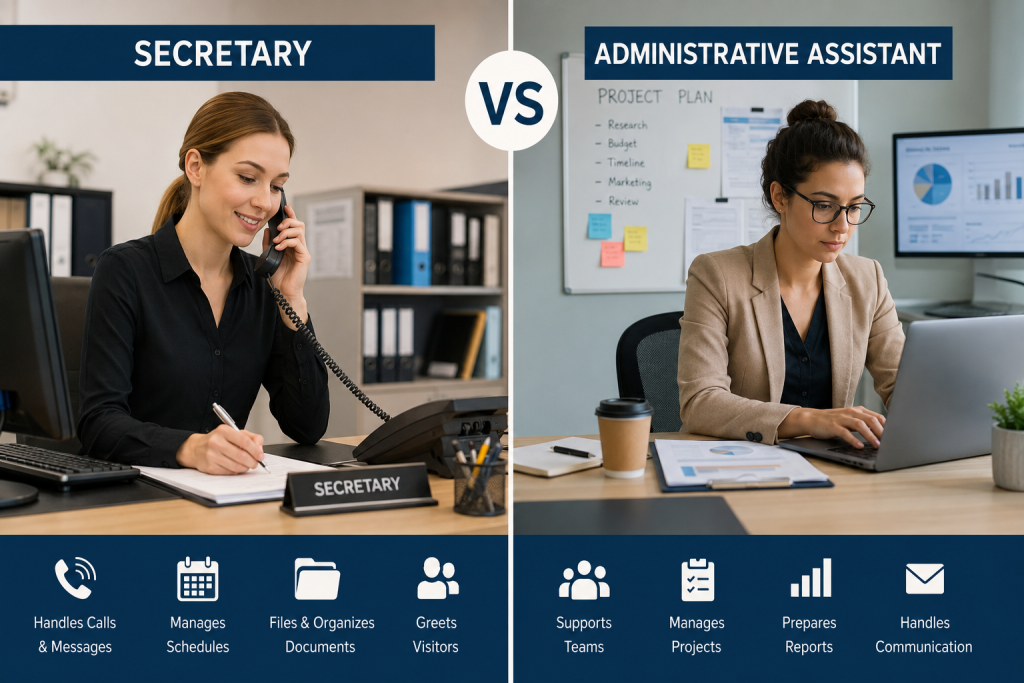
If you’ve ever looked at two job postings, one for a secretary and one for an administrative assistant, and thought they sounded exactly the same, you’re not alone. Plenty of people use those titles interchangeably. In some offices, they even blur together. But as soon as you dig into the daily work, the expectations, and the pay, the differences start to matter, especially if you’re applying for one or hiring for one.
The confusion sticks around because both roles live in the world of office support. They both answer calls, manage schedules, and keep things organized. The distinction comes from the scope. A secretary typically handles the clerical rhythm of a single person or department. An administrative assistant often steps into a broader job, one that involves coordinating workflows, managing projects, and making small decisions that keep a team moving.
Understanding the difference between secretary and administrative assistant matters on both sides of the hiring table. If you’re a job seeker, you want to know which title matches your skills and which one pays better. If you’re an employer, using the right terminology attracts candidates who actually fit the job. This guide breaks down what each role does, how they differ, and where they overlap.
What Is a Secretary?
The secretary role has been around for decades. It’s a classic office support position built around a specific manager or department. The core of the job is clerical. Think answering phones, managing a calendar, handling correspondence, filing documents, and keeping the front desk running smoothly.
A secretary often acts as a gatekeeper. They screen calls, schedule meetings, and make sure the person they support has what they need without getting buried in administrative noise. Their day tends to follow a routine. The tasks are clear, repeatable, and essential for keeping an office from descending into chaos.
In many industries, the title carries a traditional feel. Some companies have retired it in favor of “administrative assistant” even when the duties haven’t changed much. But in legal offices, medical practices, and government agencies, the secretary title still holds strong with defined expectations around typing, dictation, and visitor reception.
What Is an Administrative Assistant?
An administrative assistant picks up where clerical work leaves off and steps into operational territory. Yes, they might still answer phones and schedule appointments. But their job usually extends into things like preparing reports, coordinating across departments, managing small projects, and supporting entire teams rather than just one person.
The role tends to involve more decision-making. An administrative assistant might be trusted to handle vendor communications, plan company events, or oversee the onboarding paperwork for new hires. They often use more advanced software, pull data for presentations, and step in to solve problems without needing constant direction.
Modern administrative assistant roles and responsibilities have evolved significantly. In a startup, an admin assistant might run office operations almost like an office manager. In a larger corporation, they might be embedded in a marketing or finance team, handling department-specific coordination. The title has grown more versatile, and that’s a big part of why the secretary vs administrative assistant confusion exists.
Administrative Assistant vs Secretary: Quick Comparison Table
This side by side look makes the core differences easier to scan.
| Feature | Secretary | Administrative Assistant |
| Primary Focus | Clerical and reception support | Operational and team coordination |
| Typical Reporting | Single manager or executive | Team, department, or multiple executives |
| Decision-Making | Limited, task oriented | Moderate, often autonomous |
| Technology Use | Basic office tools, phone systems | Advanced software, databases, project tools |
| Scope of Work | Routine daily tasks | Multi-functional and project-based tasks |
| Strategic Involvement | Low | Growing, especially in smaller companies |
The line blurs depending on the employer. A secretary in a small law firm might do everything an administrative assistant does elsewhere. But the general shape of each role follows this pattern.
Key Differences Between a Secretary and an Administrative Assistant
When someone asks about the difference between administrative assistant and secretary, they’re really asking where the job stops being purely clerical. The differences stack up across several dimensions.
Scope of responsibilities is the biggest one. A secretary focuses on direct support like scheduling, typing, filing, and call management. The job is built around efficiency and reliability. An administrative assistant still does some of that, but the role often stretches into project coordination, data analysis, and internal communication management.
Level of authority differs too. Secretaries generally follow established procedures with limited room for interpretation. Administrative assistants are expected to make judgment calls. They might prioritize a manager’s tasks, choose vendors, or improve office processes without waiting for approval.
Strategic involvement marks another divide. Secretaries rarely sit in on strategic planning meetings. Administrative assistants, especially those supporting executives, often prepare materials for those meetings, track action items, and follow up on deliverables. They become a quiet integration point that keeps strategic work from falling apart.
Technology usage reflects the shift. A secretary might live in the phone system, email client, and calendar app. An administrative assistant may also work with CRM platforms, project management software like Asana or Monday, and reporting tools like Excel at an advanced level. That technical gap often translates directly into salary differences.
Communication responsibilities differ in tone and audience. A secretary communicates predominantly on behalf of an individual. An administrative assistant communicates across teams, sometimes representing a department to external contacts. The role demands more discretion and a broader understanding of the business.
Workflow coordination illustrates the day to day difference. A secretary manages one person’s workflow. An administrative assistant manages the intersection of multiple workflows, spotting bottlenecks before they become problems. This proactive, systems-aware mindset is one of the clearest signals that a role has moved beyond the traditional secretary job description.
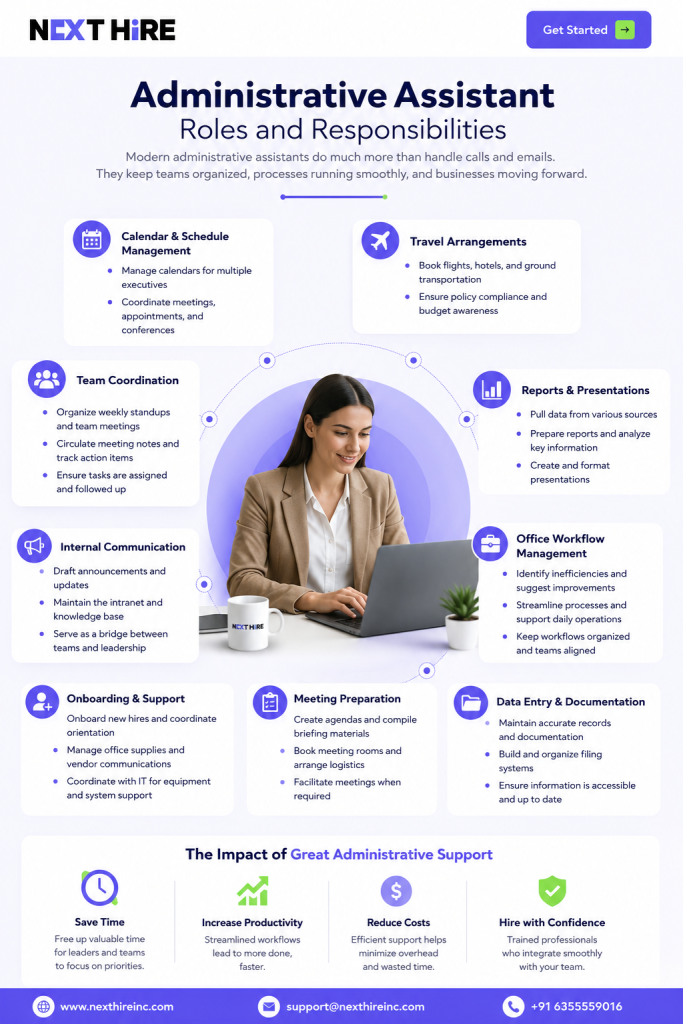
Administrative Assistant Roles and Responsibilities
Modern administrative assistants wear many hats. Their duties stretch far beyond typing and phones. Calendar management is a given, but it often involves juggling the schedules of several executives simultaneously. Travel arrangements come with policy considerations and budget awareness.
Team coordination sits at the heart of the role. An administrative assistant might organize weekly standups, circulate meeting notes, and track who is responsible for what. Preparing reports, pulling data from various sources, and formatting presentations becomes a regular rhythm. Internal communication lands on their desk, including drafting announcements and maintaining the intranet.
Office workflow management ties everything together. They spot inefficiencies and suggest fixes. They might onboard new hires, manage office supplies, and coordinate with IT when equipment fails. Meeting preparation involves more than booking a room. It means creating agendas, compiling briefing materials, and sometimes facilitating the session itself.
Data entry and documentation haven’t disappeared either. They just live alongside higher level work. The administrative assistant often builds and maintains filing systems that make information accessible to the whole team. The role is hands on, but it requires critical thinking.
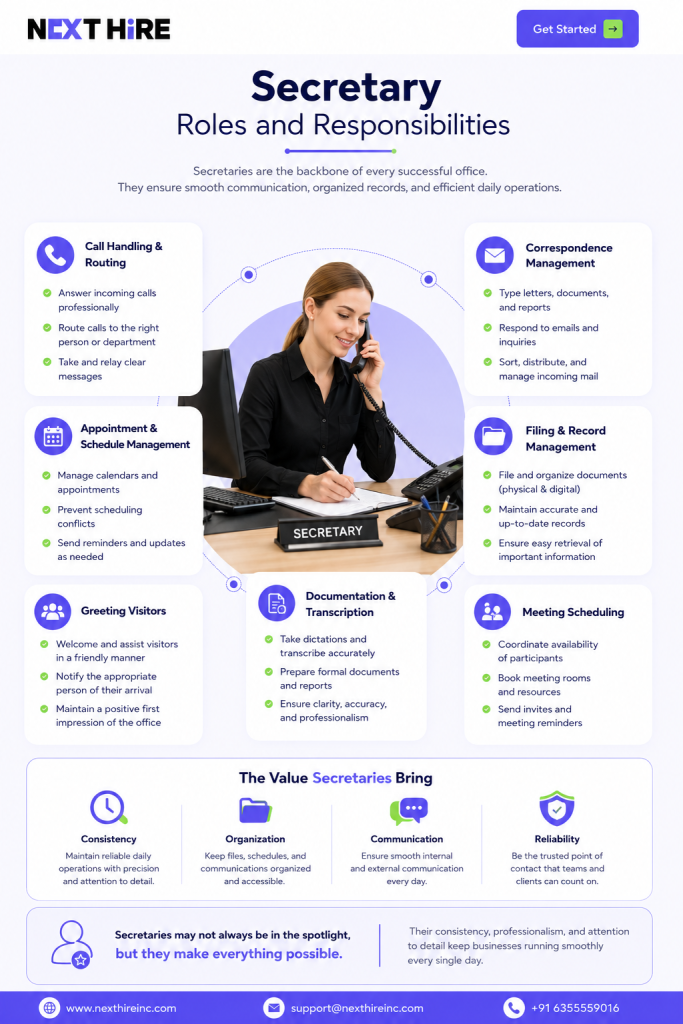
Secretary Roles and Responsibilities
A secretary keeps the wheels turning. Answering calls and routing them to the right person takes up a significant part of the day. Managing appointments and preventing scheduling conflicts is a core function. Handling correspondence, whether that’s typing letters, responding to emails, or sorting mail, forms the backbone of the workload.
Greeting visitors sets the tone for an entire office. A secretary is often the first face or voice someone encounters. Filing documents and maintaining records, both physical and digital, ensures the organization doesn’t lose its institutional memory. Scheduling meetings involves coordinating availability, booking rooms, and sending reminders.
The role thrives on consistency. Someone who takes pride in zero missed calls and flawlessly organized files brings immense value. In many organizations, particularly legal and medical offices, the secretary’s command over dictation, transcription, and formal correspondence remains irreplaceable. The position is narrower than an administrative assistant’s, but it’s foundational.
Executive Secretary vs Administrative Assistant
Up at the executive level, the lines get especially blurry. An executive secretary supports a senior leader, often the CEO or a managing partner. The job involves highly confidential tasks, gatekeeping access to the executive, and handling communications that can have legal or financial weight. It’s a trusted position with significant responsibility, but the focus stays on supporting one individual.
An administrative assistant at the executive level might support multiple VPs or a department head. Their work leans more operational. They coordinate across the leadership team, manage strategic project timelines, and prepare board presentation materials. The distinction is subtle. One job protects a leader’s time. The other actively contributes to a leadership team’s output.
The salary gap between an executive secretary and an administrative assistant can be narrow. In some organizations, the executive secretary earns more due to the confidentiality and trust required. In others, the administrative assistant commands a higher salary because of the broader organizational impact. It depends heavily on the employer’s structure.
Skills Required for Each Role
Both roles demand exceptional communication and organization. Beyond that, the skill profiles start to diverge.
| Skill | Secretary | Administrative Assistant |
| Communication | Highly polished phone and writing skills | High, across multiple channels and audiences |
| Technical Skills | Moderate, focused on office suites | Advanced, including project tools and CRMs |
| Organization | High, managing one person’s world | Very high, managing intersecting workflows |
| Project Coordination | Low to none | Moderate to high |
| Multitasking | Moderate, handling a steady stream | High, switching contexts frequently |
| Problem-Solving | Low, escalating issues | Moderate, resolving issues independently |
Soft skills like empathy, patience, and discretion matter in both roles. The administrative assistant needs to add proactive thinking and the ability to anticipate needs before they’re voiced. Technical skills tilt heavily toward the administrative assistant as offices adopt more complex digital ecosystems.
Secretary vs Administrative Assistant Salary
Talking about money can feel awkward, but salary often tells you exactly how a company values a role. In most cases, administrative assistants earn more than secretaries. The job usually comes with broader responsibilities and more independent decision-making, and that shows up in the paycheck.
In the United States, secretaries typically earn a median salary somewhere in the low to mid-forties. It shifts depending on the industry and where the job is located. Administrative assistants tend to land closer to the high forties or low fifties. If you move into executive administrative assistant territory, salaries can jump past sixty or even seventy thousand dollars a year.
Those numbers aren’t set in stone. Industry matters a lot. A secretary at a big law firm in a major city might earn more than an administrative assistant at a small nonprofit. Geography matters just as much. A salary in New York or San Francisco will look different from one in a rural town. The comparison isn’t a straight line. It’s more of a scatterplot with a lot of variables.
Career growth also tilts the long-term numbers. Administrative assistants often pick up project work and strategic tasks that push their salary higher over time. A secretary who stays in the same role for decades might reach a ceiling. The person in the administrative assistant track has more room to move into office management or executive support roles that pay significantly more.
Career Growth and Advancement Opportunities
The career paths reflect the differences in scope. A secretary’s upward path often leads to senior secretary or executive secretary roles. From there, lateral moves into office management are possible, but the ladder has fewer rungs.
Administrative assistants have a broader set of next steps. Many move into executive assistant positions that come with significant salary bumps. Others shift into office manager roles, HR coordination, or operations management. The project coordination experience gained as an administrative assistant opens doors into entry-level project management or team leadership.
The overlap means that a secretary can absolutely become an administrative assistant. Picking up additional technical skills and seeking out project involvement can bridge that gap. The roles aren’t locked silos. They’re points on a continuum of office support, and plenty of professionals have moved from one to the other.
Education and Certification Requirements
Neither role typically requires a bachelor’s degree, though having one can accelerate advancement. An associate degree or some college coursework is common. What matters more are specific certifications and demonstrable skills.
For secretaries, certifications like the Certified Administrative Professional (CAP) or Microsoft Office Specialist (MOS) add credibility. Legal secretaries often pursue specialized certifications like the Accredited Legal Secretary (ALS) designation.
Administrative assistants benefit from those same credentials plus project management fundamentals. A CAP remains valuable. Learning platforms like LinkedIn Learning offer paths in business communication, data analysis, and specific software tools. The administrative assistant who continuously updates their technical toolkit stays ahead of automation and job market shifts.
Technology and Modern Workplace Evolution
The office that existed twenty years ago isn’t the same office today. Remote work, virtual administrative assistants, and AI-driven automation have reshaped both roles. Secretaries who once managed physical switchboards now coordinate across Slack, Teams, and Zoom.
Virtual administrative assistants operate entirely remotely, supporting clients or teams across time zones. This arrangement demands higher digital fluency and self-management skills. It blurs the line between traditional clerical work and freelance professional services.
AI office automation handles more routine tasks every year. Scheduling tools reduce back and forth emails. Document management systems make filing cabinets obsolete. This evolution means the purely repetitive parts of both roles shrink over time. The human value shifts toward judgment, communication nuance, and the kind of coordination that algorithms still fumble.
Cloud-based office systems mean that organizational skills must translate into digital organization. Maintaining folder structures, permissions, and shared knowledge bases becomes as important as keeping a physical filing cabinet organized.
Which Career Is Better?
Asking which role is better misses the point. They suit different people. A secretary role might be a great fit for someone who values routine, clarity, and the satisfaction of keeping a busy professional perfectly organized. The scope is defined. The expectations are clear. At the end of the day, the work is done.
An administrative assistant role fits someone who enjoys variety and wants a broader view of how a business operates. They’ll deal with more ambiguity. They’ll be asked to solve problems that don’t have a script. The workload can be heavier and more stressful, but the career growth ceiling sits higher.
Consider salary goals, tolerance for stress, and long term ambitions. Neither role traps you. Both can be stepping stones or satisfying careers in their own right. The key is choosing the one that matches your personality and your appetite for growth.
Common Misconceptions About Secretaries and Administrative Assistants
One of the most persistent myths is that the two roles are identical. They overlap, but the day to day experience can be quite different, especially in medium to large organizations. Assuming they’re the same leads to mismatched hires and dissatisfied employees.
Another misconception is that secretaries only answer phones. Their job includes detailed document preparation, visitor management, and often the emotional labor of being an office’s first point of contact. It’s deeper than it looks from the outside.
Some people think administrative assistants only push paperwork. In reality, many act as the operational glue for entire departments. They solve problems, manage small crises, and keep teams aligned. Dismissing the role as purely clerical overlooks the coordination and troubleshooting involved.
There’s also a mistaken belief that both positions offer no real career growth. Professionals who invest in skills and seek out additional responsibilities can move up significantly. The path exists for those willing to build it.
How Employers Define These Roles Today
Corporate terminology has shifted. Many companies have dropped the secretary title altogether, rebranding all office support roles as administrative assistants. This doesn’t always change the duties. It often reflects a desire to modernize the organization’s image.
Industry-specific variations persist. Legal and medical fields still use “secretary” with pride. In startups, job titles are looser. An “office coordinator” or “operations associate” might do work that combines both secretary and administrative assistant functions. Enterprise companies tend to differentiate more clearly, with defined pay grades for each title.
HR departments today often write job descriptions based on the work performed rather than legacy titles. That’s a good thing. It means candidates can evaluate roles based on substance, not a label.
Future Outlook for Administrative Careers
Automation will continue to absorb routine clerical tasks. Scheduling bots, AI transcription, and digital filing systems handle work that once filled a secretary’s entire day. This doesn’t make the roles obsolete. It shifts them toward more strategic, human-centered work.
Remote administration has opened the talent pool. Companies can hire skilled assistants anywhere. This increases competition but also creates opportunities for people in lower cost of living areas to land better paying roles.
The growing expectation for administrative assistants to think critically and manage projects signals a future where the role looks more like a junior operations position. Adopting that mindset early, building technical skills, and developing business literacy will separate those who thrive from those who get left behind.
Conclusion
The difference between a secretary and an administrative assistant comes down to scope, authority, and the complexity of work performed. Secretaries focus on clerical and communication support, often for one person. Administrative assistants operate more broadly, coordinating across teams and handling operational responsibilities.
Neither role is inferior. Both are essential. The distinction matters because it affects salary, career trajectory, and daily job satisfaction. Understanding where one role ends and the other begins helps you write better job descriptions, make smarter career moves, and value the people who keep offices running.
If you’re trying to decide which career path fits you, spend some time with real job descriptions. Look beyond the title at the actual duties. That’s where the truth lives. The title matters less than the work you’ll do every day.
Frequently Asked Questions
What is the difference between a secretary and an administrative assistant?
A secretary typically handles clerical tasks like phone calls, scheduling, and filing for one person or department. An administrative assistant takes on broader operational work, including project coordination, team support, and higher level communication.
Is an administrative assistant higher than a secretary?
In most organizations, yes. The administrative assistant role usually involves more responsibility, autonomy, and a wider scope of work. This often leads to a higher salary and clearer paths for advancement.
Do administrative assistants make more money than secretaries?
On average, administrative assistants earn more due to the expanded skill set and responsibilities. The gap depends on industry, location, and company size.
What skills does an administrative assistant need?
Strong communication, advanced technical abilities with office and project management software, exceptional multi-tasking, problem-solving skills, and the ability to coordinate across multiple teams.
What does a secretary do daily?
A typical day includes answering and routing calls, scheduling appointments, greeting visitors, managing correspondence, filing documents, and preparing meeting materials.
Can a secretary become an administrative assistant?
Absolutely. Gaining experience with project coordination, learning advanced software tools, and taking on broader team-support responsibilities can transition a secretary into an administrative assistant role.
What is an executive secretary?
An executive secretary provides high-level administrative support to a senior executive, handling confidential correspondence, managing complex schedules, and serving as a trusted gatekeeper. The role demands discretion and in-depth knowledge of the executive’s priorities.