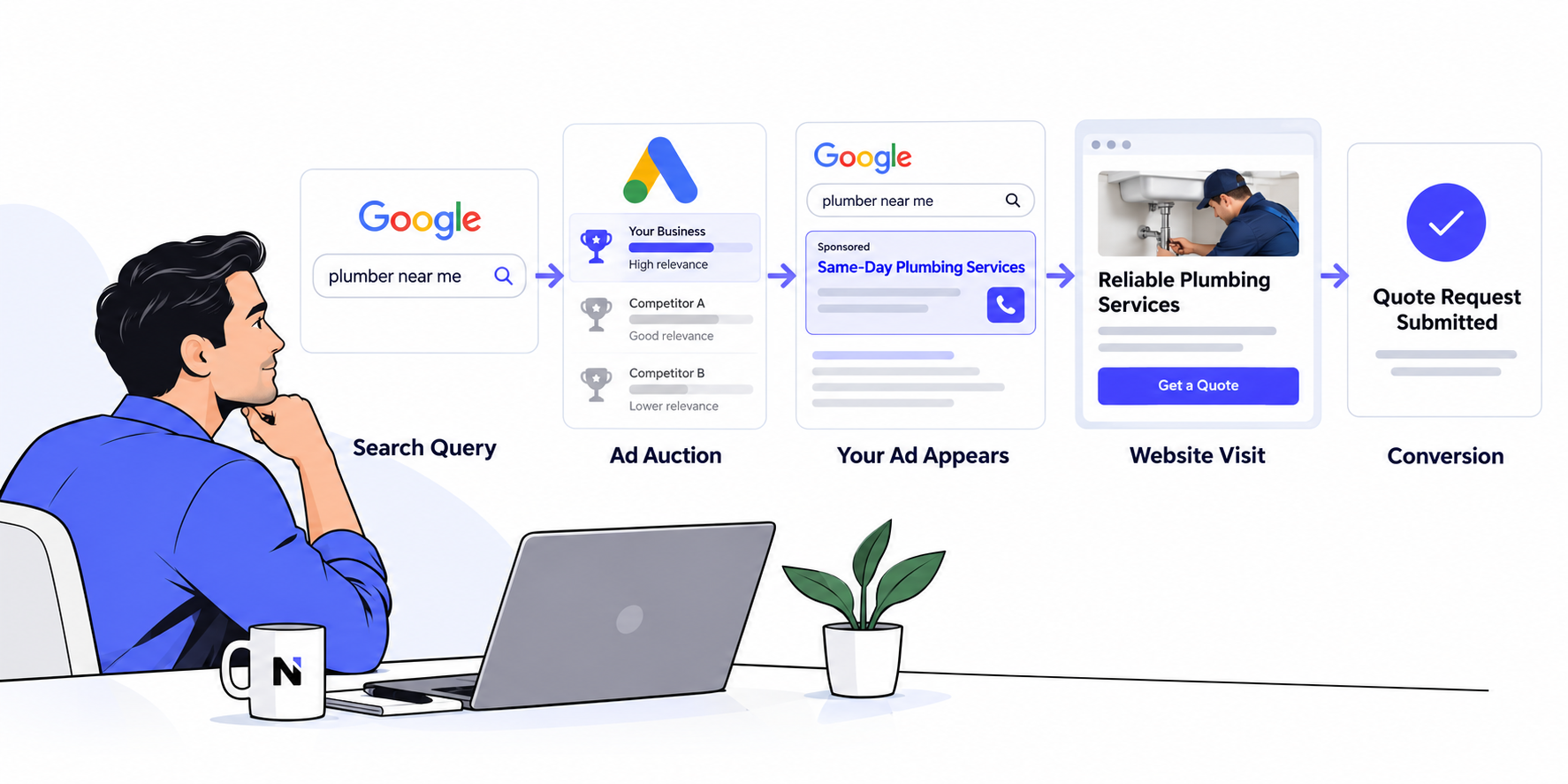


Google Ads can put your business in front of people who are actively searching for what you sell, but the platform is not simply a case of paying to appear first. If you are asking how does Google Ads work, the useful answer is that Google combines targeting, bidding, ad quality, user context, and conversion data to decide when your ads appear and what each click is worth to your business.
For a business owner, the goal is not to understand every setting. It is to understand the system well enough to control spend, judge performance, and avoid paying for traffic that never turns into revenue.
Key Takeaways
- Google Ads uses real-time auctions to decide whether an eligible ad appears and where it ranks.
- Your bid matters, but ad relevance, landing page quality, search context, competition, and expected impact of ad assets also influence Ad Rank.
- The campaign only becomes useful when conversion tracking connects ad spend to leads, calls, bookings, or sales.
What Is Google Ads?
Google Ads is Google’s paid advertising platform. Businesses use it to show ads across Google properties and partner inventory, depending on the campaign type.
For many small businesses, Search campaigns are the easiest place to understand the model. Someone searches for a product or service, advertisers become eligible for that search, Google runs an auction, and qualifying ads may appear around the search results.
Other campaign types can reach people on YouTube, shopping placements, Gmail, Discover, Maps, apps, and Google’s wider advertising network. In 2026, eligible Display campaigns are also moving into Demand Gen.
You choose the campaign goal, audience, budget, and the action that should count as a conversion.
How Does Google Ads Work Step by Step?
The easiest way to understand how Google Ads work is to follow what happens from the moment you create a campaign to the moment a customer converts.
1. You choose a business goal
Start with the outcome, not the ad format.
A local service business may want phone calls or quote requests. An ecommerce store may want purchases. A SaaS company may want demo bookings or trials.
Your goal affects campaign type, conversion setup, bidding, landing pages, and reporting. Optimizing for clicks when you really need qualified leads can buy traffic without improving revenue.
2. You choose where and who to target
For Search campaigns, keywords and search themes help Google understand relevant queries. You can also control locations, languages, devices, schedules, and audiences.
The key decision is intent. Someone searching “emergency plumber near me” is much closer to buying than someone searching “how plumbing works.” Strong targeting reduces wasted clicks before you start adjusting bids or ad copy.
3. You set a budget and bidding strategy
You decide how much you are comfortable spending. Google then uses your bidding settings to decide how aggressively to compete for available ad opportunities.
Google Ads bidding strategies can optimize for clicks, conversions, conversion value, impression share, target cost per acquisition, or target return on ad spend. Smart Bidding uses Google AI to set auction-time bids for conversion goals. Google currently identifies Target CPA, Target ROAS, Maximize conversions, and Maximize conversion value as Smart Bidding strategies.
Automation still needs good inputs. Weak conversion tracking, poor targeting, or low-quality landing pages can push optimization toward the wrong outcome.
4. Google runs an ad auction
The Google Ads auction happens whenever there is an eligible opportunity to show an ad.
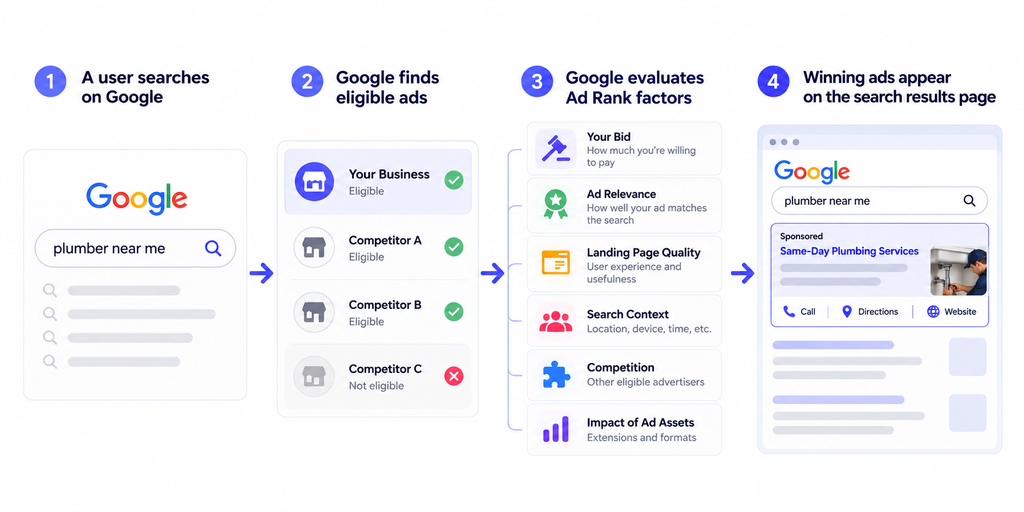
For Search, Google first identifies ads that may match the query. It removes ads that are not eligible, such as campaigns targeting the wrong location or ads that violate policy. It then uses Ad Rank to determine whether an ad can show and where it may appear.
Ad Rank is influenced by factors including your bid, ad and landing page quality, minimum thresholds, competition, the context of the search, and the expected impact of assets and ad formats.
That means the advertiser with the biggest bid does not automatically get the best position. Google states that a more relevant ad can sometimes outrank a higher bidder.
5. Your ad appears and the user chooses what to do
Winning the auction does not mean winning the customer. Your ad still has to match intent, explain the offer, and earn the click.
The landing page then has to continue the same promise. If an ad says “same-day AC repair” but sends people to a generic homepage, you are paying for friction.
6. Google measures conversions and uses the data to optimize
A conversion is an action that matters to your business, such as a purchase, call, form submission, signup, or booking. Google Ads conversion tracking connects ad interactions to those outcomes.
This matters even more with automated bidding. If Google is optimizing toward conversions, the data you feed it should reflect real business value.
How Do Google Ads Work in the Auction?
A common mistake is to think Google simply gives the top position to whoever bids the most. The real process is more nuanced.
Google calculates Ad Rank using multiple signals. These include the bid, the quality and usefulness of the ad and landing page, auction competitiveness, search context, Ad Rank thresholds, and the expected impact of assets.
Quality Score is related to ad quality, but it is not the auction formula itself. Google describes Quality Score as a 1-to-10 diagnostic tool based on expected click-through rate, ad relevance, and landing page experience. Google also explicitly says Quality Score is not an input in the ad auction.
For a business owner, the practical takeaway is simple: do not try to solve weak campaigns by increasing bids alone. Improving relevance and the post-click experience can make the same budget work harder.
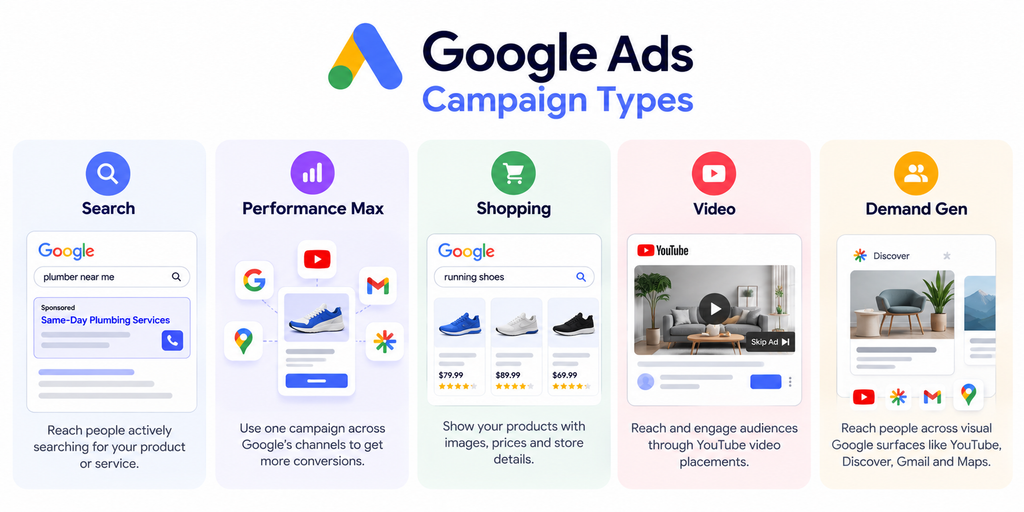
What Are the Main Google Ads Campaign Types?
The best Google Ads campaign types depend on where your customers are and how they buy.
| Campaign type | Best fit | Where it can help |
| Search | High-intent leads and service searches | Reach people actively searching for an offer or solution |
| Performance Max | Conversion-focused businesses using multiple Google channels | Use one campaign across Google’s inventory with automated optimization |
| Shopping | Ecommerce and product retailers | Show products with information such as image, price, and store details |
| Video | Awareness, consideration, and video-led offers | Reach audiences through YouTube video placements |
| Demand Gen | Visual prospecting and demand creation | Reach people across visual Google surfaces such as YouTube, Discover, Gmail, Maps, and the Display Network |
Google’s current documentation lists multiple campaign and ad formats, while Performance Max can use Google’s channels from a single campaign and Demand Gen focuses on visual surfaces.
You do not need every campaign type. A local service business may get more value from a focused Search campaign than from spreading a small budget across every channel.
How Much Do Google Ads Cost?
There is no fixed Google Ads price that applies to every business.
Your cost depends on the auctions you enter, competition, targeting, bidding, ad quality, location, and search demand. You control the campaign budget, but different searches can still produce different click costs.
A better question than “What is the average cost per click?” is “What can we afford to pay to acquire a profitable customer?”
If a lead is worth $20 to your business, a $30 cost per lead is a problem. If a qualified lead is worth $500, paying $80 may be attractive. The economics of your business should set the limits.
What Should You Measure Beyond Clicks?
Clicks tell you that someone visited. They do not tell you whether the advertising worked.
For lead generation, track qualified form submissions, booked calls, phone leads, and downstream sales when possible. For ecommerce, focus on purchases, revenue, conversion value, cost per acquisition, and return on ad spend.
Useful metrics usually include:
- Conversions
- Conversion rate
- Cost per conversion
- Conversion value
- Return on ad spend
- Search terms and lead quality
- Landing page performance
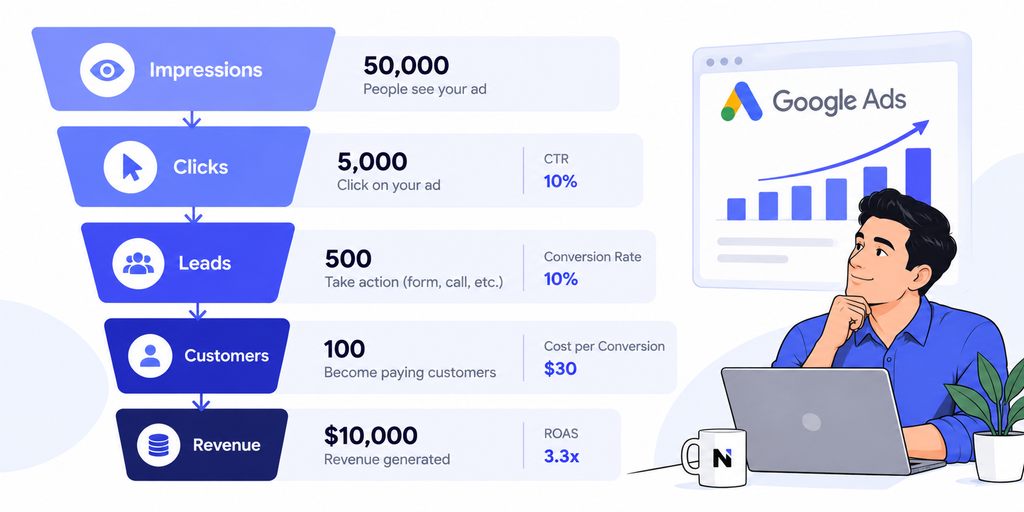
If you only report impressions and clicks, you can make an unprofitable campaign look busy. Tie advertising back to actual business outcomes.
Why Google Ads Campaigns Waste Money
Google Ads usually becomes expensive when the account is sending money toward the wrong traffic or measuring the wrong outcomes.
Common problems include broad targeting, sending every ad to the homepage, weak negative keyword management, poor conversion tracking, and optimizing toward low-value actions.
Mixing too many goals can also muddy the bidding signal. Keep the primary conversion focused on what actually matters to revenue.
Can Small Businesses Use Google Ads Effectively?
Yes, but a smaller budget leaves less room for waste.
A small business does not need to outspend every competitor. It needs tighter targeting, a clear offer, accurate tracking, and a landing page that turns intent into action.
Start with the part of the market closest to a sale, then expand once the data shows what converts profitably.
When Should You Manage Google Ads Yourself?
Managing a simple campaign yourself can make sense when your offer is straightforward and you have time to review search terms, tracking, bids, ads, and landing pages.
Outside help becomes more useful when spend rises, lead quality is inconsistent, or tracking is unreliable. If you need a Google Ads expert for your business, the value should come from better measurement, tighter control, and faster testing, not simply account access.
A Simple Google Ads Workflow for Business Owners
You do not need to manage every setting personally. Use this five-part workflow to judge whether the account is healthy:
- Define one primary business outcome for the campaign.
- Confirm conversion tracking is recording that outcome correctly.
- Review where spend is going, including search terms, locations, devices, and campaign types.
- Compare cost per conversion with the value of the leads or sales being generated.
- Test one meaningful change at a time, then keep what improves business performance.
This keeps the conversation focused on profit instead of vanity metrics.
FAQs About How Google Ads Work
How do Google Ads work for a small business?
A small business sets a goal, budget, targeting, ads, and conversion actions. Google then uses auctions to decide when eligible ads appear. The business pays according to the campaign’s charging model and measures whether the traffic produces valuable outcomes.
Do I pay Google every time my ad appears?
Not always. How you are charged depends on the campaign and bidding setup. Search campaigns commonly use click-based pricing, while other campaign types may optimize or charge around different actions and goals.
Does the highest bidder always rank first?
No. Bid is only one Ad Rank factor. Google also considers ad and landing page quality, auction competition, search context, thresholds, and the expected impact of ad assets.
How quickly can Google Ads generate results?
Ads can begin generating traffic once campaigns and ads are eligible, but profitable performance usually requires clean tracking, enough data, and ongoing testing. Early clicks should be treated as data, not proof that the campaign is working.
Is Google Ads the same as SEO?
No. Google Ads is paid advertising. SEO focuses on earning organic visibility. Both can capture search demand, but the cost structure, timing, and optimization process are different.
Turn Google Ads Into a Measurable Acquisition Channel
The real answer to how does Google Ads work is not “you pay Google and get traffic.” You define an outcome, enter auctions for relevant opportunities, earn clicks with a strong message, convert those visitors on the landing page, and feed accurate results back into the system.
When those pieces line up, Google Ads becomes measurable. When they do not, the platform can optimize efficiently toward the wrong goal.
For growing businesses, the priority is control: know what you are paying for, what a conversion is worth, and which campaigns create real revenue. NextHire can help you add specialized Google Ads talent without building a full in-house team.