


Running a business may look exciting from the outside, but in reality, it comes with constant pressure. Managing operations, handling client communication, taking care of administrative work, and planning for growth can quickly become overwhelming. At some point, every business owner reaches a stage where doing everything alone is no longer sustainable.
This is where the hiring decision becomes critical. Many business owners struggle to decide whether they should hire a full-time employee or choose a more flexible option like a virtual assistant. This is not just a hiring decision; it directly affects your costs, efficiency, and long-term scalability.
Understanding the real difference between a virtual assistant vs employee will help you make a smarter and more practical choice for your business.
What is a Virtual Assistant?
A virtual assistant is a remote professional who supports your business by handling specific tasks without being physically present in your office. Businesses today are increasingly using virtual assistant outsourcing to manage work such as administrative support, customer service, content creation, and even technical operations.
One of the biggest advantages of working with a virtual assistant is flexibility. You can hire them based on your exact needs, whether it is a few hours a day, part-time support, or project-based work. This allows you to pay only for the work being done instead of committing to a fixed monthly salary.
For many growing companies, especially startups and agencies, working with a remote staffing agency makes it easier to find skilled professionals quickly without going through a long hiring process.
What is a Traditional Employee?
A traditional employee is someone who works as a part of your internal team. They usually follow fixed working hours, operate under company policies, and receive a regular salary along with additional benefits such as insurance, paid leave, and bonuses.
Employees are generally hired for long-term roles and are expected to grow with the company. They require onboarding, training, and ongoing management. While this provides better control and consistency, it also increases responsibility and long-term financial commitment.
Virtual Assistant vs Employee: Key Differences That Matter
The difference between a virtual assistant and an employee is not just about location. It affects how your business operates daily.
A virtual assistant gives you the flexibility to scale work up or down based on demand. You can assign tasks as needed and adjust hours depending on workload. On the other hand, an employee works on a fixed schedule, which means you are paying for their time regardless of how much work is available.
Hiring speed is another major difference. A virtual assistant can often start within a few days, especially when working with a remote staffing agency. In contrast, hiring an employee involves multiple steps, including interviews, onboarding, and training, which can take weeks.
The level of commitment is also very different. Virtual assistants are usually hired for specific tasks or projects, while employees are long-term investments who require consistent work and management.
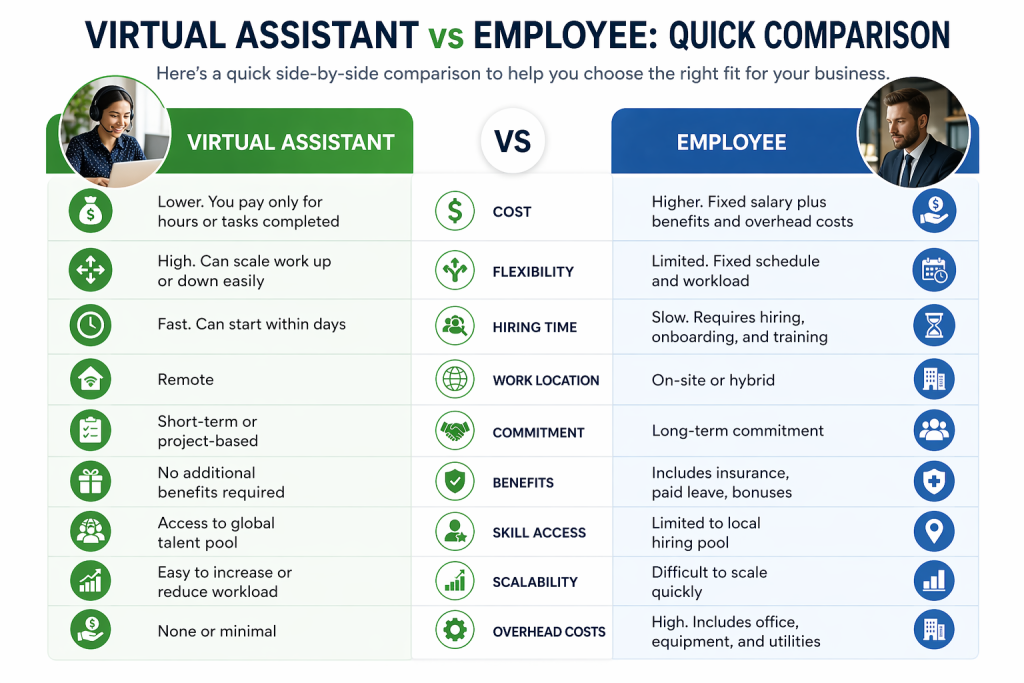
Virtual Assistant vs Employee: Quick Comparison
To understand the difference more clearly, here is a side-by-side comparison of a virtual assistant and a traditional employee:
| Factor | Virtual Assistant | Employee |
| Cost | Lower. You pay only for hours or tasks completed | Higher. Fixed salary plus benefits and overhead costs |
| Flexibility | High. Can scale work up or down easily | Limited. Fixed schedule and workload |
| Hiring Time | Fast. Can start within days | Slow. Requires hiring, onboarding, and training |
| Work Location | Remote | On-site or hybrid |
| Commitment | Short-term or project-based | Long-term commitment |
| Benefits | No additional benefits required | Includes insurance, paid leave, and bonuses |
| Skill Access | Access to a global talent pool | Limited to the local hiring pool |
| Scalability | Easy to increase or reduce workload | Difficult to scale quickly |
| Overhead Costs | None or minimal | High. Includes office, equipment, and utilities |
Real Cost Breakdown: Virtual Assistant vs Employee
Cost is one of the most important factors when deciding between a virtual assistant and an employee, yet many businesses underestimate the true cost of hiring.
When you hire a full-time employee, the expense goes far beyond salary. A typical employee may cost between $3,000 to $6,000 per month in salary, depending on their role and location. On top of that, you also need to consider benefits such as insurance, bonuses, and taxes, which can add an additional 20 to 30 percent.
There are also overhead costs involved. These include office space, equipment, software, and other operational expenses. Training and onboarding also require time and money. When all these factors are combined, the total cost of an employee can easily reach $4,000 to $8,000 per month or even higher.
In comparison, the virtual assistant cost is significantly lower. Most virtual assistants charge between $5 to $15 per hour, depending on their skills and experience. This usually translates to a monthly cost of around $800 to $2,500. Since virtual assistants work remotely, there are no additional overhead costs such as office space or equipment.
The most important difference is that you only pay for the actual work done. This makes the virtual assistant price more flexible and cost-efficient, especially for businesses with changing workloads.
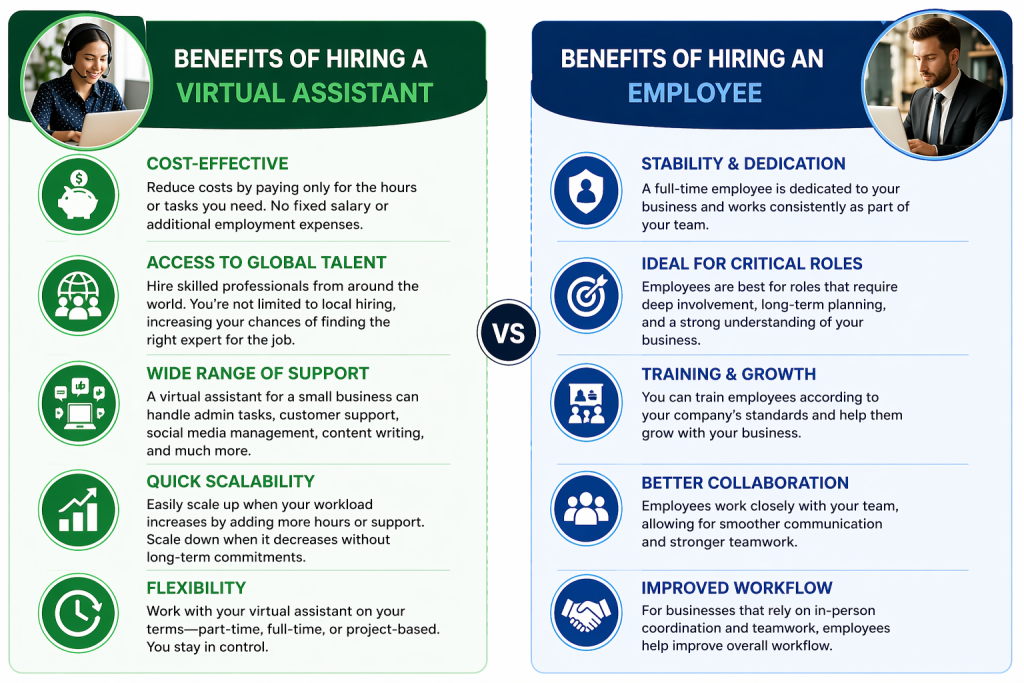
Benefits of Hiring a Virtual Assistant
One of the main reasons businesses are choosing virtual assistant outsourcing is that it allows them to reduce costs while maintaining productivity. Instead of committing to a fixed salary, you can manage expenses based on your actual needs.
Another advantage is access to a global talent pool. You are not limited to hiring locally, which increases your chances of finding skilled professionals for specific tasks. A virtual assistant for a small business can handle a wide range of responsibilities, including customer support, social media management, content writing, and administrative tasks.
Virtual assistants also allow you to scale quickly. If your workload increases, you can simply add more hours or hire additional support. If it decreases, you can reduce hours without facing long-term commitments.
Benefits of Hiring an Employee
While virtual assistants offer flexibility, employees provide stability. Having a full-time employee means you have someone dedicated to your business who understands your processes and contributes consistently.
Employees are ideal for roles that require deep involvement, long-term planning, and regular collaboration. They can be trained according to your company’s standards and can take ownership of responsibilities over time.
For businesses that rely heavily on teamwork and in-person coordination, hiring an employee can improve communication and overall workflow.
Real Example: Choosing the Right Option
Consider a small digital marketing agency that manages multiple clients. The agency needs help with tasks such as keyword research, reporting, content updates, and client communication.
Hiring a full-time employee for these tasks could cost around $4,000 per month, even if the workload varies. In contrast, hiring a virtual assistant could cost between $1,200 to $1,800 per month, depending on the hours required.
In this situation, a virtual assistant provides the same support at a lower cost while allowing the agency to remain flexible.
When Should You Choose a Virtual Assistant?
A virtual assistant is a better option when your business requires flexibility and cost control. It works well when your workload is not consistent or when you need specific skills for certain tasks.
It is also a practical choice for startups and small businesses that want to grow without increasing fixed expenses. Working with a remote staffing agency can make the hiring process even easier by providing trained professionals who are ready to start quickly.
When Should You Hire an Employee?
Hiring an employee makes more sense when the role is essential to your business and requires long-term commitment. If the position involves daily collaboration, strategic planning, or core business operations, having a full-time employee can be more effective.
Employees are also better suited for roles where control, supervision, and consistency are important.
Final Verdict: Which One Is Right for Your Business?
The decision between a virtual assistant and an employee depends on your business needs, budget, and long-term goals.
If your focus is on reducing overhead costs, maintaining flexibility, and scaling efficiently, a virtual assistant is often the better choice. On the other hand, if you need stability, deeper involvement, and long-term commitment, hiring an employee may be the right decision.
Many successful businesses today use a combination of both. They rely on employees for core roles and use virtual assistants for support and scalability. This balanced approach allows them to stay efficient while controlling costs.
FAQs
Is a virtual assistant cheaper than an employee?
Yes, a virtual assistant’s cost is usually much lower because you do not have to pay for benefits, office space, or idle time.
Can a virtual assistant replace a full-time employee?
In many cases, yes. Virtual assistants can handle task-based roles effectively, but strategic positions may still require employees.
What tasks can a virtual assistant handle?
Virtual assistants can manage administrative work, customer service, content creation, social media management, and more.
Is virtual assistant outsourcing reliable?
Yes, especially when you work with a trusted remote staffing agency that provides trained professionals and proper support.



