


There is a moment every growing tech company hits where the gap between what their development team can deliver and what the business actually needs becomes impossible to ignore. Deployments are slow. Infrastructure is held together with what feels like digital duct tape. The engineering team is buried in maintenance work, and nobody has time to think about automation, monitoring, or CI/CD pipelines. Meanwhile, competitors are shipping faster, scaling cleaner, and operating with far less friction.
That moment is usually when DevOps outsourcing enters the conversation.
But outsourcing DevOps is not a simple decision. It touches your infrastructure, your security, your deployment processes, and ultimately your ability to deliver value to customers consistently. Done right, it can completely transform how your engineering organization operates. Done wrong, it can introduce new problems that are harder to fix than the ones you started with.
This guide covers everything you need to make an informed decision. What DevOps outsourcing actually means, what you gain from it, what risks you need to manage, what it costs, and how to get started without disrupting the work your team is already doing.
What Is DevOps Outsourcing?
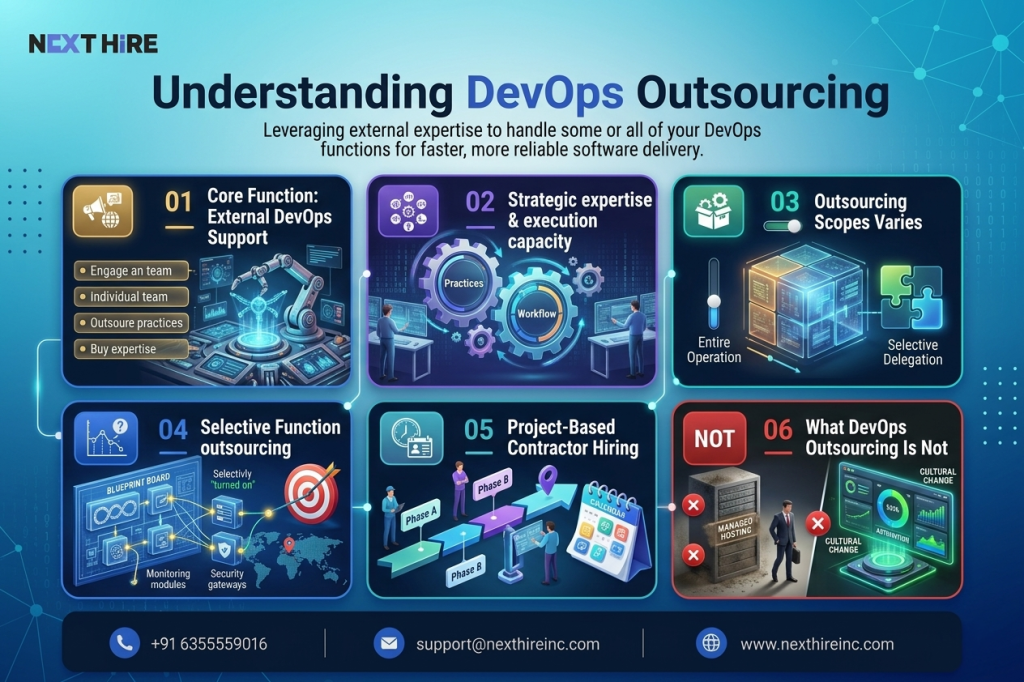
DevOps outsourcing means engaging an external team, company, or individual engineer to handle some or all of your DevOps functions. Instead of building an in-house DevOps team from scratch, you bring in outside expertise to design, implement, and manage the practices, tools, and infrastructure that keep your software development and delivery running smoothly.
The scope of what gets outsourced can vary significantly depending on your business needs. Some companies outsource their entire DevOps operation to a specialized DevOps outsourcing company. Others outsource specific functions like cloud infrastructure management, CI/CD pipeline setup, security automation, or monitoring and alerting. And some simply choose to hire DevOps engineer contractors on a project basis to fill specific skill gaps or accelerate particular initiatives.
What all of these arrangements have in common is the core goal of DevOps itself: bringing development and operations closer together to enable faster, more reliable software delivery. When you outsource DevOps, you are essentially buying expertise and execution capacity that would otherwise take months or years to build internally.
It is worth being clear about what DevOps outsourcing is not. It is not simply handing your servers to a managed hosting provider and walking away. True DevOps outsourcing involves strategic work around automation, continuous integration and delivery, infrastructure as code, monitoring and observability, security practices, and the cultural and process changes that make all of that sustainable over time.
Who Should Consider DevOps Outsourcing?
Not every company is in the same situation, and DevOps outsourcing is not the right answer for everyone at every stage. But there are certain patterns that consistently signal it is worth serious consideration.
Startups and early-stage companies that need to move fast but cannot afford to build out a full internal DevOps team. Hiring experienced DevOps engineers in-house is expensive and competitive. Outsourcing gives you access to senior-level expertise immediately without the six-month hiring timeline.
Mid-sized companies that have grown quickly and now have infrastructure that was never properly architected. The deployment process is slow, environments are inconsistent, and the engineering team is spending too much time on operational firefighting instead of building features.
Enterprises running digital transformation initiatives that need to modernize legacy infrastructure, migrate to the cloud, or adopt microservices architecture. These projects require specialized expertise that most enterprise IT teams do not have in-house.
Companies with specific short-term needs like a cloud migration, a Kubernetes implementation, or a CI/CD pipeline build. Rather than hiring for a permanent role that may not be needed long-term, they bring in a DevOps outsourcing company for the duration of the project.
Key Benefits of DevOps Outsourcing
The decision to outsource DevOps carries real and measurable advantages when approached strategically. Here is a deep look at what you actually gain:
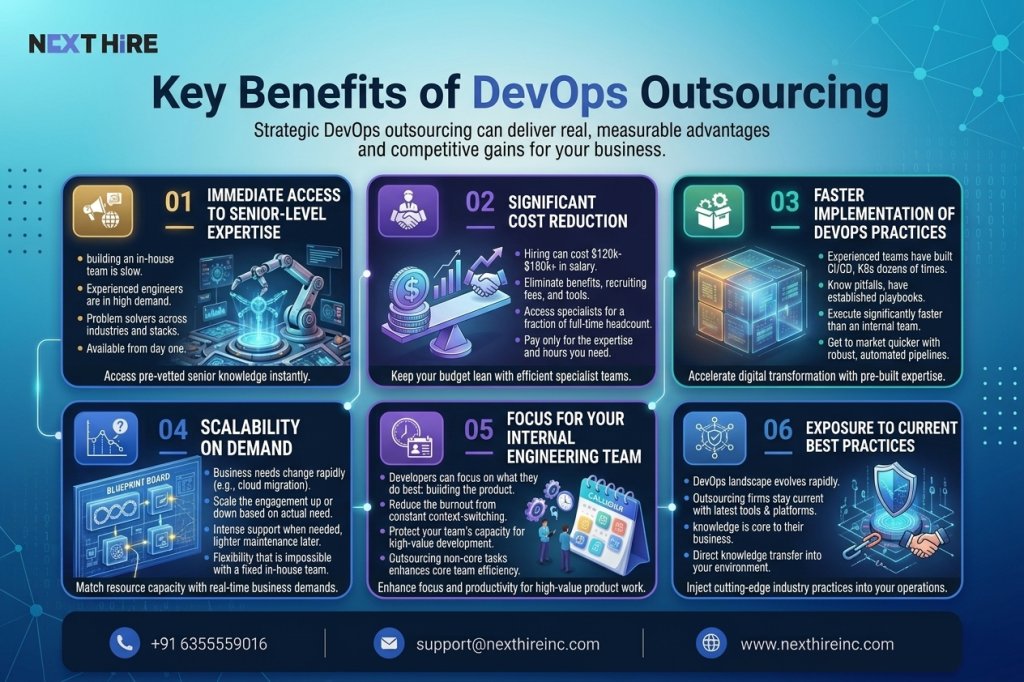
Immediate Access to Senior-Level Expertise: Building an in-house DevOps team is a slow process. Experienced DevOps engineers are in extremely high demand, salaries are at a premium, and the hiring process can take six months or longer before someone is fully productive. When you work with a reputable DevOps outsourcing company, you get access to engineers who have already solved the problems you are facing across multiple industries and tech stacks. That expertise is available from day one.
Significant Cost Reduction: Hiring a single senior DevOps engineer in-house can cost anywhere from $120,000 to $180,000 per year in salary alone in major tech markets, before you factor in benefits, recruiting fees, and tooling costs. DevOps outsourcing services give you access to a team of specialists for a fraction of that cost. You pay for the expertise and hours you actually need rather than carrying full-time headcount.
Faster Implementation of DevOps Practices: An experienced outsourced team has built CI/CD pipelines, migrated infrastructure to the cloud, and implemented Kubernetes clusters dozens of times. They know the pitfalls, they have the playbooks, and they can execute significantly faster than an internal team figuring things out for the first time.
Scalability on Demand: Business needs change. You might need intensive DevOps support during a major cloud migration and much lighter ongoing maintenance afterward. With outsourcing, you can scale the engagement up or down based on what the business actually needs at any given time. That kind of flexibility is nearly impossible to achieve with a fixed in-house team.
Focus for Your Internal Engineering Team: When your developers are not getting pulled into infrastructure issues and deployment problems, they can focus on what they do best, which is building the product. Outsourcing DevOps functions protects your engineering team’s capacity for high-value development work and reduces the burnout that comes from constant context-switching.
Exposure to Current Best Practices: The DevOps landscape evolves rapidly. A specialized DevOps outsourcing company stays current with the latest tools, platforms, and practices because it is their core business. Your outsourced team brings that knowledge directly to your environment without requiring investment in ongoing internal training.
Risks of DevOps Outsourcing and How to Manage Them
Honest guidance requires addressing the risks alongside the benefits. Here is what to watch for and how to handle each one:
Knowledge Transfer and Documentation: One of the most significant risks is ending up with critical infrastructure knowledge living entirely with the external team. If that relationship ends, your internal team may be left managing systems they do not fully understand. Require thorough documentation as part of every deliverable and build knowledge transfer sessions into the contract throughout the engagement, not just at the end.
Security and Data Privacy Concerns: Giving an external team access to your infrastructure and potentially sensitive data carries inherent risk. Work only with partners who have verifiable security credentials. Use role-based access controls to limit external access to what is strictly necessary. Require NDAs and data processing agreements as part of the contract, and ensure compliance with relevant regulations like GDPR, HIPAA, or SOC 2 if your industry requires it.
Communication and Collaboration Challenges: Remote and often cross-timezone collaboration introduces friction that can slow down work and create misalignment. Establish clear communication protocols from the start, define which tools you will use, how frequently you will sync, and what the expected response times are for different types of issues.
Dependency Risk: Over time, heavy reliance on an outsourced DevOps team can erode whatever internal knowledge your team has. Even while outsourcing, invest in growing internal DevOps awareness among your engineers so the outsourced team handles specialized work while your team builds enough understanding to oversee and guide the function strategically.
DevOps Outsourcing vs In-House vs Consulting
Before you decide to outsource DevOps, understanding how the different models compare helps you choose the approach that fits your situation best.
| Factor | In-House DevOps Team | DevOps Outsourcing | DevOps Consulting |
| Cost | Highest, full salaries and benefits | Moderate, pay for hours or scope | Varies, often project based |
| Speed to Start | Slowest, 3 to 6 months to hire | Fast, days to weeks | Fast, project scoped quickly |
| Expertise Level | Depends on who you hire | High, specialized teams | High, strategic advisory focus |
| Scalability | Low, fixed headcount | High, scale up or down easily | Low to medium, project scoped |
| Knowledge Retention | High, stays in house | Risk if not documented well | Low, advisory leaves after project |
| Best For | Large companies with consistent need | Growing companies needing flexibility | Companies needing strategy and direction |
Most growing companies land somewhere between full outsourcing and a hybrid model where an outsourced team handles specialized work while a small internal team oversees direction and maintains organizational knowledge.
What Does DevOps Outsourcing Actually Cost?
Pricing for DevOps outsourcing services varies based on scope, experience level, geographic location of the partner, and whether you engage on a project basis or ongoing retainer.
| Engagement Model | Cost Range | Best For |
| Hourly DevOps Engineer (Junior) | $25 to $50 per hour | Specific tasks, limited scope |
| Hourly DevOps Engineer (Mid-Level) | $50 to $90 per hour | Ongoing support, pipeline work |
| Hourly DevOps Engineer (Senior) | $90 to $150 per hour | Architecture, complex migrations |
| Monthly Retainer (Basic) | $2,000 to $5,000 per month | Maintenance, monitoring, support |
| Monthly Retainer (Full Service) | $5,000 to $15,000 per month | Comprehensive DevOps management |
| Project-Based Engagement | $10,000 to $100,000+ | Cloud migrations, CI/CD builds |
| Dedicated Outsourced Team | $15,000 to $40,000 per month | Full DevOps team replacement |
Compare these numbers to the cost of building an in-house team. A senior DevOps engineer in the United States commands a base salary of $140,000 to $180,000 per year. Add benefits, recruiting fees, and tooling costs and you are looking at a total cost well above $200,000 per engineer annually. For most small to mid-sized companies, outsourcing DevOps delivers comparable or superior capability at 30 to 50 percent of the cost of building an equivalent in-house team.
Core Tasks You Can Outsource to a DevOps Team
Understanding the specific outsource DevOps services available helps you define the scope of what you actually need.
| Category | Specific Tasks | Tools Commonly Used |
| CI/CD Pipeline | Pipeline design, build automation, test integration, deployment automation | Jenkins, GitHub Actions, GitLab CI, CircleCI |
| Cloud Infrastructure | Architecture design, provisioning, cost optimization, scaling | AWS, Azure, Google Cloud, Terraform |
| Containerization | Docker setup, image optimization, container security | Docker, Docker Compose, Amazon ECR |
| Orchestration | Kubernetes cluster setup, Helm charts, auto-scaling | Kubernetes, Helm, Istio, ArgoCD |
| Infrastructure as Code | IaC design, state management, module development | Terraform, Pulumi, Ansible, CloudFormation |
| Monitoring and Alerting | Metrics setup, dashboards, alerting rules, log management | Prometheus, Grafana, Datadog, ELK Stack |
| Security and Compliance | Vulnerability scanning, secrets management, access control | Vault, Snyk, AWS IAM, Trivy |
| Incident Management | Runbook creation, on-call setup, post-mortem processes | PagerDuty, OpsGenie, Statuspage |
How to Choose the Right DevOps Outsourcing Company
The quality of your outsourcing experience depends enormously on who you partner with. Here is what to evaluate during your selection process:
Technical depth across the full DevOps stack: A strong DevOps outsourcing company should have demonstrated expertise across cloud platforms, CI/CD tools, containerization, infrastructure as code, monitoring, and security. Ask for specific examples of projects they have delivered and the technical challenges they solved along the way.
Security practices and credentials: Ask how they handle access management, how they store and rotate secrets, what their process is for offboarding when the engagement ends, and whether they hold any security certifications relevant to your industry. This is non-negotiable regardless of the size or scope of your engagement.
Documentation standards: Require that all work be documented as it is delivered, not in a rush at the end of the engagement. Ask to see examples of documentation from previous projects to assess the quality and completeness before you commit.
References from similar clients: Talk to companies that have worked with the outsourcing partner in a similar capacity. Ask about results, communication quality, reliability, and how issues were handled when they arose.
Flexibility and contract terms: Avoid partners who lock you into rigid long-term contracts with no flexibility. The best outsource devops services providers offer contract structures that can evolve as your needs change over time.
How to Get Started with DevOps Outsourcing
Getting started does not have to be overwhelming. Here is a clear process that reduces risk and sets the engagement up for success from day one:
Step 1: Audit Your Current State
Before you bring in any external help, get a clear picture of where things stand today. Document your current infrastructure, deployment process, tooling, pain points, and the specific areas where you know things need to improve. This audit becomes the foundation for scoping the outsourcing engagement and ensures you can communicate your needs clearly to potential partners.
Step 2: Define Your Goals and Scope
What does success look like for this engagement? Are you trying to reduce deployment time, migrate to the cloud, or implement proper monitoring? Define specific and measurable goals and use them to scope the work clearly before you start talking to vendors.
Step 3: Evaluate and Select Your Partner
Use the criteria outlined above to evaluate potential partners. Request proposals, conduct technical interviews, check references, and assess cultural fit. Do not make this decision based on price alone. The cheapest option is rarely the best value when the work touches your core infrastructure.
Step 4: Start with a Pilot Engagement
Rather than committing to a large long-term contract immediately, start with a bounded pilot project that has clear deliverables and a defined timeline. A successful pilot proves the partnership works before you expand the scope of the engagement.
Step 5: Establish Governance and Communication
Set up communication rhythms, reporting cadences, access controls, and documentation standards before work begins. Define who owns decisions on your side and who the primary contacts are on the outsourcing side. Getting this structure in place early prevents a significant amount of friction down the road.
Step 6: Plan for Knowledge Transfer from the Start
Do not wait until the end of an engagement to think about knowledge transfer. Build it into the process from the beginning. Require documentation as part of delivering each workstream and schedule regular knowledge-sharing sessions with your internal team throughout the engagement.
Common Mistakes Companies Make with DevOps Outsourcing
Learning from mistakes others have already made is one of the most valuable things this guide can offer.
Outsourcing before defining goals leads to work that does not move the needle. Before you engage anyone, know exactly what you are trying to achieve and how you will measure success.
Choosing based on price alone is a trap. DevOps work touches critical infrastructure and the cheapest option that lacks relevant experience or security rigor can cost you far more in incidents, delays, and technical debt than you saved on the engagement fee.
Skipping the documentation requirement is one of the most common and costly mistakes. Organizations often reach the end of a successful outsourcing engagement with improved infrastructure but no clear record of how it works. Require documentation from day one as a non-negotiable part of the engagement.
Ignoring security until it becomes a problem is a pattern that creates serious risk. Security should be built into the outsourcing engagement from the first conversation, not added as a checklist item at the end of a project.
Why NextHire Inc. Is the Right Partner for DevOps Outsourcing
When you are ready to hire DevOps engineer talent or engage a team for broader outsource DevOps services, the partner you choose matters as much as the decision to outsource itself.
At NextHire Inc., we specialize in connecting businesses with pre-vetted DevOps professionals and teams who have the technical depth, communication skills, and reliability to deliver real results. Whether you need a single senior engineer to lead a cloud migration, a dedicated team to manage your entire infrastructure, or DevOps consulting support to build a strategy before execution begins, we have the expertise and the network to make it happen.
Every engineer and team in our network goes through a rigorous evaluation covering technical skills, security practices, communication quality, and track record with previous clients. You do not get a stack of resumes to sort through. You get matched with professionals who are genuinely qualified for what your business needs right now.
Frequently Asked Questions
How long does a typical DevOps outsourcing engagement last?
It depends on the scope of work. A focused project engagement like building a CI/CD pipeline or completing a cloud migration might run two to four months. An ongoing managed services arrangement can run indefinitely. Most companies start with a defined project and transition to a lighter ongoing support retainer once the major work is complete.
Is DevOps outsourcing secure enough for companies in regulated industries?
Yes, provided you choose the right partner and implement proper governance. Companies in healthcare, finance, and other regulated industries successfully outsource DevOps functions while maintaining compliance with HIPAA, SOC 2, GDPR, and other frameworks. The key is working with a partner who has verifiable experience in your regulatory environment.
Can I outsource only part of my DevOps function rather than all of it?
Absolutely. Many companies take a hybrid approach where specific functions like cloud cost optimization, security automation, or CI/CD pipeline management are outsourced while other functions remain in-house. Define the boundaries of the outsourced scope clearly and ensure both teams have a shared understanding of who owns what.
How do I know if my outsourced DevOps team is actually performing well?
Define KPIs at the start of the engagement and review them regularly. Key metrics include deployment frequency, deployment failure rate, mean time to recovery from incidents, infrastructure cost trends, and pipeline build times. Consistent improvement across these metrics over time is the clearest evidence that the engagement is delivering real value.
Final Thoughts
DevOps is the operational foundation that determines how fast you can ship, how reliably your systems run, and how quickly you can recover when things go wrong. For most growing companies, building all of that capability in-house from scratch is slow, expensive, and increasingly unnecessary.
DevOps outsourcing gives you a smarter path. You get immediate access to senior expertise, faster implementation of practices that accelerate your engineering organization, and the flexibility to scale support up or down as your needs evolve, all at a fraction of the cost of building an equivalent in-house team.
The key is going in with clear goals, choosing the right partner with the rigor the decision deserves, and building the engagement in a way that grows your internal capability rather than creating dependency. Done that way, outsourcing DevOps is not just a cost decision. It is a strategic one that can fundamentally change how your engineering organization operates.
When you are ready to explore what the right model looks like for your specific situation, NextHire Inc. is here to help you find the right people and build the right engagement structure to get there.