

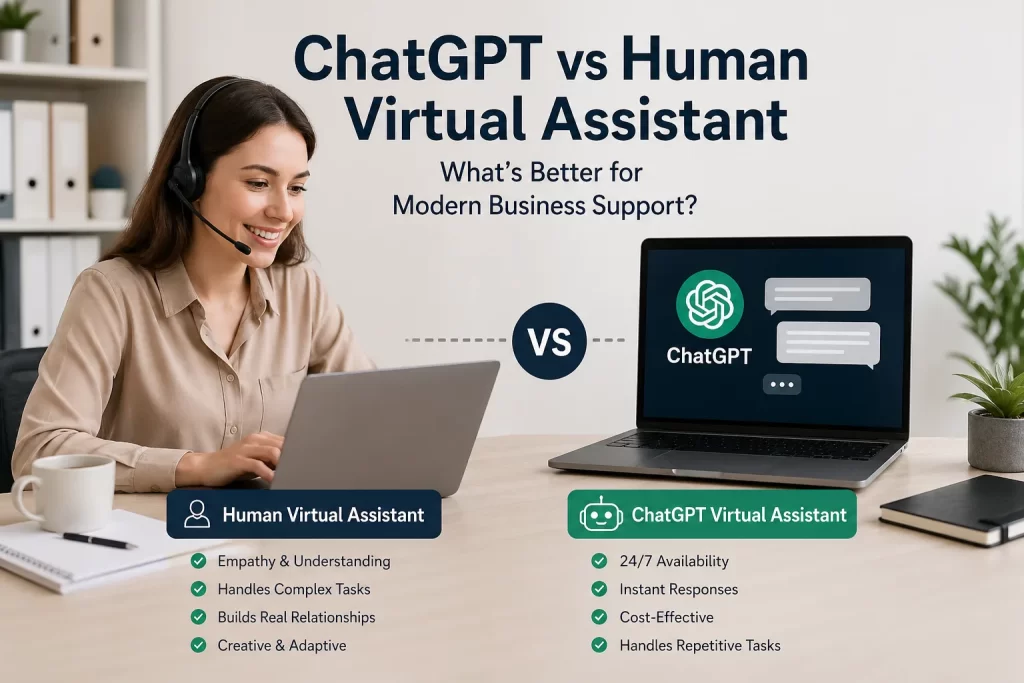
The way businesses handle support, admin tasks, and daily operations has changed dramatically over the past few years. With tools like ChatGPT making headlines and human virtual assistants continuing to prove their value, small business owners are stuck asking one big question: which one should I actually invest in?
It is not a simple answer. Both options bring something different to the table, and the right choice depends on what your business actually needs, not just what sounds impressive or trendy. In this guide, we are going to break down the real differences between a ChatGPT virtual assistant and a human virtual assistant so you can make a decision that actually moves your business forward.
Let us get into it.
Understanding What ChatGPT Actually Does
Before comparing anything, it is important to understand what ChatGPT is and what it is not. ChatGPT is a large language model built by OpenAI. It generates text responses based on patterns it learned from massive amounts of data. You type a prompt, and it gives you an answer. Simple as that on the surface, but the reality is more nuanced.
ChatGPT can draft emails, summarize documents, brainstorm ideas, write content, answer customer questions, and even help with basic coding. It works 24/7, never asks for a break, and processes information almost instantly. For businesses looking for an AI virtual assistant that handles repetitive text-based tasks, it checks a lot of boxes.
But here is the thing. ChatGPT does not think. It does not understand your business goals, your brand voice on a deep level, or the context behind a frustrated customer’s email. It predicts the next word in a sequence. That is powerful, but it is not the same as judgment, intuition, or experience.
When people refer to a ChatGPT virtual assistant, they usually mean using the tool as a productivity aid, either directly or integrated into workflows through APIs and automation platforms. It is not a person sitting on your team. It is a tool you use, and the quality of output depends entirely on how well you use it.
What a Human Virtual Assistant Brings to the Table
A human virtual assistant is a real person who works remotely and handles tasks for your business. These tasks can range from email management, calendar scheduling, and data entry to more complex work like customer relationship management, social media strategy, bookkeeping, and project coordination.
The biggest advantage a human virtual assistant has is adaptability. A person can read between the lines. They pick up on tone, understand urgency without being told explicitly, and can handle situations that require empathy or creative problem-solving. When a client sends a vague email that could mean three different things, a skilled human assistant knows how to interpret it and respond appropriately. ChatGPT would likely give you a generic reply or ask you to clarify, which is not always practical in fast-moving business environments.
Human virtual assistants also build relationships. They get to know your clients, your preferences, and your workflow over time. That kind of institutional knowledge is incredibly valuable, especially for small businesses where every interaction matters. Virtual assistant services for small businesses have grown significantly because owners realized they needed more than just task completion. They needed someone who could represent their brand and think on their feet.
The Real Comparison: ChatGPT vs Human Virtual Assistant
Let us stop dancing around it and put these two side by side on the factors that actually matter for your business.
| Factor | ChatGPT Virtual Assistant | Human Virtual Assistant |
| Availability | 24/7 with no downtime | Set working hours, but flexible scheduling is possible |
| Cost | Low monthly subscription or API usage fees | Higher cost, but delivers personalized value |
| Task complexity | Handles simple to moderately complex text tasks | Handles simple to highly complex, multi-step tasks |
| Judgment and decision-making | No real judgment, pattern-based responses | Uses experience, context, and critical thinking |
| Brand understanding | Requires detailed prompting every time | Learns your brand deeply over time |
| Customer interaction | Can feel robotic or generic to customers | Natural, empathetic, relationship-building interactions |
| Accuracy | Can hallucinate or generate incorrect information | Can make human errors, but can verify and self-correct |
| Scalability | Scales instantly | Scaling requires hiring additional assistants |
| Emotional intelligence | None | High, especially with experienced assistants |
| Confidentiality | Data may be processed through third-party servers | Governed by contracts and trust-based relationships |
| Learning curve | Requires prompt engineering knowledge | Requires onboarding but adapts organically |
| Integration with tools | Needs technical setup for tool integration | Can directly use CRMs, project tools, and email platforms |
This table tells a clear story. Neither option is universally better. They serve different purposes, and in many cases, the smartest move is using both.
Where ChatGPT Wins
There are specific scenarios where using ChatGPT as an AI virtual assistant makes total sense, and pretending otherwise would be dishonest.
Content drafting and brainstorming are one of the clearest wins. If you need blog outlines, social media caption ideas, product description drafts, or email templates, ChatGPT can produce a solid starting point in seconds. A human assistant might take 30 minutes to do what ChatGPT does in 30 seconds. The human version might be better, but if speed matters more than perfection in that moment, ChatGPT delivers.
Data summarization is another strong suit. Hand ChatGPT a long report or article and ask for a summary, and it will give you something usable almost instantly. For business owners drowning in information, this alone can save hours every week.
Quick research and answers also favor ChatGPT. Need to understand a concept, compare two software tools, or get a quick overview of a topic? ChatGPT handles this efficiently. It is not always perfectly accurate, so you need to verify important details, but for general research it speeds things up considerably.
Repetitive text-based tasks like formatting data, rewriting content in different tones, or generating multiple variations of something are where ChatGPT truly shines. These tasks do not require judgment. They require processing power and consistency, and that is exactly what the tool offers.
For a small business owner exploring an ai virtual assistant for small business needs, starting with ChatGPT for these kinds of tasks is a low-risk, low-cost entry point.
Where a Human Virtual Assistant Wins
Now let us talk about where no amount of prompt engineering can replace a real person.
Complex customer communication is the most obvious one. When a high-value client is upset, when a situation requires negotiation, or when the conversation involves sensitive information, you need a human. People can tell when they are talking to a bot, and in many cases, it makes them feel undervalued. A human virtual assistant handles these moments with grace, empathy, and the kind of nuance that builds long-term loyalty.
Project management and coordination is another area where humans dominate. Managing timelines, following up with team members, adjusting plans when things go sideways, and keeping multiple moving parts aligned requires cognitive flexibility that ChatGPT simply does not have. A virtual assistant for small business operations can become the backbone of your daily workflow in ways a language model cannot.
Strategic thinking and proactive support separate a good human assistant from any AI tool. A skilled assistant does not just do what you tell them. They anticipate what you need. They notice patterns, flag potential problems before they become emergencies, and suggest improvements based on their understanding of your business. ChatGPT responds to prompts. It does not initiate.
Tasks requiring access to multiple platforms also favor humans. Your assistant can log into your CRM, update records, send a follow-up email through your business account, schedule a meeting on your calendar, and update your project management tool, all in one workflow. Getting ChatGPT to do this requires significant technical integration, and even then, it is not seamless.
Confidential and sensitive work is better handled by a human you trust and have a contract with. While ChatGPT has improved its data handling policies, many businesses are uncomfortable running sensitive financial data, client information, or proprietary strategies through a third-party AI platform. A human assistant operating under a signed NDA provides a level of security and accountability that software cannot match.
The Cost Question: What Are You Actually Paying For?
Let us talk money, because this is often where the decision starts for most small business owners.
ChatGPT Plus costs around $20 per month. If you are using the API for more advanced integrations, costs scale based on usage but generally remain affordable for small to mid-level usage. On the surface, this looks like a no-brainer compared to hiring a human assistant.
A human virtual assistant typically costs anywhere from $5 to $50+ per hour, depending on skill level, location, and the complexity of work involved. Through a company that provides virtual assistant services for small businesses, you can often find experienced assistants at competitive rates with the added benefit of management oversight and quality assurance.
But cost is not just about the dollar amount. It is about the value of what you get back. If you spend $20 a month on ChatGPT but still have to spend two hours a day managing tasks it cannot handle, editing its output, and fixing errors, you are not really saving money. You are just spending it differently.
On the other hand, a human assistant at $15 per hour who works 20 hours a week and genuinely takes work off your plate, freeing you up to focus on revenue-generating activities. The return on investment often far exceeds the cost.
The smartest approach is to calculate what your time is worth and then figure out which tasks each option can realistically handle without requiring your constant involvement.
Why the “Either/Or” Thinking Is Holding You Back
Here is what most articles on this topic get wrong. They frame it as a competition. ChatGPT vs human virtual assistant, pick a side. But the businesses getting the best results right now are using both.
Think of it this way. ChatGPT is a powerful tool. A human virtual assistant is a skilled craftsperson. The craftsperson can use the power tool to work faster and produce better results. That combination is where the real magic happens.
A human assistant can use ChatGPT to draft content faster, then refine it to match your brand voice. They can use it to summarize meeting notes, then add their own insights and action items. They can use it to generate customer response templates, then personalize each one based on the specific situation.
This hybrid approach gives you speed, cost efficiency, and quality all at the same time. And it is exactly what forward-thinking businesses are doing right now.
What Small Businesses Should Actually Do
If you are a small business owner trying to figure out the right move, here is a practical framework.
Start by listing every task you want to delegate. Write down everything you currently do that someone or something else could handle. Be specific. Do not just write “emails.” Write “responding to client inquiries within 2 hours” or “sending follow-up emails after sales calls.”
Categorize each task. Which ones are repetitive, text-based, and low-stakes? Those are candidates for ChatGPT. Which ones require judgment, relationship management, or multi-platform coordination? Those need a human.
Consider your growth stage. If you are just starting out and every dollar counts, using ChatGPT for basic tasks while you handle the complex stuff yourself can work temporarily. But as you grow, the lack of human support will become a bottleneck. Investing in a virtual assistant for small business support sooner rather than later prevents that bottleneck from slowing you down.
Think about your customers. If your business depends on client relationships, personal service, and trust, a human assistant is not optional. It is essential. Your clients will notice the difference between an AI-generated response and a thoughtful, personalized one. And that difference affects your revenue.
Common Mistakes to Avoid
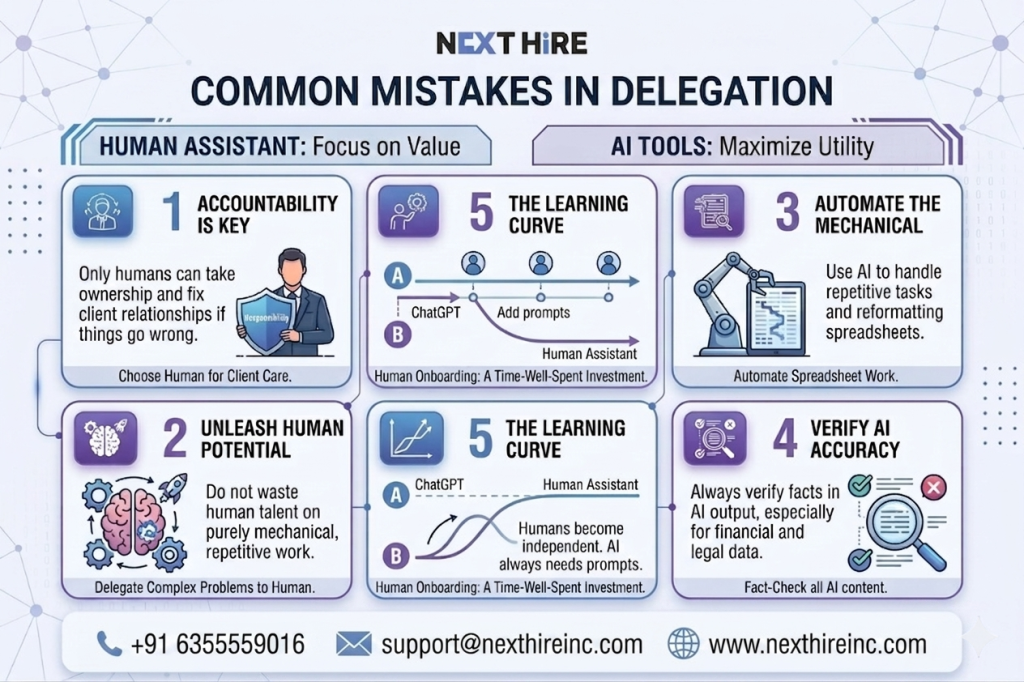
Do not use ChatGPT for tasks that require accountability. If something goes wrong with an AI-generated response to a client, there is no one to hold responsible and no one who can proactively fix the relationship. A human assistant takes ownership.
Do not hire a human assistant for tasks that are purely mechanical. If someone is spending three hours a day reformatting spreadsheets or rewriting the same type of email with minor changes, that is a waste of human talent. Automate those tasks and let your assistant focus on work that actually requires a brain.
Do not assume ChatGPT output is always accurate. It generates plausible-sounding text, but it can and does produce incorrect information. Always verify facts, especially for client-facing content, financial data, or anything with legal implications.
Do not undervalue the learning curve. Getting good output from ChatGPT requires skill in writing prompts. Getting good output from a human assistant requires proper onboarding and communication. Both require an investment of your time upfront, but the human assistant becomes more independent over time, while ChatGPT will always need your prompts.
The Bottom Line
The debate around ChatGPT vs human virtual assistant is not really about which one is better in absolute terms. It is about which one is better for your specific needs at your specific stage of business.
ChatGPT is an incredible tool. It saves time, reduces costs for certain tasks, and gives every business owner access to capabilities that would have been unimaginable a few years ago. As an ai virtual assistant for small business use, it is a solid addition to your toolkit.
But it is not a replacement for human support. Not yet, and likely not for a long time. The businesses that thrive are the ones that understand this distinction and build their support systems accordingly.
If you are looking for reliable, experienced virtual assistant services for small businesses that can work alongside AI tools to give you the best of both worlds, the team at nexthireinc.com is built for exactly that. Real people, real accountability, and a genuine understanding of what small businesses need to grow without burning out.
The question is not whether you need AI or human support. The question is how you combine them to build something that actually works.