


Your Shopify store needs work done — a redesign, a broken integration fixed, a full rebuild. You’re stuck choosing between a freelance Shopify developer and an agency.
Both can do the job well. Both can also waste your budget if you pick wrong for your situation. Here’s how to make the call, with real 2026 numbers and the option most comparisons leave out.
Key Takeaways
- A freelancer usually makes sense under $500K/year in revenue or under 10 hours/week of dev work; an agency earns its cost once you’re past 40 hours/month or juggling multiple disciplines at once.
- Freelancer rates run $50–$200/hour with $2K–$15K project pricing; agency retainers run $5K–$20K+/month, with full builds hitting $15K–$200K+.
- The biggest cost isn’t the hourly rate — it’s what happens when a freelancer disappears mid-project or an agency buries a small task in process. Structure your hire to avoid both.
What “Freelancer” and “Agency” Actually Mean Here
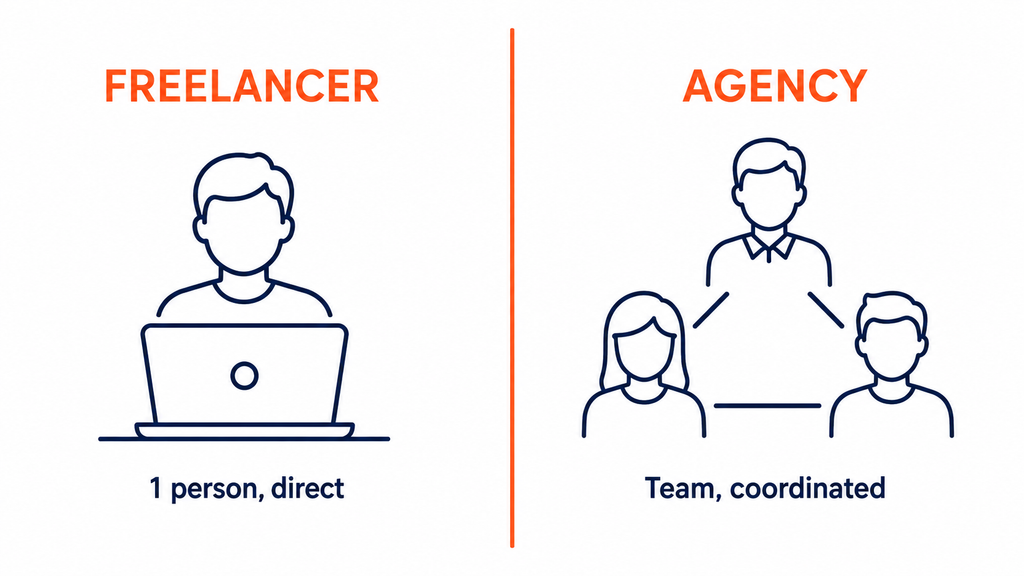
A Shopify freelancer is one person. They code, they communicate, they bill you directly. When they’re busy or sick, nobody backs them up.
A Shopify agency is a team — developers, a project manager, usually QA — working under one contract with built-in redundancy.
Neither label guarantees quality. Some freelancers charge more than agencies and deliver better work. Some “agencies” are three contractors sharing an inbox and a logo.
What matters is whether the delivery model fits your actual workload. Not which one sounds more professional on a discovery call.
Shopify Freelancer vs Agency: What It Actually Costs
Rates vary by region and experience, but 2026 market data gives a fairly consistent picture across the space.
Freelancer Pricing
- General hourly: $50–$100/hour
- Senior / Shopify Plus specialist: $100–$200/hour
- Monthly retainer (20–40 hours): $2,000–$5,000/month
- Single project or integration: $2,000–$15,000
Agency Pricing
- Boutique retainer: $5,000–$10,000/month, usually 1–2 developers
- Mid-market retainer: $10,000–$20,000/month, 2–4 developers
- Full build or migration: $15,000–$200,000+, depending on scope
The gap looks huge on paper. It shrinks in practice.
A freelancer who underbid a complex job and hits scope creep can end up costing more than the agency quote you passed on.
An agency’s rate already includes the project management and QA a freelancer either skips or bills separately once things get messy.
Price matters, but the cheapest hourly rate does not always produce the lowest total project cost. Scope, developer experience, project complexity, management overhead, and the amount of ongoing support you need can change the final number significantly.
If budget is a major part of your decision, see our complete Shopify developer cost guide for a more detailed breakdown of hourly rates, project pricing, dedicated hiring, and the factors that affect what you ultimately pay.
Where Each Option Actually Wins
Freelancers Win On Speed and Direct Access
You’re talking to the person doing the work. No account manager relaying your feedback, no status deck before a two-line fix ships.
For a well-defined task — a theme tweak, a specific bug, a single app integration — a good freelancer beats an agency on speed and price, usually by a wide margin.
Freelancers also tend to specialize narrowly. Someone who’s rebuilt fifty custom checkout flows knows edge cases an agency generalist hasn’t hit yet.
That depth is real value when your problem matches their exact niche. It’s also why some solo Shopify developers charge more than small agencies and still stay booked out for weeks.
Agencies Win On Redundancy and Multi-Discipline Work
When your “quick” fix turns out to need design, development, and QA at once, an agency absorbs that. You don’t have to find and coordinate three separate people yourself.
If a developer leaves the agency mid-project, someone else picks up documented work. Your project doesn’t stall while you post a new listing and re-explain your store from scratch.
That structure matters most for platform migrations, full redesigns, or anything touching multiple systems at once. One person juggling data migration, SEO preservation, and integration rebuilding simultaneously is a real risk on a store that’s actually generating revenue.
There’s no one to catch the mistake before it goes live.
When to Hire a Freelancer
- Your store does under $500K/year in revenue
- Dev work is occasional — under 10 hours/week on average
- The task is well-scoped and contained to one discipline (design OR development, not both)
- You or someone on your team can review the deliverable and catch mistakes
- You’re testing a new concept and need something functional, not perfect
When to Hire an Agency
- You need 40+ hours/month of consistent development support
- The project spans design, development, and QA together
- You’re doing a migration, a full rebuild, or a Shopify Plus build
- You want accountability and a backup plan if one person is unavailable
- Downtime or bugs cost you real money, not just inconvenience
There’s a useful rule of thumb here: the break-even point between paying for outside help and going in-house sits around 60 hours of consistent monthly work.
Below that, a freelancer or agency retainer is cheaper. Above it, the math starts favoring a full-time hire instead.

The Risk Nobody Prices In
Freelancer contracts fail quietly. They go dark mid-project, get a full-time offer, or simply get busier than they expected.
Picture the common version of this: a founder hires a freelancer for $2,500 to rebuild a broken checkout flow and pays half upfront. Three weeks later, the developer stops responding.
No documentation. No repo access. A half-finished theme. The “cheap” fix turns into a $6,000 rescue job with a different developer who has to reverse-engineer the mess first.
Agencies fail differently. Everything routes through a project manager, so a two-minute question turns into a scheduled call and a scope-change document.
For complex work, that process protects you from the exact scenario above. For a simple task, it just slows you down and adds cost you didn’t need to pay.
Red Flags Worth Screening For
With a freelancer: immediately available with zero waiting list, no contract or written terms, reluctant to share references, and a quote that’s suspiciously low for the scope you described.
With an agency: can’t tell you who specifically will work on your account, no post-launch support mentioned, and every answer to a direct question is “it depends” with no framework behind it.
The Option Most Comparisons Skip
Most “freelancer vs agency” breakdowns stop there, as if those are the only two doors. They’re not.
A dedicated remote developer — hired through a vetted platform instead of a marketplace gamble — gives you a lot of what both sides promise, without either one’s downside.
You get direct communication, like a freelancer. No account manager, no telephone game between you and the person writing the code.
But you’re not gambling on one person’s availability. The hire comes vetted upfront, with support built into how the engagement is structured from day one.
You also skip the agency markup that pays for account managers and sales layers you’ll never actually talk to.
What you’re paying for is the development work itself, at a flat monthly cost instead of a rate card designed to obscure what you’re really being billed for.
It’s a reasonable middle ground if you’ve been burned by an inconsistent freelancer, or you’re not ready for a $10K/month agency retainer.
You can see how that’s played out for other founders on our testimonials page.
How to Actually Decide
Don’t start with budget. Start with your workload.
Write down how many hours of Shopify work you actually need in a typical month, and whether it touches one discipline or several. That number tells you more than any hourly rate comparison will.
If the answer is “occasional, well-defined, one discipline” — hire a freelancer. Just don’t pay everything upfront, and keep admin access to your own store no matter how trustworthy they seem.
If it’s “consistent, multi-discipline, high-stakes” — an agency’s overhead is buying you real protection, not just polish you don’t need.
And if you’re somewhere in between — enough recurring work to want reliability, not enough to justify agency pricing — a dedicated developer hire is worth a look before you sign either contract.
Whichever hiring model you choose, evaluate technical fit before comparing proposals on price alone. Theme work may require strong Liquid, HTML, CSS, and JavaScript knowledge, while custom apps, integrations, Shopify Plus, or headless projects can require deeper API, application-development, performance, and deployment experience.
Use our Shopify developer skills checklist to identify the technical capabilities you should look for before interviewing or hiring someone for your store.
Bottom Line
The right choice depends less on whether freelancers or agencies are universally better and more on the type of Shopify work you need completed. A defined one-time task may suit a freelancer, a complex multi-discipline project may justify an agency, and recurring development work often benefits from a developer who can stay familiar with your store over time.
If you already know you need ongoing Shopify development capacity, you can hire Shopify developers through NextHire for theme development, custom functionality, apps, integrations, migrations, optimization, maintenance, and recurring ecommerce development work.