

If you are asking are Google Ads worth it for small business, the answer depends less on Google and more on your economics. A campaign can generate clicks quickly and still lose money if your margins, conversion rate, or sales process cannot support the acquisition cost.
The useful question is: how much can you afford to pay for a customer or qualified lead, and can Google Ads acquire them below that number?
Key Takeaways
- Google Ads make sense when your allowable customer acquisition cost is higher than the cost the campaign can realistically produce.
- Strong intent, healthy margins, a focused landing page, and accurate conversion tracking matter more than chasing cheap clicks.
- A small budget is not automatically a problem, but it must be large enough to buy meaningful traffic and produce enough conversions to evaluate.
Are Google Ads Worth It for Small Business? Start With the Math
Google Ads is an auction. You pay to compete for attention from people searching for products, services, or solutions. Whether that traffic is profitable depends on what happens after the click.
That is why Google Ads ROI should be evaluated against profit, not traffic volume. Google recommends measuring conversions because they connect ad interactions to valuable actions such as purchases, calls, or form submissions and help evaluate ROI.
Step 1: Calculate Your Maximum Profitable CPA
For an ecommerce business, start with contribution margin per new customer.
Suppose:
- Average order value: $250
- Gross margin: 50%
- Gross profit before ad spend: $125
- Desired profit after advertising: $50
Your maximum target cost per acquisition is roughly $75.
If Google Ads consistently acquires customers below $75, the campaign may be economically viable. If it costs $140 to acquire a customer, increasing the budget only increases the loss.
For recurring-revenue businesses, use expected customer value carefully. Do not justify an expensive acquisition cost with lifetime value unless retention data supports it.
Step 2: Translate CPA Into a Maximum CPC
Your website conversion rate determines how much you can afford to pay for a click.
A simple planning formula is:
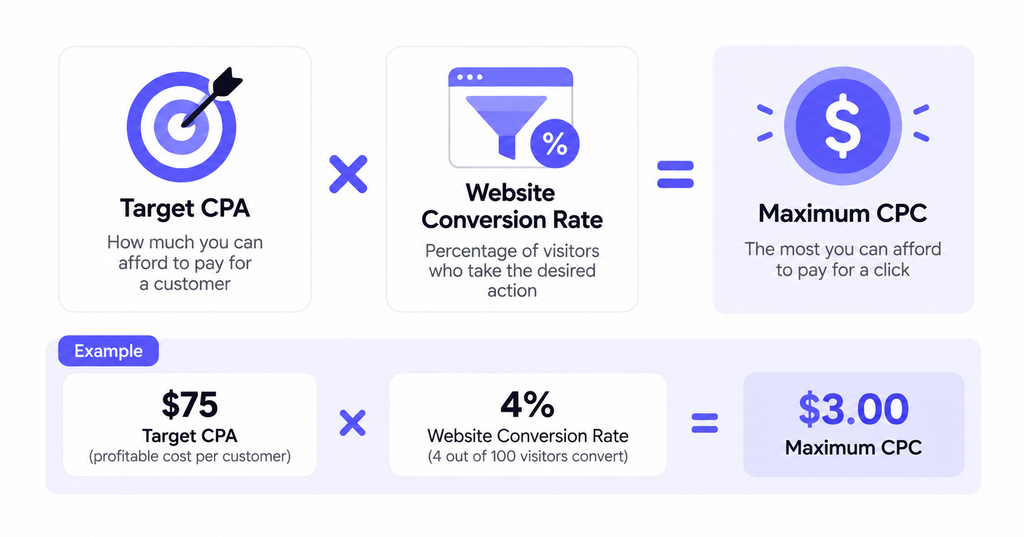
Maximum CPC = Target CPA × Website Conversion Rate
If your target CPA is $75 and your landing page converts 4% of paid visitors, your estimated maximum CPC is $3.
It gives you a rough economic boundary for planning.
Step 3: For Lead Generation, Calculate What a Lead Is Worth
Lead generation needs one extra step because a form submission is not revenue.
Suppose:
- 20% of qualified leads become customers
- Each new customer contributes $1,500 in gross profit
- Expected gross profit per lead is $300
- You want to keep at least $100 after advertising
Your target cost per lead is $200 or less.
If your landing page converts 10% of clicks into qualified leads, a $20 CPC could still work mathematically. A $5 click is not automatically cheap, and a $20 click is not automatically expensive.
When Are Google Ads Worth It?
The economics of Google Ads for small business owners are usually strongest when several conditions are true at the same time.
1. People Already Search for What You Sell
Search advertising works best when demand already exists.
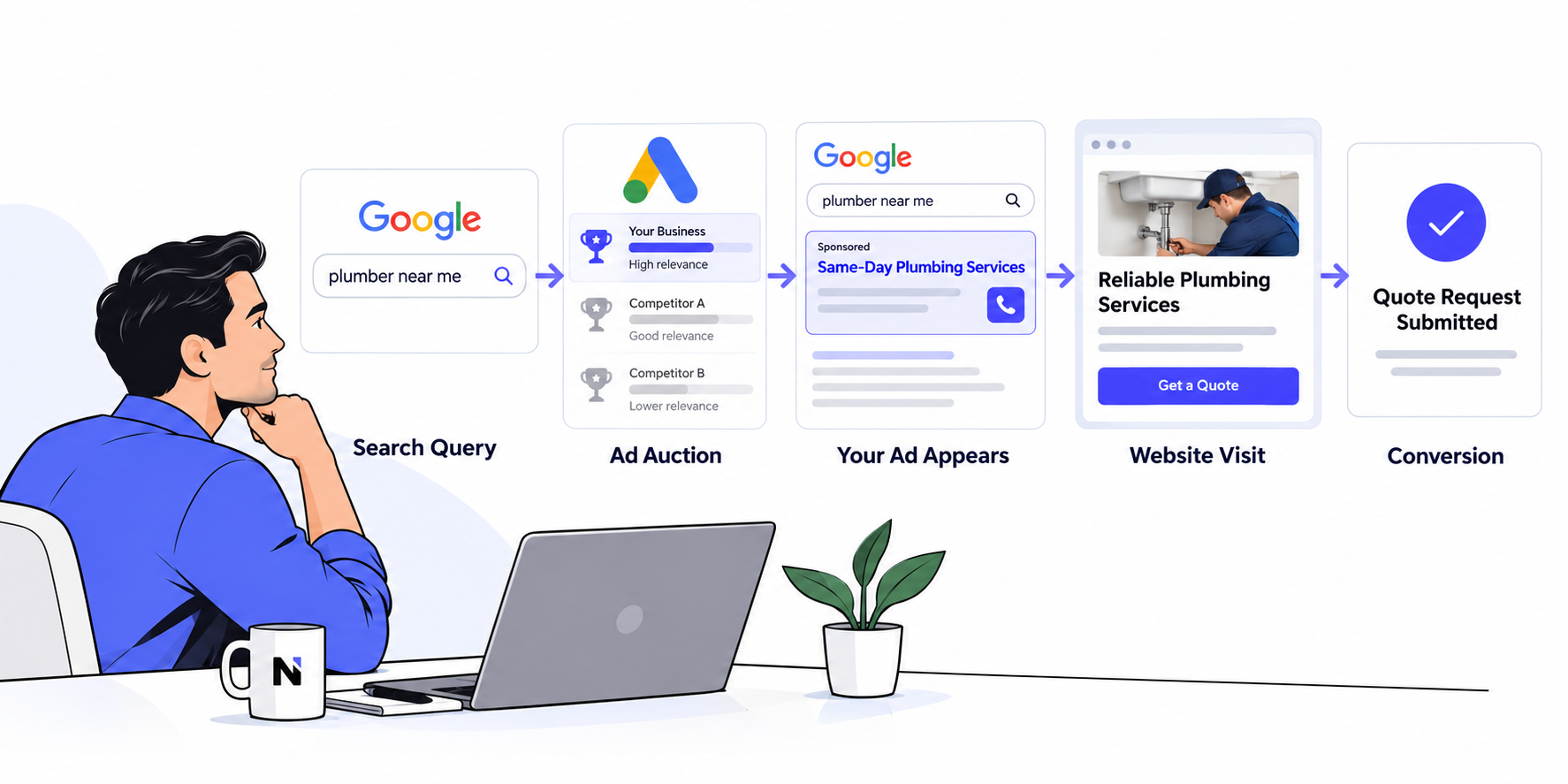
A local plumber can target emergency plumbing searches. A B2B software company can target buyers searching for a specific solution.
Use Keyword Planner or another keyword research tool to check search demand and estimated costs before launching. Google says Keyword Planner can show search estimates and estimated targeting costs, while actual performance still depends on factors such as bids, budgets, ad quality, targeting, and customer behavior.
2. Your Margins Can Absorb Paid Acquisition
Low-margin businesses have less room for error.
If you make $30 in gross profit from a new customer, a $40 acquisition cost is not sustainable unless repeat purchases create enough additional profit.
Higher-value services can often tolerate a higher CPC because one closed customer may be worth thousands of dollars.
This is why asking are Google Ads worth it without knowing customer economics misses the key variable.
3. Your Landing Page Can Convert Intent
Buying the right click is only half the job.
If the landing page is slow, confusing, generic, or asks visitors to take too many steps, you can lose high-intent traffic after paying for it.
The page should match the keyword, explain the offer quickly, reduce obvious objections, and make the next action clear.
4. You Can Track Revenue or Qualified Leads
Do not optimize around clicks if your goal is sales.
Track the actions that matter: purchases, booked calls, qualified form submissions, phone calls, or another measurable business outcome.
Google’s conversion measurement guidance explains that conversion data can show which keywords, ads, ad groups, and campaigns drive valuable activity. It also supports automated bidding toward business goals.
5. Your Budget Can Generate Enough Data
There is no universal minimum Google Ads budget. The useful number depends on expected CPC and the clicks or conversions needed to make a decision.
Imagine your expected CPC is $4 and you want roughly 400 clicks for an initial test. That would require about $1,600 in media spend. If your expected CPC is $12, the same click volume would require $4,800.
Those figures are examples, not benchmarks. The point is to budget from the economics of your market instead of choosing a round monthly number first.
6. Someone Will Actively Manage the Account
Google Ads is not a one-time setup.
Search terms need review. Negative keywords need attention. Ads need testing. Landing pages need improvement. Conversion tracking needs validation.
Smart Bidding can automate auction-level bids, but it still depends on accurate conversion data and clear business goals. Google describes Smart Bidding as using AI to optimize for conversions or conversion value in each auction.
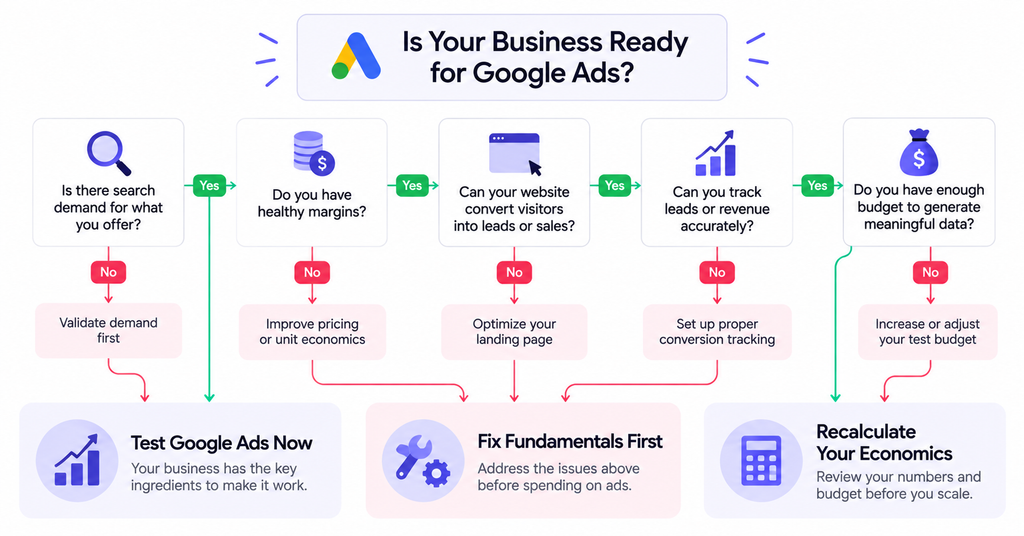
When Google Ads Are Probably Not Worth It Yet
Sometimes the right answer to is Google Ads worth it is “not yet.”
The problem may be the economics or funnel, not the platform.
| Situation | Why it is risky | What to fix first |
| You do not know your margin or customer value | You cannot define a profitable CPA | Calculate contribution margin and customer economics |
| Your offer has little search demand | There may not be enough high-intent traffic to capture | Validate demand and consider other channels |
| Your website does not convert | Paid traffic exposes the weakness faster | Improve the landing page and offer |
| You cannot track leads or sales | You cannot separate profitable traffic from waste | Set up conversion tracking |
| Your sales team rarely closes leads | A low CPL can still produce an expensive customer | Improve lead qualification and sales follow-up |
| Your test budget buys very few clicks | Results may be too noisy to judge | Narrow targeting or increase the test budget |
How to Set a Google Ads Budget From Business Economics
Do not start with “What should I spend per month?”
Start with three numbers:
- How much can I profitably pay for a customer?
- What percentage of leads become customers?
- What percentage of clicks become qualified leads or sales?
From there, work backward.
For an ecommerce store, you can estimate target CPA from contribution margin, then estimate allowable CPC from website conversion rate.
For a service business, calculate expected profit per qualified lead from close rate and profit per customer. Then set a target CPL below that value.
This creates a budget tied to outcomes.
For example, if your target CPL is $120 and you want 20 qualified leads, you can plan around a $2,400 acquisition budget. If the actual campaign needs $220 per qualified lead, you have a clear signal that something must change.
A bigger budget does not repair bad unit economics. It only produces the same problem at a larger scale.
What Metrics Should a Small Business Watch?
Clicks and impressions are diagnostic metrics, but profitability depends on the sequence from click to cash.
Cost per Qualified Lead or Sale
This tells you what the campaign pays to create the outcome you actually value.
For lead generation, avoid treating every form submission as equal. Spam, job seekers, students, and poorly matched prospects can make reported conversion volume look better than business performance.
Lead-to-Customer Rate
If marketing delivers 50 leads and sales closes one, your real acquisition cost may be far higher than the Google Ads dashboard suggests.
Track leads through the CRM when possible.
Conversion Value and ROAS
For ecommerce, conversion value and return on ad spend can help compare campaigns.
But revenue ROAS is not the same as profit. A 4:1 ROAS may be excellent for a high-margin product and weak for a product with heavy fulfillment, discounting, or return costs.
Search Terms
Search terms show what people actually typed before clicking.
Review them to find irrelevant queries, new negative keywords, and high-intent searches worth separating into tighter ad groups or campaigns.
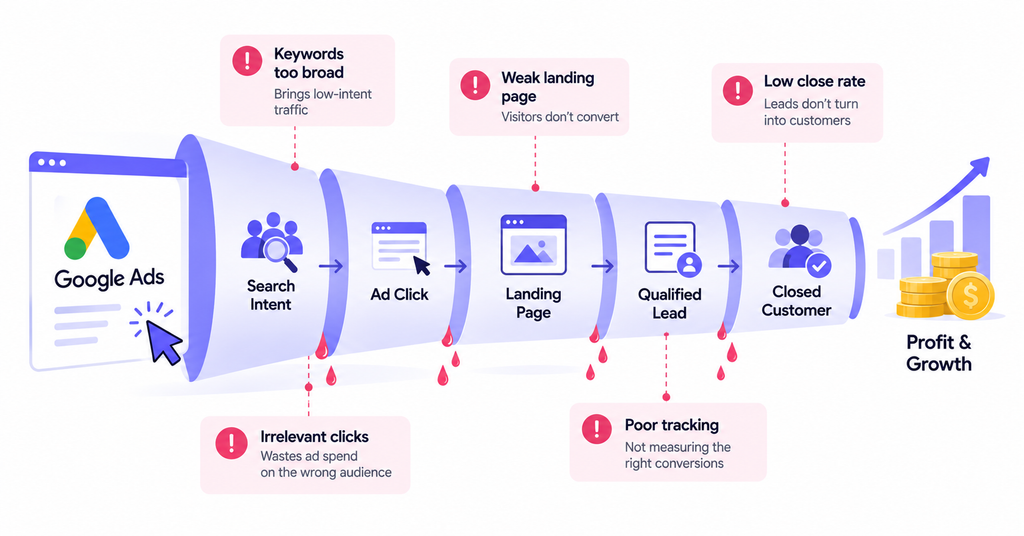
Common Reasons Small Businesses Waste Money on Google Ads
Targeting Keywords That Are Too Broad
Broad traffic can look impressive while producing weak buying intent.
Start close to the bottom of the funnel. Expand after you know which queries generate qualified leads or sales.
Sending Every Ad to the Homepage
A homepage serves many audiences. A paid landing page should usually serve one search intent.
The tighter the message match between keyword, ad, and landing page, the easier it is for the visitor to understand what to do next.
Optimizing for the Wrong Conversion
A button click is not equal to a booked call. A form submission is not equal to a qualified opportunity.
Choose primary conversions that reflect real business value.
Making Decisions From Too Little Data
Three clicks do not prove a keyword is bad. One sale does not prove a campaign is scalable.
Use enough data to separate a pattern from random variation, while still cutting obvious irrelevant spend quickly.
Scaling Before Fixing the Funnel
If a campaign is barely breaking even, doubling the budget does not automatically improve efficiency.
First determine whether the constraint is targeting, CPC, landing-page conversion, lead quality, close rate, margin, or customer value.
So, Are Google Ads Worth It for a Small Business?
They can be, but only when the numbers work. The platform gives you access to existing search demand. It does not fix a weak offer, poor margins, a low-converting website, or an ineffective sales process.
Before increasing spend, calculate your target CPA or CPL, estimate your maximum CPC, confirm demand, and make sure conversion tracking reaches the business outcome that matters.
If those numbers support paid acquisition and you need experienced campaign execution, you can hire a Google Ads expert to build, measure, and optimize around profitable customer acquisition instead of raw click volume.
Frequently Asked Questions
Are Google Ads Worth It for a Very Small Business?
They can be. A small business needs focused targeting, clear unit economics, and enough budget to collect meaningful data. Business size matters less than whether the cost of acquiring a customer leaves acceptable profit.
Is $500 Enough for Google Ads?
It depends on CPC and your goal. At a $2 CPC, $500 buys roughly 250 clicks. At a $20 CPC, it buys about 25. Judge the budget by the amount of useful data and conversions it can realistically produce.
How Do I Know if My Google Ads Are Profitable?
Track revenue or qualified leads, then compare acquisition cost with contribution margin or expected customer value. For lead generation, include the percentage of leads that become paying customers.
Should I Stop Google Ads if the First Results Are Poor?
Not automatically. First check search terms, conversion tracking, landing-page performance, lead quality, and sales follow-up. Stop or restructure when the economics remain unattractive after obvious tracking and funnel problems are corrected.