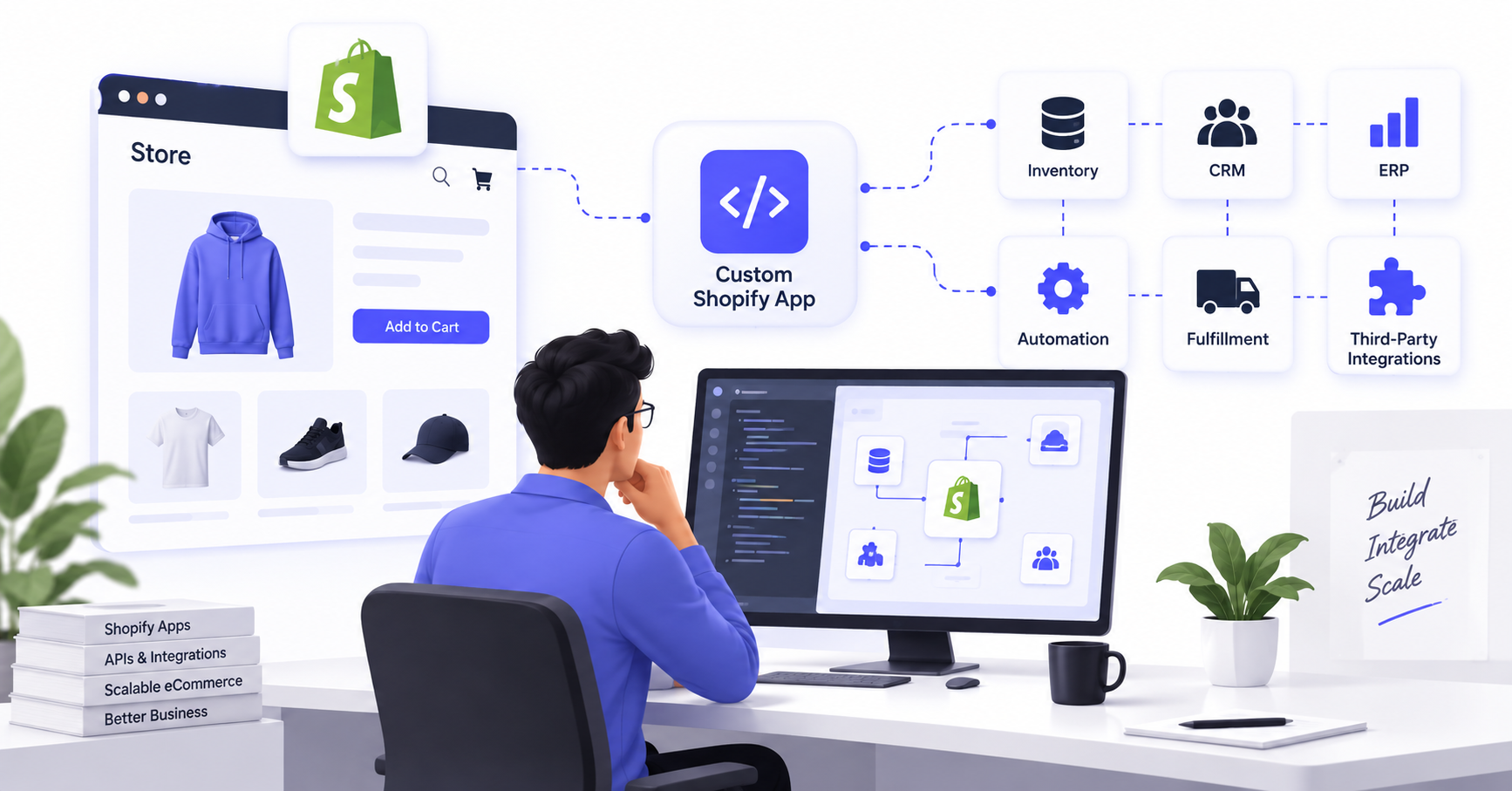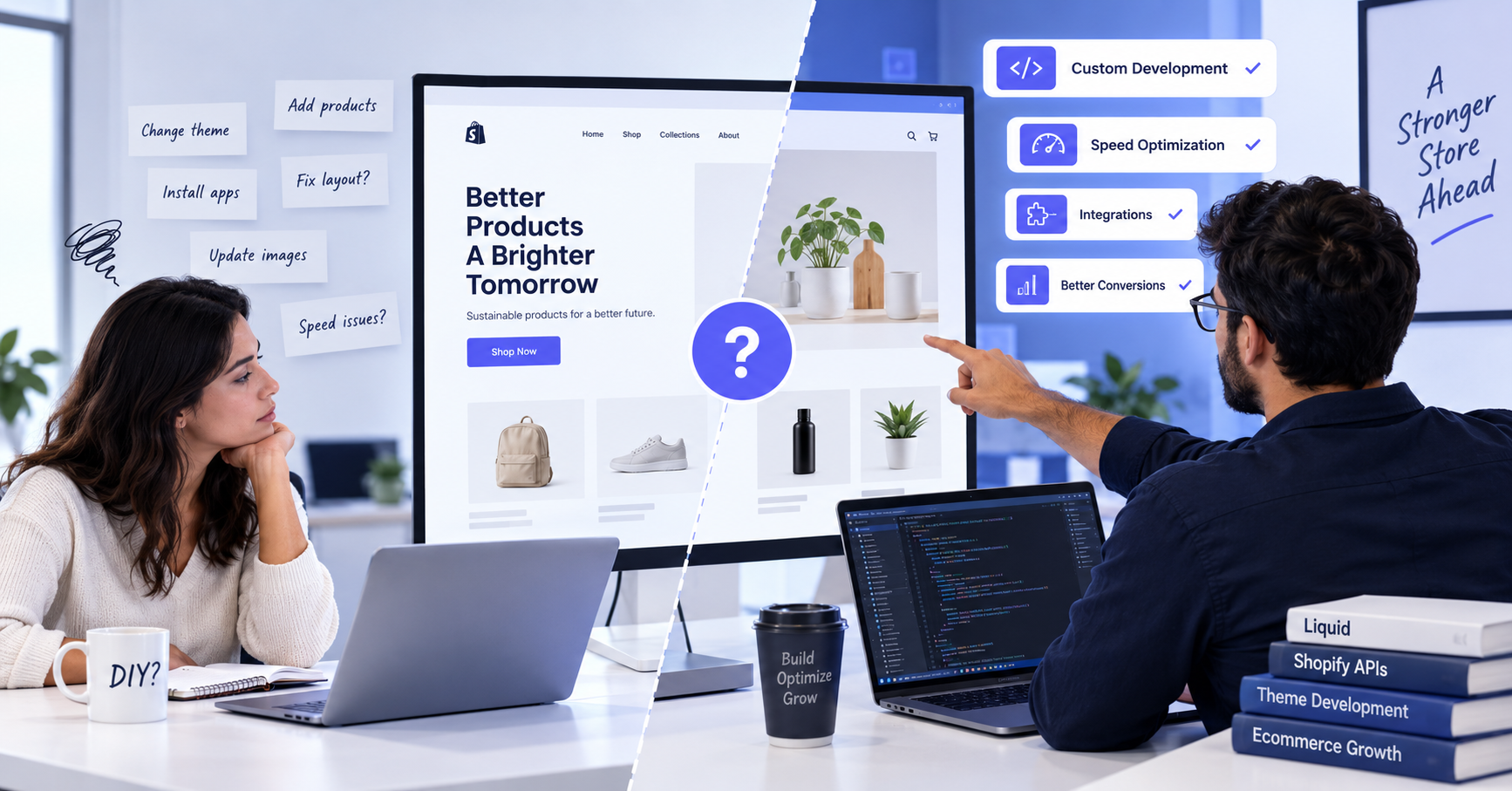


A custom Shopify app developer is worth considering when your store has a business requirement that existing apps, Shopify Flow, or normal theme customization cannot handle cleanly. The goal is not to add more software. It is to remove friction, connect systems, or create functionality that supports revenue.
The difficult part is knowing when the problem is truly custom. This guide explains the strongest signals, the cheaper alternatives to check first, what a developer should handle, and how to decide whether custom Shopify app development is justified.
Key Takeaways
- Hire a custom Shopify app developer when standard apps cannot support a critical workflow, integration, pricing rule, or customer experience without costly workarounds.
- Check existing apps, Shopify Flow, theme customization, and standard connectors before paying for a custom build.
- Treat the app as an ongoing business system. Scope, integrations, testing, security, deployment, and maintenance all affect its long-term value.
What Does a Custom Shopify App Developer Actually Build?
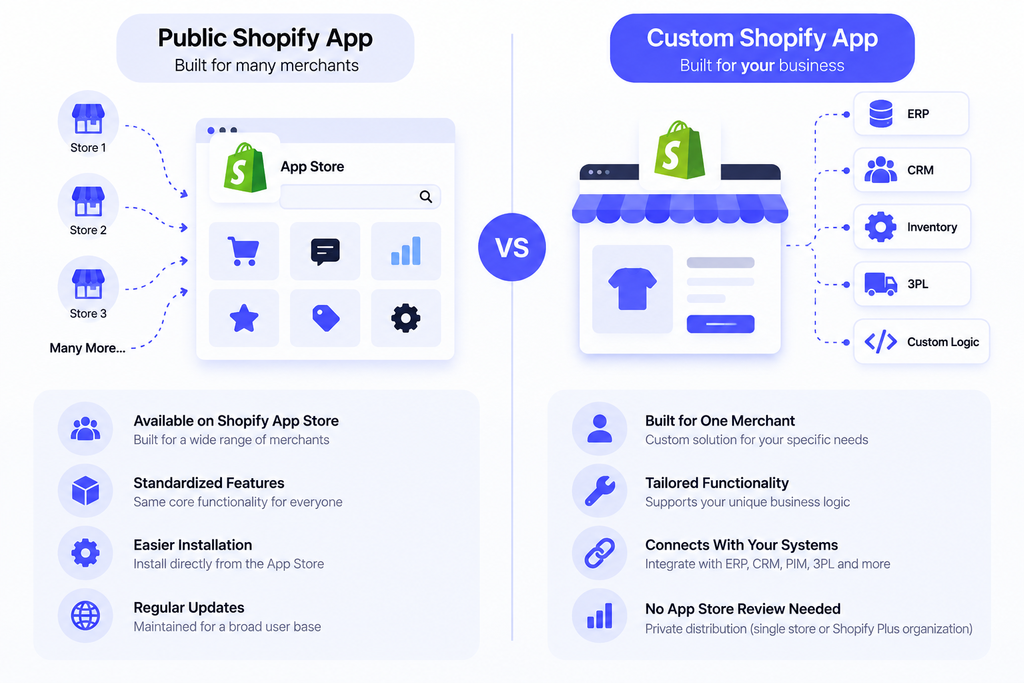
A custom Shopify app is built for a specific merchant rather than for broad App Store distribution. It can add admin functionality, connect Shopify to another business system, automate rules, or extend how a storefront works. Shopify describes custom apps as apps built exclusively for a merchant’s store.
Shopify’s current distribution model matters. A custom-distribution app can be installed on one store, or across stores in the same Shopify Plus organization, without the public App Store review process. New custom apps are managed through Shopify’s Dev Dashboard rather than being created directly in the Shopify admin.
That makes custom development useful for requirements such as ERP synchronization, wholesale pricing, approval workflows, product configurators, fulfillment rules, internal tools, or private integrations.
A good Shopify app developer should not jump straight into coding. They should translate the business problem into the smallest reliable solution that fits Shopify’s APIs, permissions, platform limits, and maintenance requirements.
6 Signs Your Store Needs Custom Shopify App Development
Not every inconvenience deserves a custom build. These signals make a stronger business case.
1. Existing Apps Almost Solve the Problem
You find an app that handles most of the workflow, but your team still depends on spreadsheets, exports, duplicate entry, or manual fixes.
If the missing functionality affects a core process, another subscription may add complexity instead of solving it. This is where a purpose-built app starts becoming more reasonable.
2. Shopify Must Connect With an ERP, CRM, PIM, or 3PL
Standard connectors work when both systems use predictable data and workflows. A custom integration becomes more useful when you need unusual field mapping, real-time synchronization, business-specific rules, approval steps, or custom error handling.
This is one of the clearest use cases for a Shopify app developer for custom integrations.
Shopify’s APIs allow custom apps to access store data and extend Shopify into other systems, which is why custom integrations are a common use case.
3. Manual Work Is Growing With Revenue
Growth should not require a matching increase in repetitive admin work.
If employees repeatedly check orders, assign tags, calculate special prices, approve wholesale accounts, copy customer data, or reconcile inventory, automation may have real ROI.
Frequency matters. A monthly inconvenience rarely justifies custom software. A task repeated hundreds of times can.
4. Your B2B or Pricing Logic Is Too Specific
Wholesale stores may need rules based on customer type, contract pricing, region, volume, minimum quantity, payment terms, or approval status.
If your team is forcing these rules into spreadsheets or correcting orders manually, a custom app can centralize the logic.
Shopify Plus custom app development can also be relevant when complex workflows need to work across stores within the same Plus organization. Shopify’s current custom-distribution model supports installation across stores belonging to one Plus organization.
5. You Need a Customer Experience Competitors Cannot Buy Off the Shelf
Some requirements are part of the product experience itself.
Examples include custom product builders, quoting tools, compatibility checkers, specialized bundles, account portals, or interfaces connected to proprietary data.
If the feature has a measurable effect on conversion, retention, or average order value, owning the functionality can be more valuable than stitching together several generic apps.
6. Your App Stack Has Become a Workaround
Several apps may touch the same data, create overlapping automations, or add conflicting logic. A custom solution can sometimes replace multiple narrow tools with one controlled workflow.
That does not automatically make it cheaper. The advantage is clearer ownership, fewer dependencies, and functionality designed around how your business actually operates.
When You Probably Do Not Need a Custom Shopify App Developer
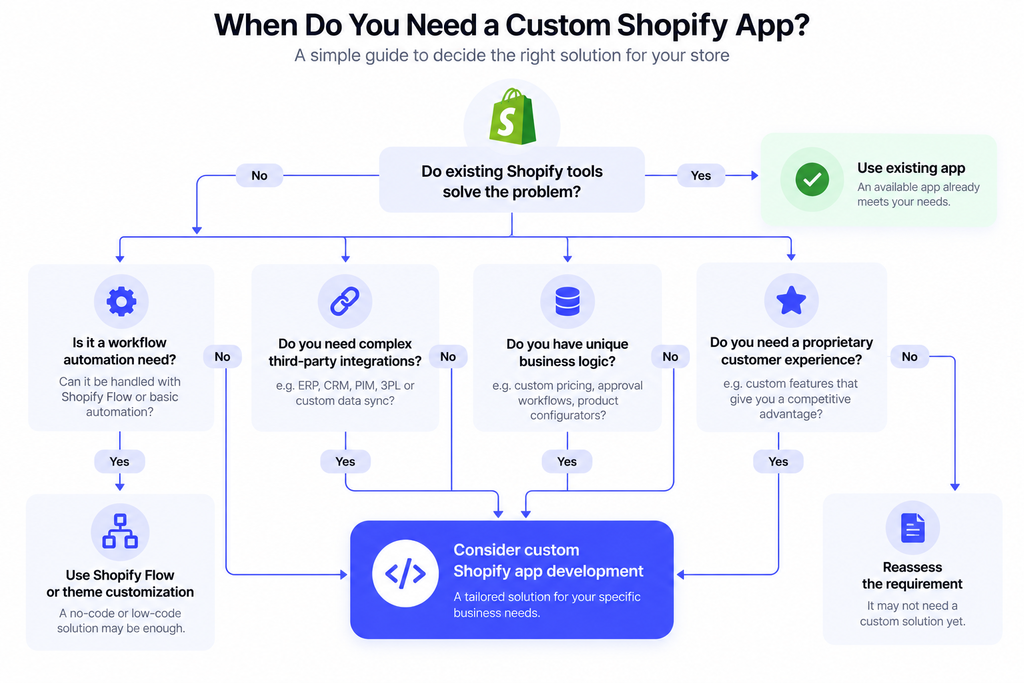
Custom development is usually the wrong first move when an existing solution already handles the requirement well.
Start with an established Shopify app for common needs such as reviews, standard subscriptions, basic loyalty, email marketing, or routine reporting.
Shopify Flow may cover workflow automation. Theme changes can solve many storefront presentation issues. Standard connectors can handle straightforward data movement.
Use custom development when the limitation has measurable operational or revenue consequences, not simply because you want to avoid another monthly app fee.
| Requirement | Start With | Consider Custom Development When |
| Common ecommerce feature | Existing Shopify app | Apps miss critical business rules |
| Repetitive admin task | Shopify Flow | Logic needs custom data or complex decisions |
| Storefront change | Theme customization | Feature requires app logic or external systems |
| System connection | Existing connector | Mapping or workflow is unique |
| Proprietary feature | Prototype | Feature supports meaningful business advantage |
How to Decide If a Custom App Is Worth the Investment
Do not judge the project only by development cost. Compare the build against the cost of leaving the problem unsolved.
Calculate the monthly hours spent on the current process. Add app subscriptions, error correction, delayed fulfillment, extra support work, and any headcount required because the workflow does not scale.
Then compare that with discovery, development, testing, deployment, and ongoing maintenance.
Annual problem cost = labor + software + errors + lost opportunities
First-year app cost = discovery + build + testing + deployment + maintenance
The business case gets stronger when the problem cost rises with store growth while the custom solution removes a large portion of that cost.
Scope discipline matters too. A developer who proposes a focused first version around the highest-value workflow may deliver more ROI than someone who immediately turns the project into a large platform rebuild.
What Should a Shopify App Developer Handle?
A production-ready Shopify app development project involves more than building the visible feature.
The developer should define requirements, choose the right Shopify APIs and extensions, configure permissions, map external data, implement authentication, handle failures, test realistic scenarios, and deploy through a controlled process.
For integrations, ask how duplicate records, failed requests, retries, logging, and synchronization errors will be handled. These details often determine whether an app is reliable in daily operations.
Ongoing maintenance also needs an owner. APIs change, connected platforms change, and your own business rules evolve.
Before launch, know who monitors the app, how updates are released, and what happens when a critical workflow fails.
How to Choose the Right Custom Shopify App Developer
Start with relevant Shopify experience, not generic software experience.
Ask candidates about Shopify APIs, webhooks, app extensions, authentication, third-party integrations, and data synchronization.
If the project connects to an ERP, CRM, PIM, marketplace, or 3PL, experience with that system matters too.
A strong developer should also be willing to tell you when a custom app is unnecessary. Ask these questions before hiring:
- What part of this requirement can Shopify handle natively?
- Which APIs, extensions, and external systems will the app depend on?
- What store data and permissions will it require?
- How will failures, retries, and logging work?
- What testing and launch support are included?
- Who maintains the app after deployment?
If you need ongoing development capacity instead of a one-time project, a dedicated developer can be a better fit than repeatedly reopening the work with different freelancers.
You can explore NextHire’s Shopify developer hiring service if you need ongoing custom development, integrations, maintenance, or store-specific technical work.
A Practical Custom Shopify App Development Process
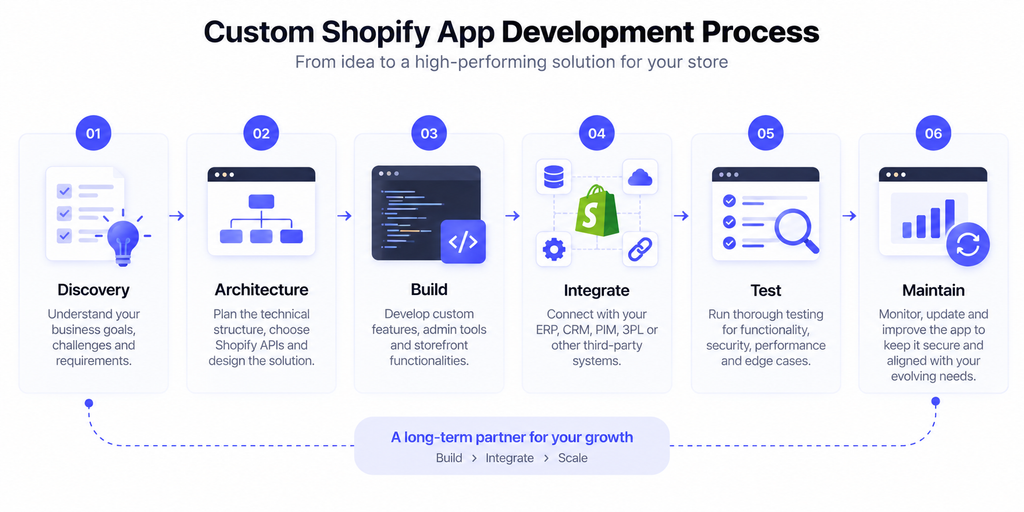
A focused project usually follows six stages.
1. Define the problem. Document the current workflow, users, inputs, outputs, edge cases, and measurable cost.
2. Check existing solutions. Review Shopify apps, Shopify Flow, native features, theme changes, and standard connectors first.
3. Scope version one. Prioritize the smallest feature set that removes the main bottleneck.
4. Build and integrate. Develop the app, connect required systems, configure permissions, and implement business logic.
5. Test realistic scenarios. Use real-world orders, products, customer records, failures, and edge cases before launch.
6. Launch with maintenance ownership. Monitor results, document the system, and assign responsibility for updates.
This process keeps custom Shopify apps tied to a measurable operational outcome instead of a long feature wishlist.
Frequently Asked Questions
What is a custom Shopify app developer?
A custom Shopify app developer builds software for a specific Shopify merchant or organization. The app can automate workflows, integrate external systems, add business logic, or create functionality that standard apps cannot provide.
When should I choose custom development over an App Store app?
Choose custom Shopify app development when existing apps cannot support a critical requirement without significant manual work, conflicting tools, or limitations that affect revenue, operations, or customer experience.
Can a custom Shopify app connect Shopify with an ERP or CRM?
Yes. Custom apps can use Shopify and external APIs to synchronize orders, customers, products, inventory, pricing, fulfillment data, and other business information.
Do custom Shopify apps require ongoing maintenance?
Usually, yes. Shopify APIs, extensions, connected platforms, and business rules change. Maintenance helps keep the app compatible, monitored, secure, and reliable.
Is a custom app only for Shopify Plus stores?
No. Custom apps can serve a single Shopify store. Shopify Plus is particularly relevant when custom distribution needs to support multiple stores within the same Plus organization or more complex enterprise workflows.
Build Custom Only When the Business Case Is Clear
A custom Shopify app should remove a real constraint, not create another technical asset your team has to manage.
Start with the business problem. Test whether an existing app, Shopify Flow, a theme change, or a standard connector can solve it.
If not, and the limitation is costing time, revenue, accuracy, or scalability, custom development becomes a much stronger investment.
If you already know the workflow you need to fix, NextHire can help you hire Shopify developers with the technical depth to build, integrate, and maintain a store-specific solution.