



Making decisions based on gut feelings worked fine when businesses were smaller and markets moved slowly. That’s not the world we live in anymore. Today, companies sit on mountains of data, but most of them don’t know how to turn that data into something useful. That’s exactly where business intelligence consulting steps in.
Whether you’re a growing startup trying to understand your customer base or a mid-sized company struggling with scattered reports and disconnected dashboards, BI consulting can be the bridge between raw data and real, actionable insight.
At NextHire Inc., we’ve seen firsthand how the right talent and strategy can transform how organizations approach data. Let’s break down what business intelligence consulting actually involves, why it matters, and how to find the right partner for your needs.
What Is Business Intelligence Consulting?
Business intelligence consulting is a specialized service where experts help organizations collect, organize, analyze, and visualize their data so that decision-makers can act on it with confidence. It’s not just about installing a tool or building a dashboard. BI consulting covers everything from understanding your current data landscape to designing a strategy that aligns with your business goals.
Think of it this way: you might have Tableau, Power BI, or some other analytics platform already in place. But if your data is messy, your reports are inconsistent, or your teams are pulling numbers from different sources and getting different answers, the tool alone isn’t solving anything. A BI consultant looks at the bigger picture. They assess your data infrastructure, identify gaps, and build a framework that actually works for your organization.
BI consulting isn’t a one-size-fits-all engagement. For some companies, it starts with something as foundational as cleaning up a data warehouse. For others, it’s about building predictive models or creating self-service reporting that empowers non-technical teams to explore data on their own.
The goal is always the same, though: help businesses stop guessing and start knowing.
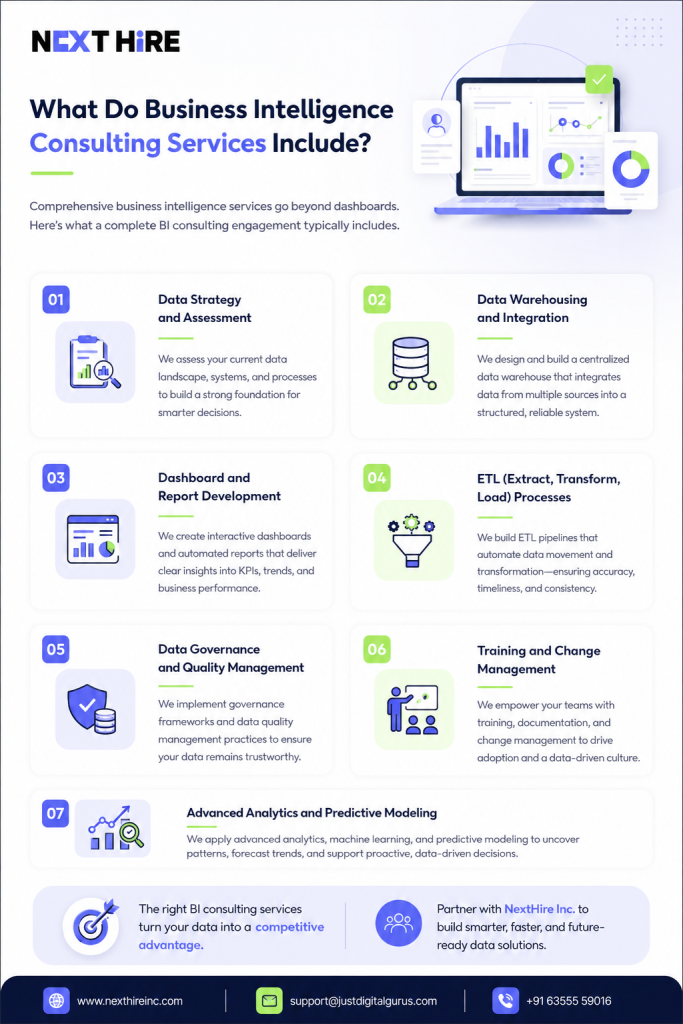
What Do Business Intelligence Consulting Services Include?
When people hear “business intelligence consulting services,” they sometimes imagine someone showing up, building a couple of dashboards, and calling it a day. The reality is much broader than that.
Here’s what comprehensive business intelligence services typically cover:
Data Strategy and Assessment
Before anything gets built, a good consulting engagement starts with understanding where you are. What systems are you using? Where does your data live? Is it clean? Is it accessible? This assessment phase lays the groundwork for everything that follows.
Data Warehousing and Integration
Most companies pull data from multiple sources, whether that’s a CRM, ERP, marketing platforms, financial systems, or even spreadsheets. BI consulting services include designing and building a centralized data warehouse that brings all of this together in a structured, reliable way.
Dashboard and Report Development
This is the part most people think about first. Building interactive dashboards and automated reports that give stakeholders a clear view of KPIs, trends, and performance metrics. But the key difference when a consultant does this versus someone internal is the strategic thinking behind what gets measured and how it’s presented.
ETL (Extract, Transform, Load) Processes
Getting data from point A to point B in a usable format is more complex than it sounds. BI consultants design ETL pipelines that automate this process, ensuring data is accurate, timely, and consistent.
Data Governance and Quality Management
Bad data leads to bad decisions. Business intelligence services often include setting up governance frameworks, establishing data quality rules, and creating processes that keep your data trustworthy over time.
Training and Change Management
A fancy BI system means nothing if nobody uses it. Good consultants train your teams, build documentation, and help manage the cultural shift that comes with becoming a more data-driven organization.
Advanced Analytics and Predictive Modeling
For companies that are further along in their data maturity, consulting services can extend into machine learning, forecasting, and predictive analytics that go beyond descriptive reporting.
The scope of business intelligence consulting services really depends on where your organization is in its data journey and where it wants to go.
Role of a Business Intelligence Consultant
So what does a business intelligence consultant actually do on a day-to-day basis? It’s a role that blends technical skills with business acumen, and honestly, the best consultants are the ones who can speak both languages fluently.
A business intelligence consultant typically:
- Assesses existing data infrastructure and identifies inefficiencies or gaps
- Translates business requirements into technical specifications for BI solutions
- Designs data models and architectures that support reporting and analytics needs
- Builds and optimizes dashboards, reports, and visualizations
- Works with stakeholders across departments to understand what metrics matter most
- Recommends and implements BI tools and platforms suited to the organization’s needs
- Establishes best practices for data management, governance, and security
- Provides training and ongoing support to internal teams
What makes a great BI consultant isn’t just their ability to write SQL queries or design a Power BI dashboard. It’s their ability to listen, understand the business context, and deliver solutions that people actually use. Too many BI projects fail not because the technology was wrong but because the consultant didn’t take the time to understand how the business operates.
At NextHire Inc., when we help companies find business intelligence consultants, we look for that combination of technical depth and communication skills. The best BI talent doesn’t just build things; they explain why those things matter.
Key Benefits of BI Consulting for Businesses
Investing in BI consulting services isn’t cheap, so it’s fair to ask: what’s the actual return? Here are the benefits that consistently show up across industries.
Better Decision-Making, Faster
This is the obvious one, but it’s worth stating clearly. When your leadership team has access to accurate, real-time data presented in a way that’s easy to understand, decisions get made faster and with more confidence. No more waiting a week for someone to pull a report from three different systems.
Operational Efficiency
BI consulting often reveals redundancies and inefficiencies that have been hiding in plain sight. Maybe your sales team is tracking leads in a spreadsheet while your CRM has the same data. Maybe your finance team spends 20 hours a month building reports manually that could be automated. These inefficiencies add up, and BI consulting helps eliminate them.
Revenue Growth and Cost Reduction
When you can see clearly which products are performing, which customer segments are most profitable, and where your marketing dollars are actually working, you can allocate resources more effectively. Business intelligence and consulting together create a feedback loop where data informs strategy and strategy produces measurable results.
Competitive Advantage
Companies that leverage data well tend to outperform those that don’t. BI consulting services give you the infrastructure and insights to spot market trends early, respond to customer behavior in real time, and make strategic moves before your competitors do.
Scalability
A well-designed BI framework grows with your business. Rather than rebuilding your analytics every time you add a new product line or enter a new market, BI consulting sets you up with a scalable foundation that adapts as your needs evolve.
Improved Data Culture
One of the less talked about benefits of BI consulting is the cultural shift it creates. When employees across the organization have access to data and know how to use it, the entire company starts thinking more analytically. That shift has compounding effects over time.
Business Intelligence Implementation Services Explained
There’s a difference between knowing what you need and actually getting it done. That’s where business intelligence implementation services come in. Implementation is the phase where strategy turns into reality.
Here’s what this typically looks like:
Platform Selection and Setup
Based on the strategy and requirements defined earlier, the implementation phase involves selecting the right BI platform (or optimizing the one you already have) and configuring it for your specific use case. This might mean setting up Power BI, Tableau, Looker, Qlik, or another tool depending on your needs and budget.
Data Pipeline Development
Implementation includes building the actual data pipelines that move information from source systems into your data warehouse and from there into your reporting tools. This involves writing ETL processes, setting up automated data refreshes, and handling data transformations.
Dashboard and Report Deployment
The dashboards and reports that were designed during the consulting phase get built, tested, and deployed. This includes making sure they perform well, load quickly, and display accurate information.
Security and Access Controls
Not everyone in your organization should see everything. Implementation services include configuring role-based access, row-level security, and compliance measures to protect sensitive data.
Testing and Validation
Before anything goes live, thorough testing ensures that the data is accurate, the reports are reliable, and the system performs under real-world conditions.
User Onboarding and Training
The final piece of implementation is getting your team up and running. This includes hands-on training, user guides, and sometimes ongoing support during the initial adoption period.
Business intelligence implementation services are where the rubber meets the road. A great strategy with poor implementation is just a PowerPoint deck. The implementation phase is what actually changes how your organization works with data.
Business Intelligence and Data Analytics Services
It’s worth talking about how business intelligence and data analytics services overlap and where they diverge, because the terms get used interchangeably a lot and that creates confusion.
Business intelligence is primarily about understanding what happened and what’s happening now. It’s focused on reporting, dashboards, KPIs, and descriptive analytics. When your CFO wants to see last quarter’s revenue broken down by region, that’s BI at work.
Data analytics goes a step further. It asks why something happened, what might happen next, and what actions should be taken. This includes statistical analysis, predictive modeling, machine learning, and prescriptive analytics.
Business intelligence and analytics services that combine both disciplines give organizations a complete picture. You get the operational reporting you need to run the business day-to-day, plus the deeper analytical capabilities to drive strategic decisions.
For example, a retail company might use BI to track daily sales performance across stores. But with data analytics layered on top, they can predict which products will see increased demand next month and adjust inventory accordingly.
The most effective consulting partners offer both capabilities because one without the other leaves gaps. You don’t want to just know your numbers; you want to know what to do with them.
At NextHire Inc., when we staff business intelligence and data analytics roles, we often see companies looking for professionals who can bridge both worlds. The demand for people who can build a report and also build a predictive model continues to grow.
Power BI Consulting and Reporting Services
Microsoft Power BI has become one of the most widely adopted BI platforms, especially for organizations already invested in the Microsoft ecosystem. And for good reason. It’s powerful, relatively affordable, and integrates seamlessly with tools like Excel, Azure, SharePoint, and Teams.
Power BI consulting services focus on helping organizations get the most out of the platform. This goes well beyond just creating a few charts.
What Power BI Consulting Typically Includes:
- Assessing whether Power BI is the right fit for your organization’s needs
- Designing a Power BI architecture that supports enterprise-level reporting
- Building data models in Power BI that are optimized for performance
- Creating DAX calculations and measures for complex business logic
- Developing interactive dashboards and paginated reports
- Setting up Power BI Service, workspaces, and automated data refreshes
- Configuring row-level security and governance policies
- Integrating Power BI with other data sources and platforms
- Training users on how to build their own reports (self-service BI)
One of the biggest advantages of Power BI is its self-service capability. With the right setup and training, business users can explore data and create their own reports without constantly relying on IT or the analytics team. Power BI consulting services help make that a reality rather than just a promise.
Business intelligence reporting services, whether through Power BI or another tool, are ultimately about making data accessible and meaningful to the people who need it. A well-designed report doesn’t just display numbers; it tells a story and points toward action.
If your organization is already using Power BI but struggling with slow reports, inconsistent data, or low adoption, a Power BI consulting engagement can often solve those problems relatively quickly.
How to Choose Business Intelligence Consulting Companies
Choosing between business intelligence consulting companies isn’t always straightforward. The market is crowded, and most firms say similar things on their websites. Here’s what to actually look for when evaluating potential partners.
Industry Experience
BI needs vary significantly by industry. A consulting firm that’s done great work in healthcare might not understand the nuances of manufacturing or financial services. Look for business intelligence consulting firms that have relevant experience in your sector.
Technical Breadth
Some firms specialize in a single platform. That’s fine if you’ve already committed to that platform, but it can be limiting if you’re still evaluating options. The best consulting companies are platform-agnostic and recommend tools based on your needs, not their preferences.
End-to-End Capabilities
Can the firm handle everything from strategy through implementation and ongoing support? Or do they only do one piece of the puzzle? Working with a partner that covers the full lifecycle reduces friction and ensures consistency.
Proven Track Record
Ask for case studies, references, and examples of past work. Any reputable business intelligence consulting company should be able to show you tangible results they’ve delivered for clients.
Cultural Fit
This one gets overlooked, but it matters. You’ll be working closely with these people, potentially for months. Make sure their communication style, work approach, and values align with your team’s.
Scalability and Flexibility
Your needs today might be different from your needs six months from now. Choose a partner that can scale up or down as your requirements change. Rigid contracts and inflexible engagement models are red flags.
Support and Training
Implementation is just the beginning. What happens after the dashboards are built? A good consulting firm provides ongoing support, maintenance, and training to ensure long-term success.
Talent Quality
At the end of the day, a consulting company is only as good as the people they put on your project. Ask about the qualifications, experience, and certifications of the consultants who will actually be doing the work.
This is one of the areas where NextHire Inc. adds value. We help organizations find and evaluate BI consulting talent and partners, ensuring you get professionals who can actually deliver, not just sell.
When Should You Hire a BI Consulting Company?
Not every company needs external BI consulting. If you have a strong internal analytics team and a well-designed data infrastructure, you might be in good shape. But there are clear signals that indicate it’s time to bring in outside help.
You’re drowning in data but starving for insights. You have data everywhere but no cohesive way to make sense of it. Reports are manual, inconsistent, or take too long to produce.
Your BI tools are underutilized. You invested in a platform like Power BI or Tableau, but adoption is low and nobody’s really using it to its potential.
You’re making major business decisions without data. If leadership is still relying heavily on intuition or outdated spreadsheets for strategic decisions, that’s a clear sign.
Your team lacks specialized skills. BI requires a specific skill set that your current team might not have. Hiring full-time specialists isn’t always practical, especially if the need is temporary or project-based.
You’re going through a digital transformation. If you’re migrating systems, merging with another company, or overhauling your tech stack, BI consulting ensures your data and analytics capabilities don’t fall behind.
You need to scale quickly. Growth is great, but it creates complexity. A business intelligence services company can help you build scalable systems that grow with you.
Compliance and data governance are becoming a concern. As regulations around data privacy increase, having proper governance frameworks becomes essential, not optional.
If any of these situations sound familiar, it’s probably time to have a conversation with a BI consulting company. The cost of inaction, in terms of missed opportunities and poor decisions, often exceeds the cost of bringing in expert help.
How NextHire Inc. Supports Your BI Journey
At NextHire Inc., we understand that business intelligence success depends on having the right people in place. Whether you need a full BI consulting team or a single specialist to fill a critical gap, we connect you with top-tier talent who can drive real results.
Our staffing and consulting approach focuses on understanding your specific needs, your data maturity, your industry, your technology stack, and then matching you with professionals who fit. We don’t just fill positions; we help you build the analytical capabilities your business needs to grow.
If you’re exploring business intelligence consulting or looking to strengthen your data team, reach out to us. Let’s talk about where you are, where you want to be, and how we can help you get there.
Final Thoughts
Business intelligence consulting isn’t a luxury anymore. It’s becoming a necessity for companies that want to compete effectively and make informed decisions at speed. The right BI strategy, tools, and talent can fundamentally change how your organization operates.
But getting it right takes more than just buying software. It takes thoughtful planning, skilled execution, and a commitment to building a culture that values data. Whether you’re just starting your BI journey or looking to take it to the next level, investing in the right consulting support can make all the difference.
The data is there. The question is what you’re going to do with it.



