

A polished resume tells you what a developer has studied. It does not tell you whether that person can enter a real codebase, understand the problem, communicate trade-offs, and ship useful work. If you are figuring out how to hire a software developer, focus on evidence of performance, not just credentials.
This guide shows the technical, practical, and communication signals that separate a job-ready developer from someone who only interviews well.
Key Takeaways
- A job-ready developer should show real project work, explain technical decisions, debug methodically, and collaborate inside an existing workflow.
- Use realistic scenarios instead of relying only on degrees, certifications, years of experience, or trivia-heavy interviews.
- Match your evaluation to the role. Frontend, backend, full-stack, CMS, and mobile developers should not be judged against the same checklist.
What Does “Job-Ready” Mean for a Software Developer?
Job-ready does not mean knowing every framework. It means the developer can contribute useful work with a reasonable amount of onboarding.
For a junior developer, that may mean taking a defined ticket, asking useful questions, using version control correctly, and submitting reviewable code. For a senior developer, it means making sound technical decisions, identifying risks, mentoring others, and owning delivery.
The U.S. Bureau of Labor Statistics projects employment for software developers, QA analysts, and testers to grow 10% from 2025 to 2035, with about 106,100 openings per year on average. Strong evaluation matters because companies are competing for people who can become productive quickly. U.S. Bureau of Labor Statistics occupational outlook
Practical experience can come from internships, freelance work, open source, employment, or hands-on development projects. The source matters less than whether the candidate can explain what they built, what broke, and what they learned.
How to Hire a Software Developer Based on Evidence
A degree or certification can support a candidate’s story. It should not be treated as proof that the person can handle your product.
Look for evidence across technical ability, execution, and teamwork.
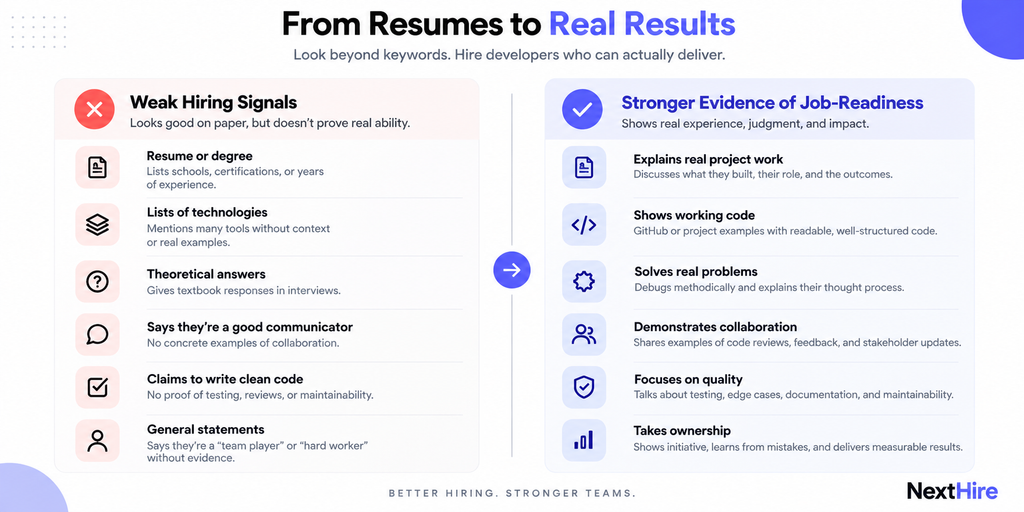
| Hiring signal | Weak evidence | Stronger evidence |
| Technical knowledge | Lists languages | Explains where and why each technology was used |
| Project experience | Shows screenshots | Explains code, architecture, trade-offs, and mistakes |
| Problem solving | Gives textbook answers | Debugs an unfamiliar issue methodically |
| Collaboration | Says “good communicator” | Gives examples of reviews, feedback, and stakeholder updates |
| Quality | Says they write clean code | Discusses tests, edge cases, documentation, and maintainability |
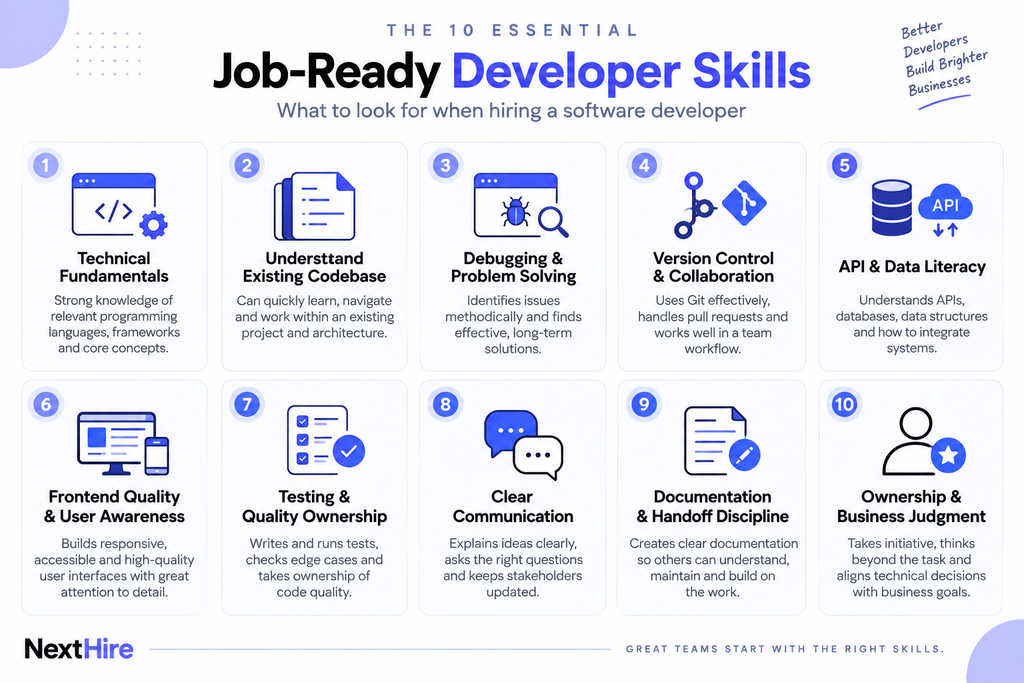
10 Job-Ready Software Developer Skills to Look For
1. Technical Fundamentals That Match the Role
Start with what the person will do in the first 90 days. A frontend role may require JavaScript or TypeScript, responsive UI work, accessibility, and API integration. A backend role may require server-side programming, databases, authentication, API design, and cloud basics.
Exposure to a full-stack development learning path can show breadth, but verify depth. Someone who has touched ten technologies is not automatically stronger than someone who understands four well.
2. Ability to Understand an Existing Codebase
Most business hiring is not greenfield work. Developers often inherit existing architecture, naming conventions, technical debt, and documentation gaps.
Ask how they approach an unfamiliar repository. Strong candidates usually mention running the project locally, reading documentation, tracing key workflows, reviewing recent changes, and asking targeted questions before editing code.
3. Debugging and Problem Solving
Give the candidate a realistic failure: an API returns inconsistent data, a form breaks on mobile, or a feature fails in production.
Watch the process. Do they reproduce the issue, check logs, narrow the scope, form a hypothesis, and test it? Candidates with backend development practice should also be able to explain how requests, application logic, and data stores interact.
4. Version Control and Team Workflow
Knowing Git commands is not enough. A job-ready developer should understand branches, pull requests, merge conflicts, code review, commit quality, and rollback strategy.
Ask how they respond when another developer challenges their implementation. You want someone who improves the team rather than creating unnecessary friction.
5. API and Data Literacy
Even frontend developers regularly interact with APIs and structured data. Candidates should understand requests, responses, authentication, validation, status codes, and error handling.
Backend candidates should go deeper into database design, performance, caching, and service boundaries. Test this with a real integration scenario instead of definitions.
6. Frontend Quality and User Awareness
Frontend work is not only making a page look correct. Production work includes responsive behavior, accessibility, loading states, validation, browser differences, performance, and missing-data scenarios.
Candidates with frontend project experience should be able to explain why they structured an interface a certain way.
7. Testing and Quality Ownership
A developer who considers the task finished as soon as the happy path works can become expensive quickly.
Ask what they check before opening a pull request. Good answers may include unit tests, integration tests, manual edge cases, validation, browser checks, error states, and regression risk.
8. Clear Communication
Remote development makes communication a production skill.
A developer should explain what they are working on, what is blocked, what changed, and what decision needs input. During interviews, notice whether answers are structured and specific. If you repeatedly have to extract basic context, that problem may continue after hiring.
9. Documentation and Handoff Discipline
You are not only paying for code. You are paying for code another person can understand later.
Ask for a README, setup guide, API note, or technical explanation the candidate created. For CMS-heavy work, candidates with WordPress and CMS development exposure should also explain plugin choices, customization, updates, and handoff requirements.
For dedicated CMS work, compare that evidence with what you expect when you hire WordPress developers.
10. Ownership and Business Judgment
The strongest developer is not always the person who writes the most sophisticated code. It is often the person who understands the business goal and chooses an appropriate solution.
Ask about a time they simplified a requirement, caught a risk early, or pushed back on unnecessary complexity. Good developers know that useful, maintainable software matters more than clever code.
How to Test These Skills Before You Hire
You do not need five interview rounds. You need a few high-signal steps.
Review One Real Project Deeply
Ask the candidate to choose a project they know well. Spend 20 to 30 minutes on architecture, responsibilities, difficult bugs, trade-offs, testing, and what they would change today.
Use a Realistic Technical Exercise
A small paid task or structured live exercise is usually more useful than a generic coding puzzle. Ask a frontend candidate to fix a component with validation and responsive issues, or ask a backend candidate to diagnose an API problem.
Add a Communication Check
Give the candidate an intentionally incomplete brief and see whether they clarify assumptions. Then request a short written status update explaining progress, blockers, and next steps.
Review the Output Like Production Work
Look beyond whether the task works. Review naming, structure, tests, error handling, documentation, maintainability, and the candidate’s ability to explain compromises.
Red Flags That a Developer Is Not Job-Ready Yet
Be cautious when someone cannot separate their contribution from the team’s work, cannot explain code they claim to have built, gives confident answers without clarifying requirements, ignores testing, or treats feedback as a threat.
Also watch for candidates who know tools but cannot explain fundamentals. Frameworks change. Developers who understand debugging, HTTP, databases, version control, and software trade-offs can usually adapt faster.
Match the Developer to the Work You Actually Need
“Software developer” is too broad to be a useful hiring specification by itself.
A customer-facing web product may need separate frontend and backend developer strengths. A smaller product may benefit from one full-stack hire. A short, scoped task may suit a freelancer, while an ongoing roadmap may justify a dedicated remote developer.
Write the role around expected outputs for the next three to six months. Then evaluate the skills that influence those outputs.
FAQs About Hiring Job-Ready Software Developers
What Is the Most Important Skill to Look for in a Software Developer?
Problem solving is one of the most transferable skills. Languages change, but a developer who can understand requirements, isolate problems, evaluate trade-offs, and communicate decisions can adapt across projects.
Should I Require a Computer Science Degree?
Only when the role genuinely requires it. For many web and application roles, project evidence, technical depth, problem solving, and collaboration are more useful hiring signals than the degree alone.
Should I Give Developers a Coding Test Before Hiring?
Yes, but keep it relevant. A short realistic task, debugging exercise, or code review often reveals more than an abstract algorithm challenge disconnected from the actual role.
How Can I Evaluate a Remote Developer’s Communication Skills?
Use written updates during the hiring process. Give an incomplete brief, observe the questions they ask, and request a concise update covering progress, blockers, assumptions, and next steps.
Hire for Demonstrated Ability, Not a Perfect Resume
The best hiring process asks one question: what evidence shows this person can succeed in our environment?
Define the work first. Review real projects. Test a realistic problem. Evaluate communication and ownership alongside code quality. That gives you a much clearer view of whether someone is genuinely job-ready.