


Key Takeaways
- A virtual assistant bookkeeping professional handles day-to-day financial tasks remotely, giving businesses accurate records without the cost of a full-time hire.
- Bookkeeping virtual assistants can manage invoicing, expense tracking, bank reconciliation, payroll support, and financial reporting.
- Businesses save significantly on salary, benefits, and office overhead by choosing a virtual bookkeeping assistant over an in-house hire.
- The right bookkeeper virtual assistant brings real accounting knowledge, not just data entry skills.
- Next Hire Inc shortlists pre-vetted bookkeeping virtual assistants within 24 hours, with pricing from $5/hour and a 3-day free trial.
Introduction
Most business owners didn’t start their company because they love tracking expenses or reconciling bank statements. But bookkeeping is one of those things that doesn’t care whether you enjoy it. If it’s not done consistently and accurately, the consequences show up fast: missed tax deadlines, cash flow confusion, surprise overdrafts, and financial reports that don’t actually reflect reality.
The traditional response is to hire a bookkeeper. But a full-time bookkeeper comes with a salary, benefits, office space, and a long-term commitment, which is a lot for a small or growing business to absorb. A part-time local bookkeeper can work, but they’re often expensive for the hours involved and hard to find on short notice.
That’s where virtual assistant bookkeeping makes a lot of sense. You get dedicated, skilled financial support without the overhead, and the right person can be contributing to your business within days rather than weeks.
This blog breaks down what a bookkeeping virtual assistant actually does, what the cost and benefit calculation looks like, and how to decide if it’s the right move for your business right now.
What Is a Virtual Assistant for Bookkeeping?
A virtual assistant for bookkeeping is a remote professional who handles your business’s financial record-keeping tasks. They work during agreed hours, use your existing accounting tools, and function as a dedicated part of your team, just without sitting in your office.
The key distinction from a general virtual assistant is specialization. A virtual assistant bookkeeping professional has actual accounting and financial knowledge. They understand double-entry bookkeeping, can work in software like QuickBooks, Xero, or FreshBooks, and know how to produce reports that mean something. They’re not just entering numbers into a spreadsheet; they understand what those numbers represent.
This is different from hiring a virtual CFO, who operates at a strategic financial level, or a general accounting manager, who oversees broader finance functions. A bookkeeping virtual assistant handles the day-to-day transactional work that keeps your financial records clean and current.
Businesses across retail and ecommerce, healthcare, real estate, and technology use this model to maintain accurate financials without carrying the overhead of a full-time local hire.
What Does a Bookkeeping Virtual Assistant Do?
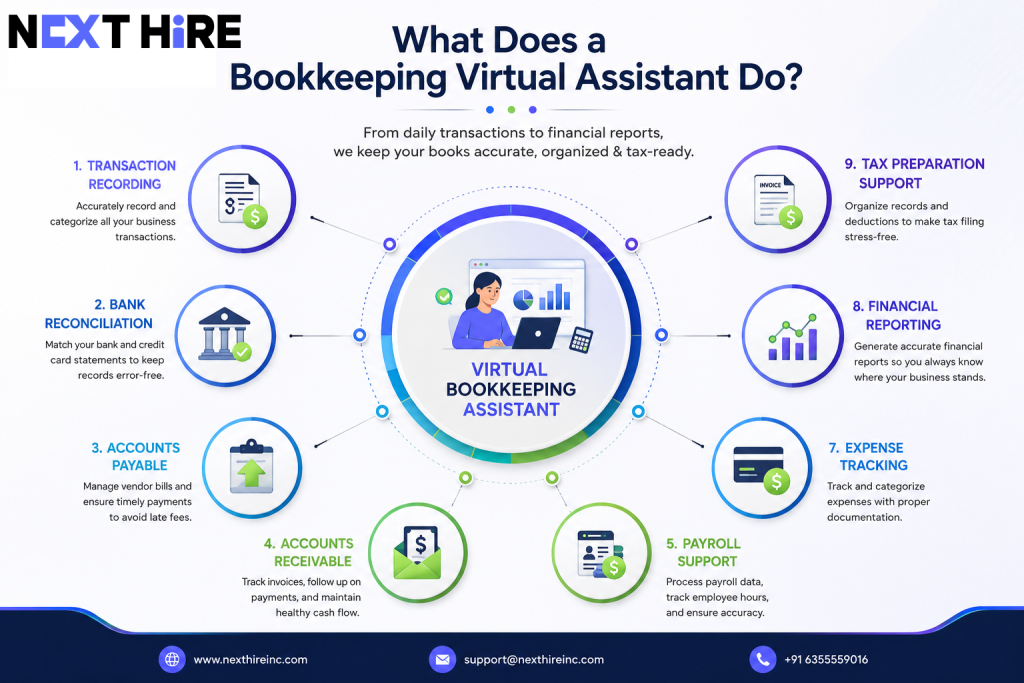
The scope of work varies depending on your business size and needs, but a bookkeeping virtual assistant typically handles the following:
Transaction recording. Every sale, purchase, payment, and expense gets recorded accurately and categorized correctly in your accounting system. This is the foundation of clean books.
Invoice management. Creating and sending invoices to clients, tracking which ones are paid, following up on overdue accounts, and reconciling payments received.
Expense tracking. Reviewing receipts, categorizing business expenses, and ensuring everything is documented properly for tax purposes.
Bank and credit card reconciliation. Matching your accounting records against actual bank statements to catch discrepancies, errors, or missed transactions.
Accounts payable. Managing vendor bills, tracking payment due dates, and ensuring suppliers are paid on time to avoid late fees or relationship issues.
Accounts receivable. Following up on outstanding client invoices and maintaining an accurate picture of what money is owed to the business.
Payroll support. Processing payroll data, tracking employee hours, and coordinating with payroll specialists or your payroll system.
Financial reporting. Generating profit and loss statements, balance sheets, and cash flow reports on a regular basis so you always know where the business stands.
Tax preparation support. Organizing financial records, categorizing deductions, and preparing documentation that makes working with your accountant or CPA faster and less expensive.
A good virtual assistant bookkeeper isn’t just executing tasks mechanically. They flag inconsistencies, ask the right questions when something doesn’t add up, and keep your records in a state where you could hand them to an accountant without embarrassment.
Virtual Assistant Bookkeeping Services You Can Outsource
When businesses think about what to delegate, bookkeeping is often on the list but never quite makes it because it feels too sensitive to hand off. That hesitation is understandable, but the reality is that virtual assistant bookkeeping services are well-established, and with the right provider and the right professional, the risk is manageable.
Here’s a practical breakdown of what’s commonly outsourced:
Monthly bookkeeping. The full cycle of recording, categorizing, reconciling, and reporting on a monthly basis. This is the most common engagement model and gives businesses a clean set of books at the end of every month.
Catch-up bookkeeping. If your records have fallen behind, a virtual bookkeeping assistant can work through months or even years of backlogged transactions and get everything current. This is particularly useful before tax season or before bringing in investors.
QuickBooks or Xero management. Setting up and maintaining your accounting software, creating chart of accounts, managing integrations, and keeping the system organized.
Expense reporting. Building and maintaining expense reports for team members, ensuring receipts are captured, and keeping everything categorized correctly.
Cash flow tracking. Monitoring incoming and outgoing cash to give you a real-time picture of your business’s financial health.
Tax-ready reporting. Preparing year-end summaries and financial statements that make the tax filing process significantly easier for your accountant.
The accounting and business support function is broader than most people realize, and a skilled virtual assistant bookkeeper can cover a substantial portion of it without requiring a full team.
Benefits of Hiring a Virtual Bookkeeping Assistant
The case for a virtual bookkeeping assistant isn’t just about cost, though cost is a real factor. It’s about what you gain across several dimensions.
You stop doing work that isn’t yours to do. Founders and business owners who are reconciling bank statements at 11pm on a Sunday aren’t using their time well. Offloading that to a skilled professional frees up real hours for decisions that actually require your judgment.
Your financial records become reliable. When bookkeeping is done consistently by someone who knows what they’re doing, your reports actually mean something. You can make decisions based on accurate data instead of guessing.
Cost savings are significant. A full-time bookkeeper in the US earns anywhere from $40,000 to $65,000 per year in salary alone, before benefits, taxes, and overhead. A virtual bookkeeping assistant engaged through a provider like Next Hire Inc starts from a fraction of that cost, and you only pay for the hours or scope you actually need.
Scalability without friction. As your business grows, you can increase the hours or scope of your virtual assistant bookkeeper without going through another hiring cycle.
Tax season becomes less painful. When your books are maintained consistently throughout the year, the work of preparing for tax season shrinks dramatically. Your accountant or CPA spends less time sorting through your records and more time on actual tax strategy.
You get a financial picture you can trust. One of the most underrated benefits is simply knowing where your business stands financially at any given point. Clean, current books give you that clarity.
Understanding how virtual assistants contribute to business scalability gives useful broader context for why this model works beyond just bookkeeping.
Virtual Assistant for Bookkeeping vs In-House Bookkeeper
This is the comparison that matters most for most businesses. Here’s how they stack up honestly:
| Factor | Virtual Bookkeeping Assistant | In-House Bookkeeper |
| Cost | Flexible, pay for hours or scope needed | Full salary plus benefits and overhead |
| Hiring time | Days with the right provider | Weeks to months |
| Commitment | Flexible engagement terms | Long-term employment |
| Availability | Agreed hours, often adaptable | Fixed office hours |
| Scalability | Adjust scope as needs change | Requires new hire or role change |
| Oversight | Provider handles management support | You manage directly |
| Backup coverage | Provider has backup resources | You manage absence coverage |
| Software flexibility | Works across common accounting tools | May need retraining for your system |
| Best for | Small to mid-size businesses, startups, growing teams | Large businesses with high-volume daily transactions |
An in-house bookkeeper makes sense when transaction volume is genuinely high enough to justify full-time attention and the business has the budget and infrastructure to support a permanent employee. For most small and mid-size businesses, a bookkeeper virtual assistant delivers the same financial function at a significantly lower cost with more flexibility.
The difference between offshoring and outsourcing is worth understanding if you’re thinking through the broader strategic question of how to structure financial support for your business.
Accounting and Bookkeeping Tasks a Virtual Assistant Can Handle
Beyond standard bookkeeping, a skilled virtual assistant bookkeeping professional can stretch into broader accounting support depending on their background.
Chart of accounts setup. Organizing your accounting system correctly from the start, or cleaning up a disorganized existing setup, so that all future entries are categorized consistently.
Budget tracking. Monitoring actual spending against budgeted amounts and flagging variances that need attention.
Multi-entity bookkeeping. Managing books for businesses with multiple entities, properties, or revenue streams, keeping each one separate and accurate.
eCommerce bookkeeping. Handling the specific challenges of ecommerce accounting, including inventory tracking, platform fees, refunds, and multi-currency transactions. This is particularly relevant for businesses in retail and ecommerce.
Grant and fund tracking. For non-profit organizations that need to track restricted and unrestricted funds separately and maintain compliance with grant reporting requirements.
Contractor payment tracking. Managing 1099 preparation, tracking contractor payments throughout the year, and ensuring documentation is complete for tax purposes.
The range of what a virtual assistant bookkeeping professional can handle depends on their specific experience and the tools your business uses. Being clear about your requirements upfront helps providers match you with someone whose background fits your actual situation.
When Should You Hire a Virtual Assistant Bookkeeper?
Timing matters here. There are some clear signals that it’s the right moment to bring in a virtual assistant bookkeeper:
Your books are consistently behind. If you’re always catching up on last month’s transactions, something needs to change. Falling behind on bookkeeping creates compounding problems because errors get harder to trace the older they are.
You’re spending your own time on bookkeeping. If you’re a founder or senior manager doing this yourself, you’re almost certainly spending time that has a much higher-value use elsewhere.
Tax season is a disaster every year. If you and your accountant spend significant time untangling your records every spring, that’s a bookkeeping problem, not just a tax problem.
You don’t actually know your cash position. If you’re making financial decisions based on your bank balance rather than actual P&L data, that’s a risk that compounds as the business grows.
You’re scaling and financial complexity is increasing. More revenue, more vendors, more employees, more transactions. At some point the volume exceeds what informal management can handle.
You want clean books before fundraising or selling. Investors and acquirers look at financial records carefully. Having a virtual bookkeeping assistant maintain clean, organized books makes that process significantly less painful.
For small businesses especially, the moment when bookkeeping starts consuming more than a few hours a month is usually the right trigger to hire help.
How to Choose the Best Virtual Bookkeeping Assistant
Not all virtual bookkeeping assistants are equal. Here’s what to actually look for:
Relevant accounting knowledge. This sounds obvious, but it’s worth verifying. A good virtual assistant bookkeeper should understand double-entry accounting, know how debits and credits work, and be able to explain what’s in a balance sheet. If they can’t, they’re doing data entry, not bookkeeping.
Software proficiency. Check that they’re experienced in the accounting software your business uses. QuickBooks Online, Xero, Wave, FreshBooks, and Sage are the most common. A mismatch here creates friction from day one.
Communication skills. Bookkeeping involves flagging issues, asking clarifying questions, and explaining financial information. A virtual assistant bookkeeper who can’t communicate clearly will create confusion even if their numbers are accurate.
Attention to detail. Ask how they handle discrepancies. A good bookkeeper has a process for catching and resolving errors. Someone who just enters data and moves on is a liability.
Experience in your industry. Ecommerce bookkeeping is different from service business bookkeeping, which is different from construction or healthcare. Industry-specific experience matters.
Provider support structure. If you’re hiring through a virtual staffing service, ask about backup resources, account management, and what happens if your primary bookkeeper is unavailable.
References or verifiable track record. Past experience with similar business types and sizes is a reasonable thing to ask about during evaluation.
The remote staffing model works particularly well for bookkeeping because the work is digital, the outputs are measurable, and quality is relatively easy to verify through regular review of the books.
Common Mistakes Businesses Make with Bookkeeping Virtual Assistants
Even with the right hire, a few avoidable mistakes can undermine the engagement:
Not defining scope clearly upfront. “Handle our bookkeeping” is too vague. Define which tasks, which software, which reporting frequency, and which deadlines you expect. Ambiguity creates gaps.
Not reviewing the work regularly. A virtual assistant bookkeeper should produce regular reports. Review them. If you never look at what’s being produced, you won’t know if something is wrong until it’s a much bigger problem.
Giving access without controls. Provide the minimum access necessary to do the job. Read-only access to bank feeds, limited permissions in accounting software. You can expand access as trust develops.
Treating it as fully hands-off. A virtual bookkeeping assistant handles the execution, but you still need to provide receipts, approve expense categories, and respond to questions. The less responsive you are, the more backlogs develop.
Hiring based on price alone. The lowest-cost option in bookkeeping is a false economy. Errors in financial records cost far more to fix than the difference in hourly rates.
How Next Hire Inc Helps You Hire Bookkeeping Virtual Assistants
Next Hire Inc provides pre-vetted bookkeepers and financial support professionals who are ready to integrate into your business quickly. Here’s what the experience looks like:
Shortlist in 24 hours. Share your bookkeeping requirements and you’ll have matched candidates to review by the next business day.
Start in 24 to 48 hours. Once you approve a candidate, the engagement begins almost immediately.
3-day free trial. Evaluate the match before committing to a longer engagement. That’s a meaningful signal of confidence in the quality of talent being offered.
Pricing from $5/hour. Monthly engagements start from $799/month. Project-based work (like catch-up bookkeeping) starts from $1,000. Full details are on the pricing page.
Trained professionals. Every candidate is screened for relevant skills, software proficiency, and communication ability before you see their profile.
Backup resource support. If your bookkeeping virtual assistant is unavailable, a backup steps in so your financial records don’t fall behind.
Dedicated account manager. One point of contact for the entire engagement. No support queues.
No hidden fees. No recruitment costs, no onboarding charges. What’s quoted is what you pay.
Beyond bookkeeping, Next Hire Inc also provides startup compliance specialists, business registration consultants, and broader accounting and business support professionals, so you can build a complete financial support function through a single provider.
Whether you’re in manufacturing, logistics, media and marketing, or finance and professional services, the team has experience matching bookkeeping professionals to different business environments and accounting needs.
Tired of falling behind on your books or doing it yourself? Next Hire Inc matches you with a skilled bookkeeping virtual assistant in 24 hours. Tell us what you need.
Frequently Asked Questions
What Is a Virtual Assistant for Bookkeeping?
A virtual assistant for bookkeeping is a remote professional who manages your business’s day-to-day financial records. They handle tasks like transaction recording, invoice management, bank reconciliation, expense tracking, and financial reporting, all done remotely using your accounting software.
What Does a Bookkeeping Virtual Assistant Do?
A bookkeeping virtual assistant records transactions, reconciles bank and credit card statements, manages accounts payable and receivable, processes invoices, tracks expenses, supports payroll functions, and produces regular financial reports. The exact scope depends on your business size and needs.
How Is a Virtual Bookkeeping Assistant Different from an Accountant?
A virtual bookkeeping assistant handles day-to-day transaction recording and financial maintenance. An accountant or CPA typically operates at a higher level, handling tax filing, financial analysis, and strategic advice. In practice, clean books maintained by a bookkeeper make your accountant’s job faster and cheaper.
Is Virtual Assistant Bookkeeping Safe?
Yes, with appropriate access controls in place. Provide the minimum permissions necessary in your accounting software and bank feeds. Use reputable providers who screen candidates thoroughly. Review the work regularly. These basic practices make virtual bookkeeping as safe as any professional financial relationship.
How Much Does a Bookkeeping Virtual Assistant Cost?
Costs vary based on hours, scope, and experience level. At Next Hire Inc, hourly engagements start from $5/hour, monthly engagements from $799/month, and project-based work such as catch-up bookkeeping from $1,000. This compares favorably to a full-time local bookkeeper earning $40,000 to $65,000 per year plus benefits.
What Software Should a Virtual Assistant Bookkeeper Know?
The most common accounting platforms are QuickBooks Online, Xero, FreshBooks, Wave, and Sage. Your virtual assistant bookkeeper should be proficient in whichever system your business uses. Confirm this during the selection process rather than assuming.
When Should I Hire a Virtual Bookkeeping Assistant?
The clearest signals are: your books are consistently behind, you’re doing bookkeeping yourself when you shouldn’t be, tax season is consistently painful, or you’re scaling and financial complexity is increasing. Any one of these is a reasonable trigger to bring in dedicated help.
Conclusion
Bookkeeping isn’t glamorous, but it’s foundational. When it’s done well, you have the financial clarity to make good decisions, prepare for taxes without panic, and understand where your business actually stands. When it’s neglected or handled inconsistently, those problems compound quietly until they become expensive to fix.
A virtual assistant bookkeeping professional gives you the dedicated, skilled support to keep your finances in order without the overhead of a full-time hire. The model works because bookkeeping is inherently digital, the outputs are measurable, and the right person can integrate into your workflow quickly regardless of geography.
If your books are behind, your financial reports are unreliable, or you’re spending your own time on tasks that shouldn’t require your attention, a bookkeeping virtual assistant is a straightforward fix worth taking seriously.
Start with a 3-day free trial and get matched with a pre-vetted bookkeeping virtual assistant through Next Hire Inc.