


Key Takeaways
- The cost of mobile app development ranges from $10,000 for a simple app to $500,000 or more for enterprise-grade products, depending on features, platform, and team model.
- Feature complexity is the single biggest driver of app development cost, more than platform choice or team location.
- iOS and Android development costs are comparable for native builds, but cross-platform frameworks like Flutter can reduce total cost by 30 to 40 percent.
- Remote development teams typically cost 40 to 70 percent less than US-based agencies for equivalent output.
- Next Hire Inc provides experienced mobile developers from $5/hour, shortlisted within 24 hours, with engagements starting in 24 to 48 hours.
Introduction
If you’ve ever tried to get a straight answer on how much it costs to build a mobile app, you’ve probably run into two kinds of responses. The first is a vague “it depends” that leaves you no better informed than before you asked. The second is a suspiciously low number that turns into something much higher once the project actually starts.
Neither is useful when you’re trying to make a real budget decision.
The cost of mobile app development does depend on a lot of variables, but those variables are knowable and quantifiable. Feature scope, platform choice, team model, backend complexity, design requirements, and third-party integrations all contribute to the final number in ways that can be estimated before a line of code is written.
This guide breaks down mobile app development cost at the feature level, by app type, by platform, and by team model. The goal is to give you a realistic picture of what you’re actually buying at different budget levels, so you can make informed decisions rather than getting surprised mid-project.
Numbers in this guide are approximate and based on general market rates. Actual costs for your specific project will depend on your exact requirements and the team you work with.
What Is the Cost of Mobile App Development?
The cost of mobile app development is the total investment required to take an app from concept to live deployment. It includes design, development, testing, project management, and launch, but it doesn’t end there. Ongoing maintenance, updates, and infrastructure costs continue after launch.
Understanding total cost of ownership matters as much as the initial build cost. An app that costs $50,000 to build might cost $15,000 to $30,000 per year to maintain, update, and host. Planning for that upfront leads to better budget decisions than treating maintenance as an afterthought.
The initial build cost breaks down across several functions:
Discovery and planning (typically 5 to 10 percent of total project cost): Requirements definition, technical architecture, project planning.
UX and UI design (typically 15 to 25 percent): User research, wireframes, visual design, prototyping.
Frontend development (typically 25 to 35 percent): Building the app interface and implementing designs.
Backend development (typically 20 to 35 percent): Server infrastructure, APIs, database, business logic.
QA and testing (typically 10 to 15 percent): Functional testing, performance testing, security testing, device testing.
Project management (typically 10 to 15 percent): Sprint planning, coordination, stakeholder communication.
Deployment and launch (typically 5 percent): App store submission, server deployment, launch support.
These percentages shift based on app type. A content app with a simple backend spends more proportionally on design and frontend. A data-intensive enterprise app spends more on backend and QA.
How Much Does It Cost to Develop an App?
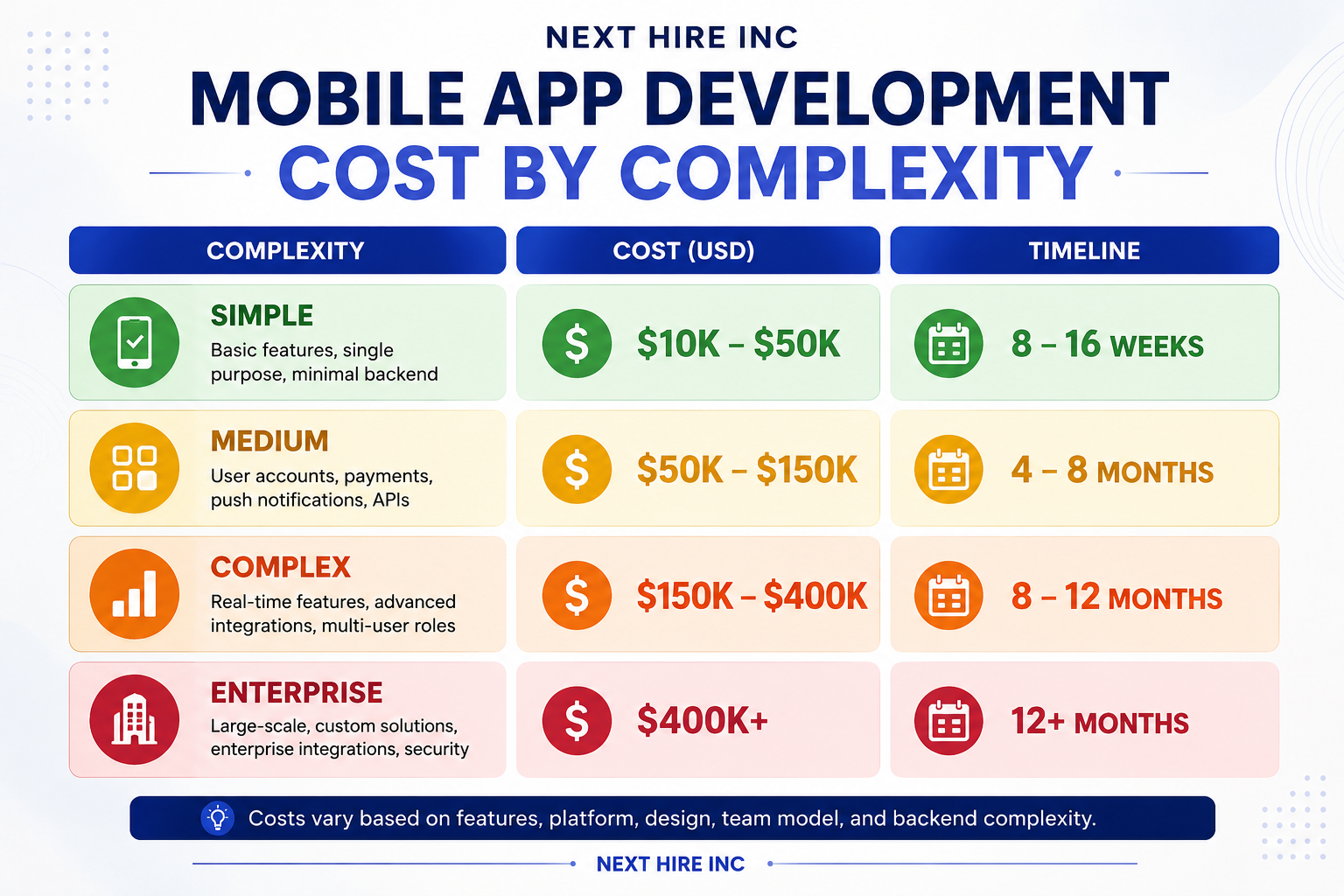
Here’s a direct breakdown by complexity level:
| App Complexity | Estimated Cost Range | Timeline |
| Simple app | $10,000 to $50,000 | 8 to 16 weeks |
| Medium complexity | $50,000 to $150,000 | 4 to 8 months |
| Complex app | $150,000 to $400,000 | 8 to 12 months |
| Enterprise app | $400,000 and above | 12+ months |
These ranges assume a competent team working from well-defined requirements. They’re US market estimates for agency or equivalent talent. Remote development teams can deliver similar quality at 40 to 70 percent lower cost, which dramatically changes what’s accessible at different budget levels.
Simple apps include single-purpose utilities, basic informational apps, and tools with minimal backend requirements. A simple expense tracker, a restaurant menu app, or a basic appointment booking tool falls in this category.
Medium complexity apps include user authentication, social features, push notifications, payment integration, content management, and moderate API connectivity. Most consumer apps targeting a specific use case fall here.
Complex apps include marketplace functionality, real-time features, advanced search and filtering, multi-user roles, complex integrations, and significant backend infrastructure. Think on-demand service platforms, social networks, or healthcare apps.
Enterprise apps add legacy system integrations, custom security requirements, multi-platform support, compliance frameworks, and large-scale data handling. These projects rarely have a firm ceiling.
Mobile App Development Cost Breakdown by Feature
This is where estimates get genuinely useful. Rather than a single project number, here’s how individual features contribute to the overall mobile app development cost.
User Authentication and Account Management
Basic email and password authentication: $2,000 to $5,000
Social login (Google, Apple, Facebook): Add $1,500 to $3,000 per provider
Two-factor authentication: Add $2,000 to $4,000
User profile management: $3,000 to $8,000
Role-based access control (admin, user, moderator): $5,000 to $15,000
Push Notifications
Basic push notifications: $2,000 to $5,000
Segmented or personalized notifications: $5,000 to $12,000
In-app messaging system: $8,000 to $20,000
Payment Processing
Basic payment integration (Stripe or similar): $5,000 to $12,000
Subscription billing: $8,000 to $18,000
In-app purchases (App Store and Google Play): $5,000 to $10,000
Multi-currency support: Add $3,000 to $8,000
Escrow or marketplace payments: $15,000 to $40,000
Maps and Location
Basic map display: $2,000 to $5,000
User location tracking: $3,000 to $8,000
Real-time location sharing: $10,000 to $25,000
Geofencing: $8,000 to $18,000
Route optimization: $15,000 to $35,000
Search and Filtering
Basic search: $3,000 to $8,000
Advanced filters and sorting: $5,000 to $15,000
Full-text search with Elasticsearch or similar: $10,000 to $25,000
AI-powered recommendations: $20,000 to $60,000
Media and Content
Image upload and display: $3,000 to $7,000
Video upload, processing, and streaming: $15,000 to $40,000
Audio playback: $5,000 to $15,000
Content management system (CMS) backend: $10,000 to $30,000
Social Features
User profiles and connections: $8,000 to $20,000
Activity feed: $10,000 to $25,000
Comments and reactions: $5,000 to $12,000
Direct messaging (text): $12,000 to $30,000
Video or voice calling: $20,000 to $60,000
Analytics and Reporting
Basic analytics integration (Firebase, Mixpanel): $2,000 to $5,000
Custom in-app dashboard: $10,000 to $30,000
Admin analytics panel: $15,000 to $40,000
AI and Machine Learning Features
Image recognition: $20,000 to $60,000
Natural language processing or chatbot: $15,000 to $50,000
Personalization engine: $25,000 to $80,000
These feature costs are additive. A medium-complexity app might combine authentication, push notifications, basic payments, search, and a CMS backend, which puts it in the $50,000 to $100,000 range before platform decisions and team rates are factored in.
Key Factors That Affect App Development Cost
Feature scope is the biggest driver, but several other factors meaningfully affect the final app development cost.
Team Location and Model
This is the largest cost variable after feature scope. Developer hourly rates vary dramatically by geography:
- US-based agency or developers: $100 to $250/hour
- Western Europe: $80 to $180/hour
- Eastern Europe: $40 to $100/hour
- India and South Asia: $20 to $60/hour
- Southeast Asia: $25 to $70/hour
- Latin America: $30 to $80/hour
A project that costs $150,000 with a US agency might cost $50,000 to $70,000 with an equally competent remote team. The cost difference is real, but so is the management overhead if you’re not working with a structured provider. Using a remote staffing platform with managed engagement support gives you the cost advantage without the coordination risk of hiring individually offshore.
Platform Choice
Native iOS and Android development have similar hourly rates but different device testing requirements. Android’s device fragmentation means more QA time. iOS has a more predictable device matrix.
Cross-platform development with Flutter reduces total development cost by sharing code between platforms. Flutter developers can produce a high-quality cross-platform app at roughly 60 to 70 percent of the cost of two separate native builds.
Progressive web apps are the cheapest platform option but don’t offer native app store presence or full device access.
Design Complexity
A standard UI with common patterns and a clean design system costs less than a highly custom, animated interface. Figma designers creating custom components and interaction animations add cost compared to implementing standard platform components.
A design system created upfront actually reduces overall cost by giving developers a consistent component library to work from, reducing design interpretation issues.
Backend Complexity
A simple REST API backend costs significantly less than a microservices architecture with real-time capabilities, complex business logic, and enterprise integrations. Backend developers working on standard CRUD operations are cheaper to engage than those with specialized expertise in distributed systems or high-performance data processing.
Using Firebase as a backend-as-a-service for appropriate projects reduces backend development cost substantially. Firebase developers can configure authentication, real-time database, and cloud functions much faster than building equivalent infrastructure from scratch.
Third-Party Integrations
Every integration adds cost: API connectivity, error handling, testing, and maintenance. Payment gateways, mapping services, analytics platforms, CRM systems, and social platforms each require implementation time that’s easy to underestimate during initial scoping.
Regulatory and Compliance Requirements
Apps in healthcare (HIPAA), finance (PCI DSS, SEC regulations), or apps targeting European users (GDPR) carry compliance requirements that add meaningful cost to both development and ongoing maintenance. Security auditing, data handling protocols, and compliance documentation are real line items.
iOS App Development Cost vs Android App Development Cost
A question that comes up constantly: is iOS cheaper than Android, or vice versa?
The honest answer is that the raw development cost is similar. The differences are in testing overhead and market considerations.
iOS development targets a defined set of devices with consistent OS adoption. Testing matrix is manageable, Apple’s developer tools are mature, and UI conventions are well-established. iOS developers and Swift developers work within a predictable environment.
Android development covers thousands of device configurations across different screen sizes, OS versions, and manufacturer customizations. The device testing matrix is larger, which adds QA cost. Android developers experienced with the full Android ecosystem account for this in their estimates.
In practice, the cost difference for a single-platform build is often within 10 to 15 percent, with Android slightly higher due to testing overhead. The bigger decision is whether to build for both platforms simultaneously.
| Approach | Relative Cost |
| iOS only | Baseline |
| Android only | 5 to 15% more than iOS baseline |
| Both native | Roughly 180 to 200% of single platform |
| Flutter (both platforms) | 120 to 140% of single platform |
| React Native (both platforms) | 120 to 145% of single platform |
For most startups and growing businesses deciding between platforms, the mobile app development timeline and budget considerations usually point toward a single platform first (often iOS) followed by Android once the product is validated.
Custom App Development Cost by App Type
Different categories of apps have predictably different cost profiles because of their inherent feature requirements.
eCommerce Mobile App
Product catalog, search, cart, checkout, payment processing, order tracking, user accounts, push notifications for deals and updates.
Estimated cost: $40,000 to $150,000
Complexity increases significantly with inventory management, multi-vendor support, or integration with existing ecommerce platforms. Shopify developers can reduce cost for businesses that want a Shopify-based mobile experience rather than a fully custom build.
Healthcare App
Patient registration, appointment scheduling, telehealth video, medical records, prescription management, HIPAA compliance infrastructure, provider portal.
Estimated cost: $80,000 to $300,000+
Compliance requirements and integration with health information systems are the primary cost drivers in the healthcare and life sciences space. Security testing is a non-negotiable cost item.
On-Demand Service App
Two-sided platform (customer and provider), real-time location, dynamic pricing, payment processing, ratings, notifications, admin dashboard.
Estimated cost: $100,000 to $350,000
Real-time features and two-sided user management are the expensive components here. API developers who specialize in real-time systems can make meaningful differences in both cost and performance.
Fintech App
Account management, transaction history, payments, budgeting tools, compliance (PCI DSS, KYC/AML), biometric authentication, financial data integrations.
Estimated cost: $100,000 to $400,000+
Regulatory compliance and security requirements in finance and professional services push costs significantly higher than comparable non-regulated applications.
Social and Community App
User profiles, content feed, messaging, media sharing, notifications, content moderation, admin tools.
Estimated cost: $80,000 to $250,000
Scalability is the hidden cost in social apps. Infrastructure that handles 1,000 users gracefully often needs significant rework to handle 100,000. Designing for scale from the beginning costs more upfront but less overall.
Education App
Course content, video lessons, quizzes, progress tracking, certifications, payment for courses, instructor management.
Estimated cost: $50,000 to $200,000
Complexity varies widely based on whether content is pre-recorded or live, whether there’s a marketplace for instructors, and what level of interactivity the learning experience requires. Businesses in education and training benefit from starting with an MVP approach before committing to full platform development.
Logistics and Delivery App
Driver and customer apps, real-time tracking, route optimization, delivery confirmation, payment, reporting dashboard.
Estimated cost: $80,000 to $300,000
Dual-app complexity (driver and customer interfaces) and real-time location infrastructure are the main cost contributors for logistics and travel apps.
Cost to Hire a Mobile App Developer
Understanding hourly and monthly rates for individual developers helps you evaluate whether an agency quote is reasonable and whether building a custom team makes more financial sense for your situation.
Junior mobile developer: $20 to $60/hour
Mid-level mobile developer: $40 to $100/hour
Senior mobile developer: $80 to $180/hour
Lead architect or tech lead: $100 to $250/hour
These ranges reflect global market rates. US-based developers sit at the top end. Developers in Eastern Europe, Latin America, and South Asia sit at lower points in the range without necessarily reflecting lower quality, especially at the mid and senior levels.
For a typical medium-complexity app requiring a team of:
- 1 project manager
- 1 UX/UI designer
- 1 iOS or Android developer
- 1 backend developer
- 1 QA engineer
Working over four to six months, the total cost at US agency rates might be $100,000 to $180,000. The same team assembled through a remote staffing provider at competitive global rates might be $35,000 to $70,000.
The virtual staffing solutions model gives you the cost advantage of global rates with the management structure of an agency engagement, which is why it’s increasingly the default approach for cost-conscious mobile app projects.
App Development Cost Calculator: How to Estimate Your Budget
While there’s no perfectly accurate calculator for app development cost (because requirements vary too much), you can build a reasonable estimate using this framework:
Step 1: List your core features. Write down every feature the app needs. Be specific: “push notifications” is more useful than “notifications.”
Step 2: Categorize by complexity. For each feature, assign a rough complexity level: simple, medium, or complex. Simple features take 1 to 5 days. Medium features take 1 to 3 weeks. Complex features take 3 to 8 weeks.
Step 3: Estimate development days. Sum the estimated days for all features. Add 20 to 30 percent for integration, testing, and bug fixing.
Step 4: Apply a daily rate. Multiply total development days by the daily rate of your development team. US rates: $800 to $1,500/day. Global remote rates: $200 to $600/day.
Step 5: Add design, project management, and QA. These typically add 40 to 60 percent on top of pure development cost.
Step 6: Add a contingency buffer. Add 15 to 20 percent for scope adjustments, unexpected complexity, and integration surprises. Projects that don’t have this buffer almost always exceed budget.
As a rough example: an app with 20 medium-complexity features at 10 days each = 200 development days. Plus 30 percent buffer = 260 days. At $400/day for a remote mid-level developer = $104,000 in development alone. Add design (25 percent) and QA (15 percent) = roughly $140,000 total.
This is a rough estimate, not a quote. But it gives you a framework for having more informed conversations with development partners.
How to Reduce Mobile App Development Cost Without Losing Quality
There are smart ways to reduce mobile app development cost and approaches that just create problems you pay for later. Here’s the difference.
Build an MVP First
The single most effective cost reduction strategy is building only what’s needed to validate the core product hypothesis. An MVP approach defers expensive features until you know users actually want the product. This isn’t cutting corners; it’s making smarter build decisions.
Choose Cross-Platform Development
When native platform-specific features aren’t a requirement, cross-platform development with Flutter or React Native reduces cost by 30 to 40 percent compared to maintaining separate native codebases. Hybrid app developers experienced with cross-platform work can deliver quality that’s comparable to native for most consumer use cases.
Use Existing Backend Services
Building custom backend infrastructure from scratch is expensive. Firebase, Supabase, AWS Amplify, and similar backend-as-a-service platforms provide authentication, databases, storage, and real-time features as managed services. Using these where appropriate significantly reduces backend development time and cost.
Invest in Discovery Before Development
Unclear requirements during development generate expensive rework. A thorough discovery and planning phase where scope is clearly defined and prioritized reduces surprises mid-build. Discovery costs a fraction of what scope-related rework costs.
Work With Remote Development Teams
Moving from a US-based agency to a structured remote development team reduces hourly rates by 50 to 70 percent for comparable skill levels. The key is working with a provider that manages the engagement, not just sourcing individual freelancers independently.
Use a Design System
Investing in a design system before development starts reduces design inconsistency and gives developers a component library that accelerates frontend implementation. The upfront cost of a design system pays back during development.
Don’t Cut QA
Reducing QA budget to save cost is the most reliably counter-productive cost-cutting strategy. Bugs discovered in production cost significantly more to fix than bugs caught during testing. A mobile app with a poor user experience at launch loses users who rarely come back.
Plan Architecture for Scalability
Building a well-architected app from the start costs more upfront than a quick build but costs dramatically less when you need to scale. Architectural rework in a production app is one of the most expensive categories of technical debt.
Post-Launch Mobile App Development Costs
The initial build is only part of the total cost of mobile app development. Planning for post-launch costs avoids budget surprises.
App store fees. Apple charges $99/year for a developer account. Google charges a one-time $25 fee. These are minimal but worth including.
Server and infrastructure costs. Cloud hosting for a small to medium app on AWS, Google Cloud, or similar typically runs $100 to $1,000/month depending on usage. Traffic growth increases these costs. Cloud and server administration is an ongoing cost item, especially as user numbers grow.
Bug fixes and maintenance. OS updates frequently break existing functionality. Plan for at least 15 to 20 percent of the original build cost per year for maintenance, bug fixes, and minor updates.
Feature development. Most successful apps add significant new features every six to twelve months based on user feedback and market changes. Treating post-launch development as a separate budget line prevents it from being a surprise.
Marketing and user acquisition. Getting users to download and use the app is a cost that’s separate from building it. ASO experts, digital marketing specialists, and performance marketing professionals are ongoing investments for apps that want to grow their user base.
Security and compliance. Regular security testing and compliance audits are recurring costs for apps in regulated industries or handling sensitive user data.
How Next Hire Inc Helps You Plan Mobile App Development Cost
One of the most controllable variables in mobile app development cost is the team model. Next Hire Inc provides access to experienced mobile developers, designers, and QA specialists at global rates, with the management structure of a professional engagement.
Here’s how the cost picture changes with Next Hire Inc compared to traditional agency models:
A senior iOS developer or Android developer through Next Hire Inc is available from significantly below US agency rates, without sacrificing the screening, accountability, and backup support that make agency models attractive.
Mobile app UI designers, UX researchers, backend developers, QA testers, and API developers are all available through the same provider, allowing you to assemble a complete development team without engaging multiple contractors independently.
The engagement model:
Candidates shortlisted within 24 hours. Engagements start in 24 to 48 hours. 3-day free trial to evaluate fit. Pricing from $5/hour, monthly engagements from $799/month. Dedicated account manager and backup resource support throughout.
Full pricing details are on the pricing page.
Every candidate is pre-vetted for technical skills, communication ability, and professional reliability. The infrastructure supporting engagements is designed for continuity and security, which matters when you’re trusting a remote team with product code and sensitive project information.
Next Hire Inc works with businesses across technology, retail and ecommerce, healthcare, finance, education, and logistics, with experience matching mobile development talent to different project types and budget requirements.
Planning a mobile app and want to understand what it will actually cost before committing to a budget? Next Hire Inc shortlists experienced developers within 24 hours. Tell us what you’re building.
Frequently Asked Questions
How Much Does It Cost to Develop an App?
Simple apps cost $10,000 to $50,000. Medium-complexity apps cost $50,000 to $150,000. Complex apps with marketplace functionality, real-time features, or enterprise integrations typically cost $150,000 to $400,000. These ranges assume competent teams and well-defined requirements. Remote development teams can deliver similar quality at 40 to 70 percent lower cost than US-based agencies.
What Is the Biggest Factor in App Development Cost?
Feature scope is the largest cost driver, followed by team model and platform choice. Adding features mid-project is more expensive than including them in original scoping because of the rework and integration cost involved.
Is iOS or Android More Expensive to Develop?
The difference is small, typically 10 to 15 percent, with Android slightly higher due to device fragmentation and testing overhead. The bigger cost decision is whether to build native for one platform or both, or whether to use a cross-platform framework.
How Can I Reduce My App Development Cost?
Build an MVP before the full product. Use cross-platform development instead of separate native builds where possible. Use backend-as-a-service platforms where appropriate. Work with a structured remote development team. Invest in discovery before development starts. Don’t cut QA.
What Are the Ongoing Costs After App Launch?
Expect to spend 15 to 20 percent of the original build cost per year on maintenance, OS updates, and bug fixes. Cloud infrastructure adds $100 to $1,000 or more per month depending on usage. Feature development, marketing, and security auditing are additional ongoing costs.
What Does a Mobile App Developer Cost Per Hour?
Globally, rates range from $20/hour for junior developers in lower-cost markets to $250/hour for senior US-based developers. Mid-level developers in Eastern Europe, Latin America, or South Asia typically range from $40 to $80/hour and can deliver equivalent quality to higher-cost markets for most project types.
Is It Cheaper to Build One App for Both iOS and Android?
Using a cross-platform framework like Flutter to target both platforms from a single codebase costs roughly 60 to 70 percent of building two separate native apps. It’s not free, but it’s significantly cheaper than maintaining two independent codebases with separate teams.
Conclusion
The cost of mobile app development is genuinely variable, but it’s not unknowable. Feature scope, platform decisions, team model, and backend complexity are all factors you can control and plan for before a project starts.
The most expensive mobile app projects aren’t necessarily the most complex ones. They’re often the ones that started without clear requirements, changed scope frequently during development, skipped proper QA, or chose the wrong team model for their budget.
Getting those fundamentals right, defining scope clearly, choosing the right platform approach, planning for QA, and working with a cost-effective team model, is what separates a mobile app investment that produces returns from one that consumes budget without delivering proportional value.
Ready to build your mobile app with a team that fits your budget? Next Hire Inc provides pre-vetted developers starting from $5/hour. Start with a 3-day free trial.



