

A Shopify theme developer becomes useful when your store has outgrown what the theme editor can handle. You may need custom sections, a better product-page experience, cleaner code, faster performance, or a design that no ready-made theme can deliver without workarounds.
The key is not hiring a developer just because you use Shopify. It is knowing when custom theme work will solve a real business problem and when a standard theme is still enough.
Theme development is only one type of Shopify technical work. If your roadmap also includes integrations, custom functionality, performance improvements, maintenance, or recurring development tasks, you may need broader support. In that case, you can hire Shopify developers for ongoing theme and store development rather than treating every change as a separate project.
Key Takeaways
- You probably do not need a Shopify theme developer if the theme editor already gives you the layouts, branding controls, and features your store needs.
- Hire one when custom layouts, reusable sections, performance fixes, complex product experiences, or deeper front-end changes require Liquid, HTML, CSS, or JavaScript.
- Choose between theme customization and a full custom Shopify theme based on the size of the gap, not on how “premium” you want the store to sound.
What Does a Shopify Theme Developer Actually Do?
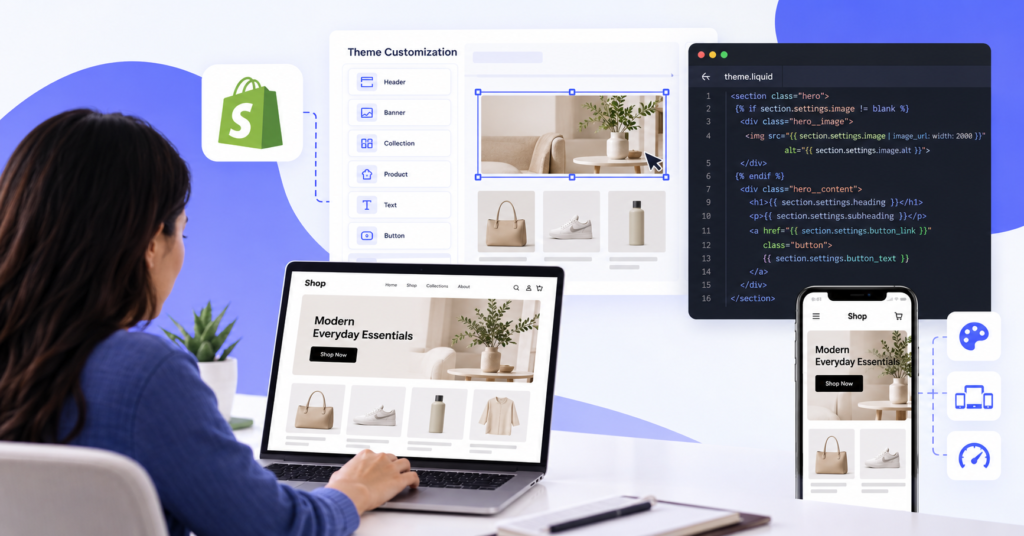
A Shopify theme developer works on the storefront layer of your store. That includes how pages are structured, how reusable sections behave, how products and collections are presented, and how the design responds across desktop and mobile.
Shopify themes are built from components such as layouts, templates, sections, blocks, snippets, configuration files, and assets. Theme developers work inside that structure instead of treating the store like a generic website.
The technical stack commonly includes Shopify Liquid, HTML, CSS, JavaScript, and JSON. A strong developer should also understand Shopify’s theme editor, responsive design, accessibility, performance, and safe deployment practices.
Typical work includes:
- Custom product, collection, landing page, and home page layouts
- Reusable sections and blocks your team can edit without touching code
- Theme-level features such as variant displays, product badges, tabs, promotional sections, and navigation behavior
- Responsive fixes for mobile and tablet
- Front-end performance cleanup
- App styling and front-end integration
A Shopify theme developer is not automatically the right person for every Shopify problem. Back-end integrations, private business logic, or a feature that needs its own application can require different development work.
When You Do Not Need a Shopify Theme Developer
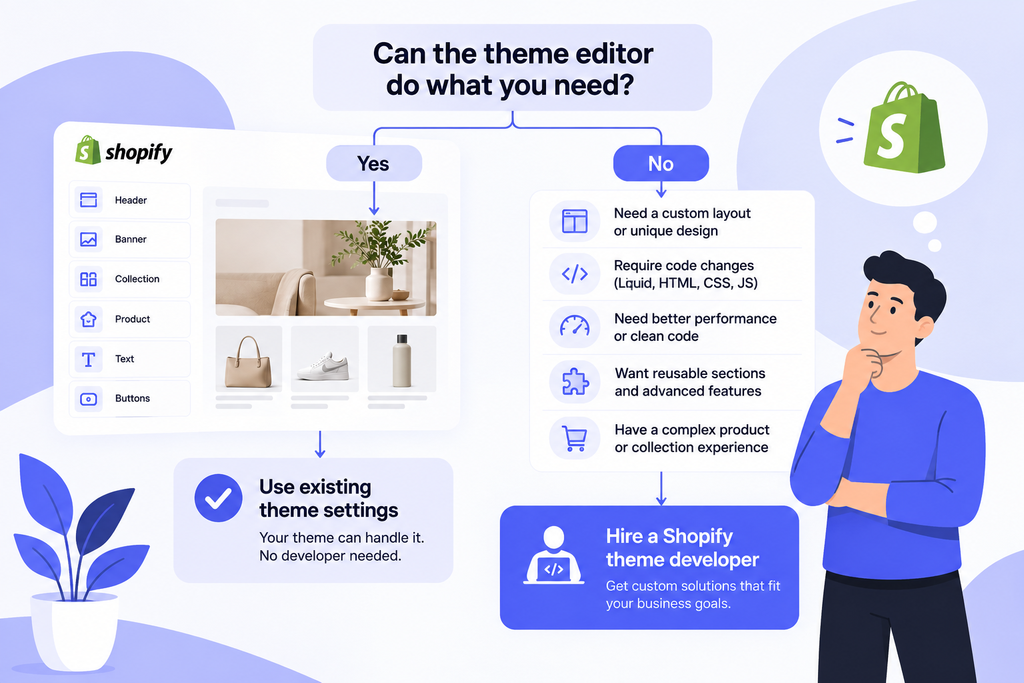
Do not hire a developer to solve a problem the theme editor already solves well.
Shopify’s theme editor lets merchants customize content, layouts, typography, colors, sections, and available theme settings without editing code. If you mainly need new banners, reordered sections, different fonts, or simple content changes, start there.
You can usually stay with the theme editor when:
- Your desired layout already exists in the theme
- Your catalog and navigation are simple
- Built-in product templates support how you sell
- You do not need unusual interactions or conditional content
- Performance is acceptable
- Your team can make routine updates without code
Custom code should solve a specific limitation. If you cannot clearly identify that limitation, you may be spending development budget too early. If you are still deciding whether your current Shopify workload justifies professional technical support at all, review the broader signs for when to hire a Shopify developer before committing to theme development.
7 Signs You Need a Shopify Theme Developer
1. Your Theme Cannot Build the Layout You Need
This is the clearest trigger.
Maybe your product page needs a comparison panel, custom specification layout, bundle explanation, interactive size guide, configurable content blocks, or a different mobile sequence. If the theme cannot create it cleanly, a Shopify theme customization project may be appropriate.
The goal should be to build reusable components, not hard-code a one-off page that becomes painful to maintain.
2. Your Brand Has Outgrown a Template Look
You may need custom typography behavior, editorial layouts, unusual product storytelling, branded navigation, or landing pages that follow your design system closely.
A Shopify theme developer can adapt an existing theme or build a more tailored front end.
3. Your Product Experience Is Becoming More Complex
Stores with variants, technical specifications, large catalogs, subscriptions, product bundles, personalization, or high-consideration purchases often need more than the default product page.
This is where front-end development affects usability directly. The developer’s job is not just to make a page look different. It is to make a more complex buying decision easier to navigate.
4. Theme Code Is Hurting Store Performance
Performance problems can come from more than the theme, but theme code is one place to investigate. Heavy scripts, duplicated app code, oversized assets, inefficient front-end behavior, and years of edits can leave a storefront difficult to optimize.
A theme developer can audit the front end, remove unnecessary code, improve loading behavior, and reduce theme-level bottlenecks. If performance is the main reason you are considering development work, review our guide to Shopify speed optimization cost to understand what typically affects scope, pricing, and the difference between a basic fix and deeper theme-level optimization.
5. Apps Work, but the Storefront Experience Feels Patched Together
Apps can solve business problems quickly, but their front-end output does not always match the rest of the store. You may see inconsistent buttons, spacing problems, duplicate widgets, layout shifts, or mobile conflicts.
A Shopify theme developer can often improve how app-generated elements appear and interact with the theme.
If the requirement involves unique business logic, external systems, proprietary workflows, or functionality that cannot live cleanly inside the theme, you may be dealing with an app project rather than theme development. Our guide to hiring a custom Shopify app developer explains when storefront customization is no longer enough.
6. You Are Redesigning a Store That Already Has Revenue
A developer can build and test changes in an unpublished theme before release. That gives your team a safer way to review responsive behavior, integrations, and edge cases before the new storefront goes live.
7. Your Team Needs Ongoing Theme Iteration
That can include new landing-page sections, seasonal merchandising components, A/B test variants, product-page upgrades, navigation changes, and front-end fixes.
At that point, repeated one-off freelancer searches can create inconsistent code and slow handoffs.
Shopify Theme Customization vs Custom Shopify Theme Development
Not every store that needs a developer needs a custom theme from scratch.
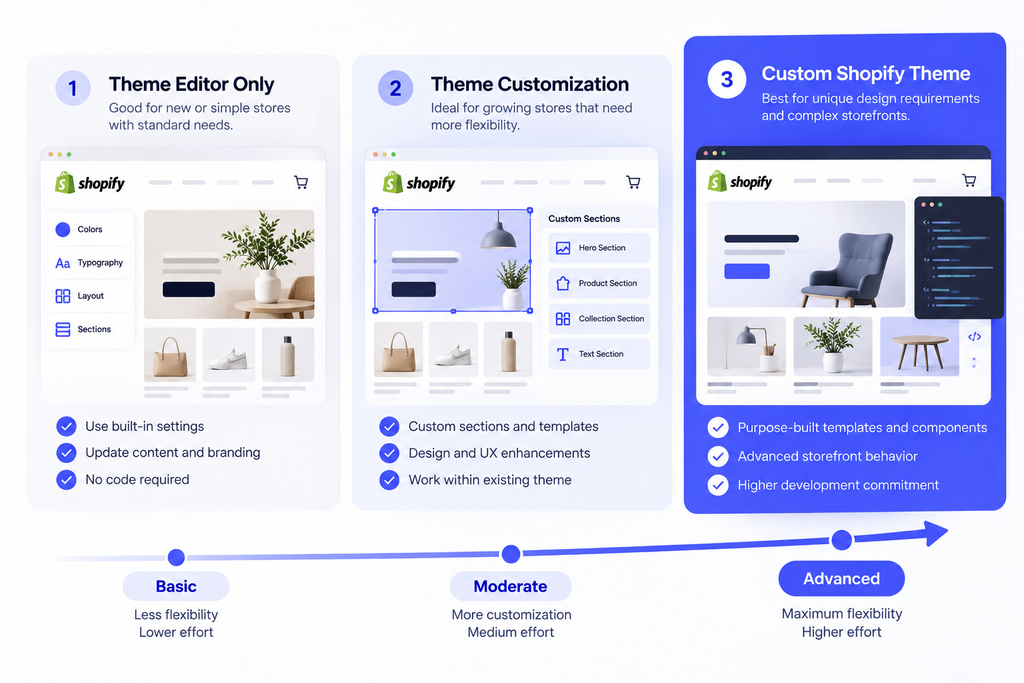
Theme customization keeps an existing theme as the base and changes selected parts. Custom Shopify theme development creates much more of the storefront around your specific requirements.
| Option | Best fit | Typical work | Main trade-off |
| Theme editor only | New or simple stores | Branding, content, built-in sections, layout settings | Limited to what the theme exposes |
| Shopify theme customization | Growing stores with a solid base theme | Custom sections, templates, styling, UX changes, code fixes | Must work within the base theme’s architecture |
| Custom Shopify theme | Stores with distinct design or complex front-end requirements | Purpose-built templates, components, design system, advanced storefront behavior | Higher build and maintenance commitment |
Start with the smallest intervention that solves the actual problem.
If 80 percent of a good theme already fits your store, replacing all of it can add cost and maintenance without creating equal value. If the base theme fights your requirements on every important page, deeper custom Shopify theme development becomes easier to justify.
Theme Developer vs Shopify App Developer
This distinction saves money during scoping.
A theme developer primarily changes the storefront presentation and front-end behavior. An app developer builds functionality that may involve APIs, databases, admin workflows, external services, or business logic that should not live inside theme code.
For example, a custom product information layout belongs in the theme. A private system that syncs complex data with another platform may require an app or integration.
Some projects need both. The important part is defining which requirements belong to the theme before hiring.
Otherwise, you can end up asking a front-end specialist to solve a back-end problem or paying for an app when a reusable theme section would have been enough.
What Skills Should You Look For?
If you plan to hire Shopify theme developer talent, ask for evidence of work that matches your scope, not just a portfolio of attractive home pages.
Look for practical competence in Shopify Liquid, HTML, CSS, JavaScript, JSON templates, sections, blocks, responsive implementation, and theme debugging. For larger projects, familiarity with Shopify CLI, Git, code review, and structured release workflows is also useful.
Ask how they would decide between editing an existing section and creating a new reusable one. Ask how they test mobile layouts. Ask what happens to custom changes when a theme is updated. Ask how they keep third-party scripts from turning into performance debt.
How Much Should You Budget for Theme Work?
The useful budgeting question is not “What does a Shopify theme developer cost?” It is “How much custom work is actually in scope?”
Changing one section, fixing a responsive issue, and rebuilding a complete storefront are completely different projects. Cost moves with the number of templates, custom components, integrations, design readiness, QA requirements, and post-launch support.
Before requesting quotes, write down:
- Pages and templates in scope
- Components that must be custom
- Features that can remain standard
- Mobile and accessibility expectations
- Support expected after release
How to Decide Before You Hire
Use three questions.
First, can the current theme editor solve the requirement without code? If yes, do that first.
Second, can a focused customization solve the problem without rebuilding the whole storefront? If yes, keep the working foundation and change what matters.
Third, are your most important customer journeys constrained by the base theme itself? If the answer is repeatedly yes, a custom Shopify theme may be the cleaner long-term option.
FAQs About Hiring a Shopify Theme Developer
What is a Shopify theme developer?
A Shopify theme developer specializes in the storefront layer of Shopify, including Liquid templates, sections, blocks, HTML, CSS, JavaScript, responsive behavior, and theme-level performance or UX improvements.
When should I hire a Shopify theme developer?
Hire one when the theme editor cannot deliver required layouts, reusable components, performance fixes, advanced product experiences, or deeper front-end customization without code.
Do I need a custom Shopify theme for a new store?
Usually not. Many new stores can launch effectively with a well-chosen free or paid theme. Custom development makes more sense when you can identify specific requirements that standard themes cannot support well.
Can a Shopify theme developer improve store speed?
Yes, when theme code, assets, scripts, or front-end implementation contribute to the problem. They should still diagnose the cause first because apps, media, tracking, and third-party scripts can also affect performance.
Should I hire a freelancer, agency, or dedicated Shopify developer?
Match the model to the workload. A freelancer can fit a defined task, an agency can cover broader design and development scope, and a dedicated developer can suit ongoing theme iteration.
Build the Storefront You Actually Need
A Shopify theme developer is valuable when your storefront has a clear technical or UX constraint, not simply because custom development sounds better than a template.
Start with the theme editor. Customize when the base is strong. Build deeper when the limitations are structural.
If theme customization, new storefront features, debugging, performance improvements, and ongoing front-end changes are becoming a regular part of your ecommerce roadmap, you can hire dedicated Shopify developers through NextHire for consistent Shopify development support without repeatedly sourcing a new developer for every change.