

Key Takeaways
- Virtual employee services go beyond just finding candidates. They include screening, onboarding support, account management, and backup coverage.
- A virtual employee works exclusively for your business during agreed hours, which makes them fundamentally different from a freelancer.
- Businesses of all sizes use this model to fill skill gaps, reduce overhead, and scale without the delays of traditional hiring.
- Onboarding and ongoing engagement are what separate a productive virtual employee relationship from one that quietly underdelivers.
- Next Hire Inc shortlists candidates within 24 hours, starts engagements in 24 to 48 hours, and offers a 3-day free trial with pricing from $5/hour.
Introduction
There’s a version of this story that most business owners know personally. You need someone with a specific skill. Maybe it’s a developer, a marketer, or someone to handle operations work that keeps falling through the cracks. You know hiring locally is slow and expensive. You’ve tried freelancers, and while they work for one-off tasks, they’re unreliable for anything ongoing. You need something in between.
That’s the gap virtual employee services fill.
The term gets thrown around loosely, so it’s worth being clear about what it actually means, what a proper service includes, and whether it’s the right fit for your specific situation. Because there’s a meaningful difference between a platform that hands you a list of candidates and a service that actually helps you build a functioning remote working relationship.
This blog breaks all of that down.
What Are Virtual Employee Services?
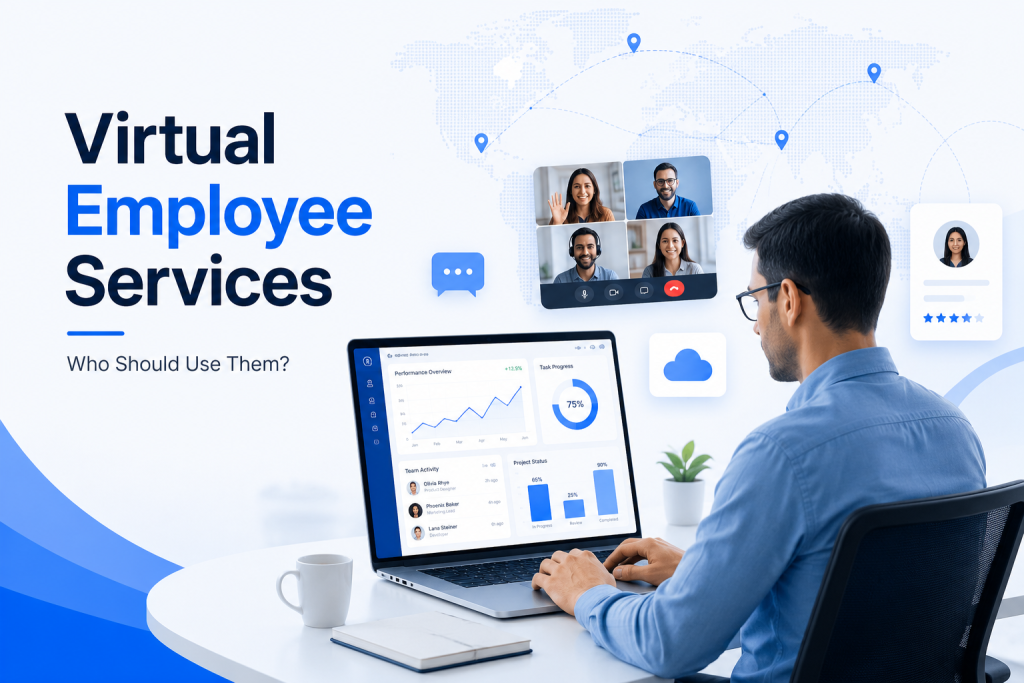
Virtual employee services are managed hiring solutions that connect businesses with skilled remote professionals who work as dedicated team members. The “managed” part is what separates them from job boards or freelance marketplaces.
When you work with a virtual employee service, you’re not just getting access to a talent pool. You’re getting a provider that handles sourcing, vetting, administrative infrastructure, performance oversight, and ongoing support. The goal is to give you a virtual employee who functions like any other team member, just without the overhead of traditional employment.
The key distinction is exclusivity. A virtual employee works for your business specifically, during agreed hours, on your priorities. They’re not managing five other clients on the side or disappearing when a bigger project comes along.
This model works across industries. Businesses in technology, retail and ecommerce, healthcare, finance, and education all use virtual employee services to build remote teams that actually function the way in-house teams do, minus the fixed costs.
What Do Virtual Employee Services Include?
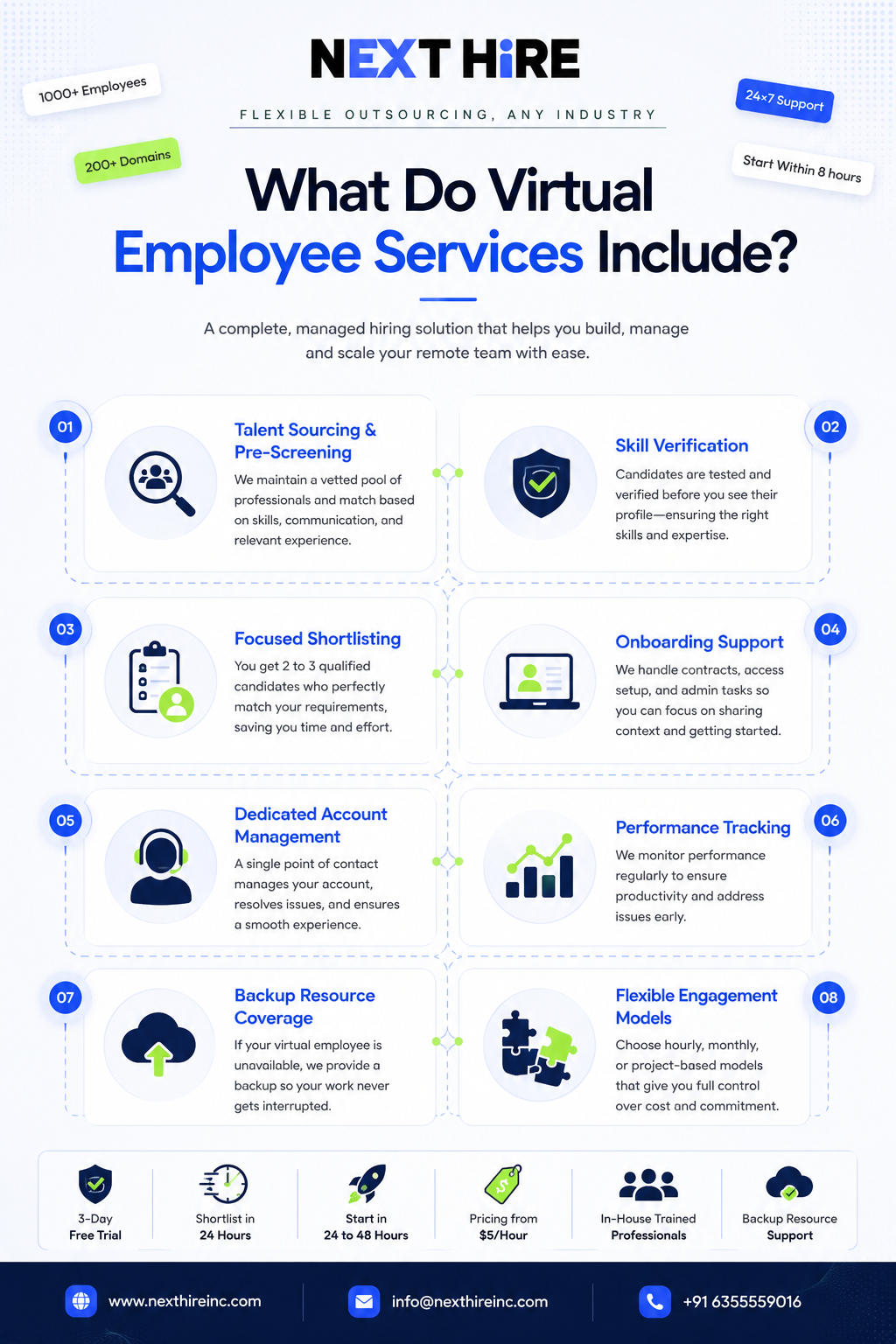
This is where a lot of providers fall short. Some offer little more than a talent marketplace with a nicer interface. A genuine virtual staffing service should include the following:
Talent sourcing and pre-screening. The provider maintains a vetted pool of professionals across multiple disciplines. When you submit a requirement, they match based on skills, communication, and relevant experience, not just keywords on a resume.
Skill verification. Candidates are tested before you ever see their profile. You’re not running your own technical assessments or hoping someone’s CV is accurate.
Focused shortlisting. Instead of reviewing dozens of applications yourself, you get 2 to 3 qualified candidates who genuinely match what you asked for.
Onboarding support. The provider handles contracts, access coordination, and administrative setup so you can focus on sharing context and getting work started.
Dedicated account management. A single point of contact manages the relationship, handles issues, and keeps the engagement on track. No support queues.
Performance tracking. Regular oversight ensures the engagement stays productive. Problems get caught early, not at the six-month review.
Backup resource coverage. If your virtual employees are unavailable due to illness or personal reasons, a backup steps in. Work doesn’t stop.
Flexible engagement models. Hourly, monthly, or project-based options give you control over cost and commitment level.
If a provider can’t speak clearly to most of these points, they’re offering a directory, not a service. That distinction matters when you’re depending on someone to actually deliver ongoing work.
Types of Virtual Employees Businesses Can Hire
The scope of what’s available through virtual employee services is broader than most people realize going in. It’s not just administrative assistants or basic data entry.
On the technical side, businesses regularly hire full-stack developers, mobile app developers, QA testers, and IT support specialists as dedicated virtual employees. These are roles that require deep familiarity with your systems and codebase over time, which is exactly why the dedicated model works better than rotating freelancers.
On the marketing side, you can hire virtual employees focused on SEO, paid media, email marketing, or content creation. These functions benefit enormously from someone who understands your brand, audience, and strategy over months rather than weeks.
Creative roles like UI/UX design, video editing, and motion graphics work well in a dedicated model too, especially when visual consistency and brand standards matter.
For operational and financial functions, businesses hire virtual bookkeepers, payroll specialists, and even virtual CFOs to handle ongoing financial oversight without the cost of a full-time local hire.
The common thread is this: any function that requires consistency, context, and skill over time is a strong candidate for a dedicated virtual employee.
Virtual Employee Services vs Freelancers
This comparison is worth taking seriously because the two options get conflated constantly, and the experience of working with each is genuinely different.
| Factor | Virtual Employee Services | Freelancers |
| Dedication | Exclusively focused on your business | Working across multiple clients |
| Consistency | Ongoing, structured engagement | Project to project |
| Context Building | Grows over time with your business | Starts from scratch each time |
| Accountability | Managed with oversight and reporting | Self-managed |
| Backup Support | Provider covers absences | Usually not available |
| Screening | Done by provider before you see profiles | You screen yourself |
| Admin Overhead | Handled by provider | You manage everything |
| Best For | Ongoing roles, team integration | Short, one-off tasks |
Freelancers are genuinely useful for contained work. A one-time design revision, a quick code fix, a single piece of content. For anything that requires ongoing attention, familiarity with your business, and reliability to your schedule, a dedicated virtual employee through a managed service is a meaningfully better fit.
The consistency gap compounds over time. Working with the same person for months means their output improves as they learn your context. That doesn’t happen when you’re cycling through new freelancers every few weeks. It’s also worth reading about the difference between a virtual assistant and a traditional employee if you’re still mapping out what model makes the most sense for your situation.
Who Should Use Virtual Employee Services?
Virtual employee services aren’t for everyone in every situation. They work best in specific circumstances.
Startups and small businesses that need skilled support but can’t justify a full-time local hire. The flexibility and cost structure make it accessible even on tight budgets. There’s a useful breakdown of how virtual assistants support small business operations if you want to see how this plays out in practice.
Growing mid-size companies scaling faster than their traditional hiring process can keep up with. When you need people now and your HR team is already stretched, virtual employee services close that gap without a six-week recruitment cycle.
Businesses in markets with limited local talent. If you need a specialist in a niche technology or a specific marketing discipline and your local market doesn’t have them, virtual hiring opens the global pool immediately.
Founders spending too much time on execution. If you’re doing work that shouldn’t require your level of expertise or decision-making, that’s a capacity problem that a virtual employee can solve.
Companies with fluctuating workloads. Some quarters are heavier than others. Virtual employee services accommodate that without the complexity of hiring and laying off full-time staff.
Teams that want to test a role before committing. Starting with a virtual employee lets you validate whether a function justifies a full-time local hire before making that investment.
If your business has consistent work that needs skilled, reliable attention and you’re not in a position to justify a traditional hire, hire a virtual employee and see how quickly the gap closes.
Benefits of Hiring a Virtual Employee
Rather than a generic list, here’s what actually changes when you bring a virtual employee into your business.
You stop doing work that shouldn’t be on your plate. Whether it’s content production, ad management, development tasks, or financial reporting, offloading execution to a skilled virtual employee frees up real time for strategic decisions.
Your overhead drops without your output dropping. No office space, no equipment, no benefits packages in most cases. The cost structure is fundamentally different from a local hire, and the savings are meaningful, especially for growing businesses watching cash flow.
Output quality improves over time. A virtual employee who works with you for six months knows your brand voice, your technical environment, your client expectations, and your standards. That accumulated knowledge produces better work. It’s the opposite of what happens when you rotate freelancers.
You can scale without the usual friction. Adding capacity doesn’t have to mean a months-long hiring process. With virtual staffing services, you can add a team member in days. And if scope changes, you can adjust.
Your core team focuses on what they’re actually good at. When operational and execution tasks are handled by virtual employees, your in-house people spend more time on the work that genuinely requires their expertise.
Understanding how virtual assistant teams contribute to business scalability gives a useful broader perspective on why this model works long-term, not just as a short-term fix.
Virtual Employee Onboarding Process
Onboarding is where virtual employee relationships either take off or quietly fall apart. It’s easy to underestimate how much the first week or two shapes everything that follows.
Good virtual employee onboarding doesn’t require an elaborate program. It requires intention.
Before day one, set up the basics. Access to tools, communication channels, and a simple document covering your workflows, expectations, and immediate priorities. Don’t make them guess what day one looks like.
Spend real time on the first call. A video conversation covering your business context, current projects, team structure, and communication preferences is worth more than a stack of documents sent over email. People do better when they understand the why behind the work.
Start with something specific and completable. A clear first task that lets them demonstrate capability and build early confidence in the relationship. Don’t front-load complexity before trust is established.
Introduce them to relevant team members. Even brief introductions reduce the isolation that remote work can create and make collaboration easier from the start.
Establish a check-in rhythm immediately. Daily standups, weekly reviews, or async updates, the format matters less than the consistency. Regular touchpoints in the early weeks prevent small misalignments from becoming bigger problems.
Virtual employee training should be context-rich, not generic. Share recordings of past meetings, examples of work you consider high quality, and documentation of how you handle recurring tasks. This kind of contextual training cuts the learning curve significantly compared to a generic onboarding doc.
Give feedback in the first two weeks. Don’t wait for a formal review. Early feedback, positive and corrective, calibrates the relationship quickly and signals that you’re genuinely invested in making it work.
The goal isn’t to check boxes. It’s to get someone from “figuring things out” to “actually contributing” as fast as possible.
How to Manage and Engage Virtual Employees
Getting someone started well is one challenge. Keeping them motivated and performing well over time is a separate one that deserves its own thinking.
Virtual employee engagement isn’t about team-building activities or forced social events. It’s about creating the conditions where someone can do their best work and feel connected enough to your business to stay invested in its outcomes.
Communicate consistently, not constantly. You don’t need hourly check-ins. But predictable, regular communication builds the rhythm that remote work depends on. When people know when they’ll hear from you, they don’t fill the silence with anxiety or assumptions.
Be explicit about priorities. Remote employees can’t pick up on ambient office signals. When priorities shift, say so directly. When something is urgent, say that clearly. Ambiguity in a remote context wastes effort in ways that are hard to see until the damage is done.
Recognize good work when it happens. Straightforward but genuinely easy to neglect when someone isn’t physically present. A quick acknowledgment when something is done well costs nothing and has a real effect on how engaged someone stays.
Include them where it makes sense. People who feel like participants rather than just executors care more about outcomes. Sharing business context, asking for input on relevant decisions, treating them as professionals with judgment rather than task-completers makes a real difference in quality over time.
Address disengagement early. If output is dropping, responses are getting slower, or communication is becoming clipped and minimal, those are signals worth paying attention to. Raising it directly and honestly is almost always better than waiting to see if it resolves itself.
There are thoughtful virtual employee appreciation approaches worth exploring if you want to build a more connected remote team culture over the long term.
When Should You Hire Virtual Employees?
Timing matters here. Bringing someone in before you have clear direction and meaningful work for them wastes both their time and yours. Waiting too long means capacity problems compound before you act.
Your team is consistently at or above capacity. If important work is getting deprioritized because people are stretched thin, adding capacity is the right response, not just pushing harder.
You’re paying local rates for work that doesn’t require local presence. If a role can be done remotely and you’re carrying salary, benefits, and office overhead for it, the economics don’t hold up.
You need a skill that nobody on your team currently has. Whether it’s a digital marketing specialist, a niche developer, or a finance professional, hiring a virtual employee is often faster and cheaper than training someone from scratch internally.
Hiring is killing your growth momentum. A six-week recruitment cycle is a real cost when opportunities move faster than that. Virtual employee services compress that timeline dramatically.
The work is ongoing and benefits from someone who knows your business. If it’s recurring, context-dependent, and requires consistent quality, you need a virtual employee, not a rotating cast of freelancers.
You want to validate a role before a full-time commitment. Hire a virtual employee first. Get real data on whether the function justifies a traditional hire before making that investment.
It’s also worth understanding the difference between offshoring and outsourcing if you’re thinking through the broader strategic question of how to structure your remote workforce going forward.
Common Mistakes to Avoid
Even with the right provider and a qualified candidate, engagements can underperform if the working relationship isn’t managed thoughtfully.
Vague expectations from the start. If you haven’t defined what success looks like in the role, you can’t reasonably expect consistent delivery. Define outputs, not just activities.
Treating them as outsiders. Virtual employees who are excluded from team context and communication tend to disengage. Include them where it makes sense, and they’ll contribute at a much higher level.
Skipping video communication. Text-based communication misses a lot. Regular video calls, even short ones, build rapport and catch misunderstandings before they become real problems.
Waiting too long to give feedback. Holding feedback until a formal review cycle is unfair and wasteful. Timely, honest feedback keeps the relationship calibrated.
Choosing purely on price. The cheapest option rarely delivers the best value. A professional who consistently delivers quality work at a slightly higher rate will save you more money in the long run than a cheaper hire who requires constant correction and rework.
How Next Hire Inc Helps With Virtual Employee Services
Next Hire Inc is built for businesses that need skilled remote professionals without the drawn-out process of traditional hiring. Here’s what working with them actually looks like in practice.
You share your requirement and get a shortlist of pre-vetted candidates within 24 hours. Once you approve someone, the engagement begins within 24 to 48 hours. A 3-day free trial lets you evaluate the match before committing to a longer engagement.
Pricing starts from $5/hour for hourly engagements and $799/month for dedicated monthly hires. Project-based work starts from $1,000. The full breakdown is on the pricing page. There are no hidden recruitment fees or onboarding charges.
Every candidate is screened for skills, communication, and reliability before you ever see their profile. If your dedicated employee is unavailable, a backup resource steps in. A dedicated account manager handles everything, one point of contact, no support queues.
The infrastructure supporting engagements is designed for operational continuity and data security, which matters when you’re depending on remote professionals for ongoing business functions.
Whether you’re in media and marketing, logistics, real estate, or manufacturing, Next Hire Inc has experience matching talent to different business environments and role requirements.
If you’re thinking about building a broader remote staffing setup rather than a single hire, that’s worth exploring too.
Ready to hire a skilled virtual employee without the usual delays? Next Hire Inc shortlists candidates in 24 hours and gets you started within 48. Tell us what you need.
Frequently Asked Questions
What Are Virtual Employee Services?
Virtual employee services are managed solutions that help businesses hire, onboard, and work with skilled remote professionals on an ongoing basis. Unlike freelance platforms, they include talent vetting, account management, backup resource support, and administrative infrastructure so businesses get a functioning team member rather than just a name on a list.
How Is a Virtual Employee Different from a Freelancer?
A virtual employee is dedicated to your business during agreed hours and builds familiarity with your processes over time. A freelancer works across multiple clients, operates independently, and suits short, one-off tasks better. The consistency, accountability, and context-building differ significantly between the two models.
What Is Included in Virtual Employee Onboarding?
Good virtual employee onboarding covers tool access setup, an introduction to your workflows and expectations, initial task assignments, team introductions, and communication protocol setup. Role-specific training using real examples and existing documentation speeds up the learning curve considerably compared to generic onboarding materials.
How Do You Keep Virtual Employees Engaged?
Consistent communication, clear priorities, timely feedback, and genuine recognition are the foundations of strong virtual employee engagement. Including virtual employees in relevant decisions and treating them as part of the team rather than external resources makes a noticeable difference in motivation and output quality over time.
When Should You Hire a Virtual Employee?
When your team is consistently overloaded, when local hiring is too slow or expensive for the role, when you need a specific skill that doesn’t exist internally, or when you want to test a function before committing to a full-time hire. Basically, when the work is ongoing and benefits from someone who knows your business.
How Quickly Can I Start Working with a Virtual Employee?
With Next Hire Inc, you receive a shortlist of pre-vetted candidates within 24 hours of submitting your requirement and can begin working with your chosen professional within 24 to 48 hours of approval. A 3-day free trial is available to evaluate the match before committing long-term.
How Much Do Virtual Employee Services Cost?
Costs depend on role, experience level, and engagement model. At Next Hire Inc, pricing starts from $5/hour for hourly engagements, $799/month for dedicated monthly hires, and $1,000 for project-based work. There are no hidden recruitment or onboarding fees.
Conclusion
Virtual employee services work because they solve a real problem: businesses need consistent, skilled support without the overhead and delay of traditional hiring. The model fills that gap in a way that freelancers can’t and that traditional employment often doesn’t justify.
What separates a good outcome from a mediocre one is usually two things. First, choosing a provider who genuinely manages the relationship rather than just making introductions. Second, investing properly in onboarding and ongoing engagement once the hire is made. Get both right and the value compounds over time.
If your business has capacity gaps, skill gaps, or simply needs reliable remote support to keep moving, virtual employee services are worth taking seriously.
Start with a 3-day free trial and build your remote team with trained professionals through Next Hire Inc.