

A Shopify store can outgrow its theme, but that does not mean every growing store needs to go headless.
Hiring a Shopify Hydrogen developer makes sense when the storefront itself is limiting a revenue-critical customer experience, content model, integration, or performance goal that Liquid cannot solve cleanly.
The real decision is not whether Hydrogen is more modern. It is whether the additional flexibility is worth owning a custom frontend application.
Key Takeaways
- Hydrogen is most useful when you need custom, app-like storefront experiences, complex content architecture, or deeper frontend control than a Shopify theme can provide.
- Headless Shopify adds engineering ownership. You gain flexibility, but you also take on more responsibility for integrations, SEO implementation, analytics, deployment, and ongoing maintenance.
- In 2026, Shopify is also previewing a new framework-agnostic Hydrogen model, so your developer should understand both the current production stack and the direction Shopify is taking next.
What Does a Shopify Hydrogen Developer Actually Do?
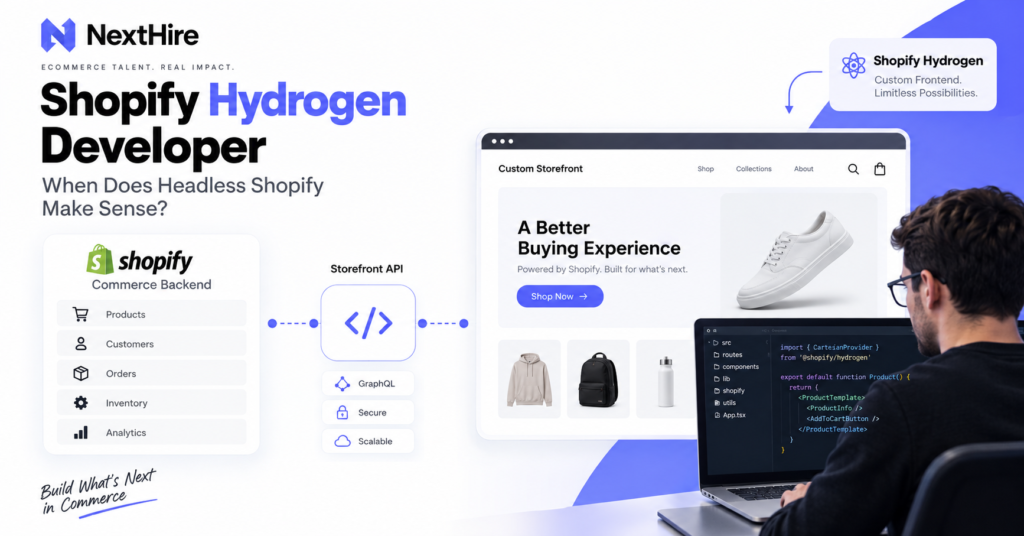
A Shopify Hydrogen developer builds and maintains a custom storefront that uses Shopify as the commerce backend rather than relying on a standard Liquid theme for the customer-facing frontend.
In a headless setup, Shopify still manages core commerce data and checkout. The frontend becomes a separate application that requests data through the Shopify Storefront API and renders the buying experience independently.
Shopify describes the production Hydrogen stack as a React Router-based approach that is optimized for Shopify commerce tooling and can deploy through Oxygen.
A good developer therefore needs more than React skills. They should understand Shopify APIs, caching, customer accounts, checkout, deployment, analytics, SEO, and the trade-offs between stable Hydrogen and preview tooling.
Shopify Hydrogen vs Liquid: What Actually Changes?
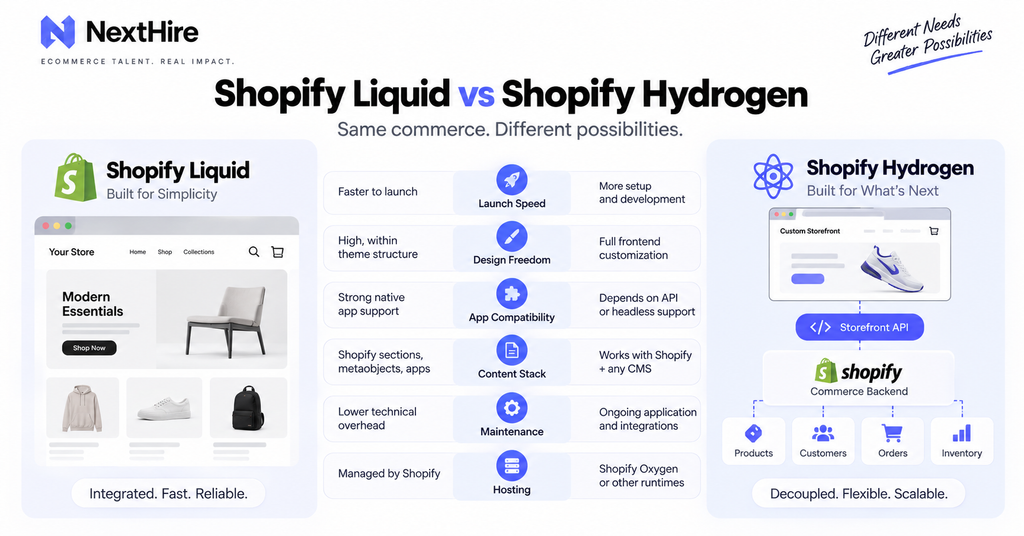
The Shopify Hydrogen vs Liquid decision is really a choice between a platform-native theme and a separately engineered storefront application.
| Area | Shopify Liquid Theme | Shopify Hydrogen / Headless |
| Frontend | Runs inside Shopify’s theme system | Separate custom frontend application |
| Launch speed | Usually faster | More architecture and engineering work |
| Design freedom | High, but within theme architecture | Very high, with full frontend control |
| App compatibility | Strongest with Shopify’s native app ecosystem | Depends on whether apps expose usable APIs or headless support |
| Content stack | Shopify sections, metaobjects, metafields, apps | Can combine Shopify with a dedicated CMS or other systems |
| Maintenance | Lower technical overhead | Ongoing application, dependency, and integration maintenance |
| Hosting | Managed as part of Shopify storefront | Shopify Oxygen or another supported runtime |
Liquid is not the “basic” option, and Hydrogen is not automatically the “advanced” option. For a standard catalog and app-supported feature set, Liquid is often simpler. For a storefront that behaves like a custom web application, Shopify headless architecture can remove costly constraints.
When Does Hiring a Shopify Hydrogen Developer Make Sense?
1. Your customer experience needs complex frontend interactions
Hydrogen starts to make sense when the storefront experience is difficult to build or maintain inside theme architecture.
Examples include advanced product configurators, personalization, 3D product experiences, guided selling, account dashboards, or flows that behave more like software than a conventional ecommerce page. If Liquid and standard Shopify APIs can handle the feature cleanly, headless may add complexity without enough benefit.
2. Content and commerce need to work as one system
Some brands have editorial teams, large resource libraries, localization workflows, or structured content that must be reused across channels. A Shopify headless commerce setup can combine Shopify’s commerce layer with a dedicated CMS in one frontend.
That is useful when content structure is a real operational requirement.
3. You need multiple storefront experiences from shared commerce data
A headless architecture can help when the same Shopify catalog supports several regions, brands, devices, or customer experiences.
You can reuse commerce data and frontend components, but multi-storefront complexity still needs to be managed in the application, data model, deployments, and integrations.
4. Performance is still a problem after proper theme optimization
Do not rebuild your storefront because a bloated theme is slow.
First identify whether third-party scripts, oversized assets, poorly implemented apps, inefficient theme code, or tracking tags are causing the issue. A focused Shopify speed optimization assessment can be far cheaper than replacing the frontend architecture.
Headless becomes more relevant when performance problems are tied to structural requirements that need tighter control over rendering, caching, and data loading.
5. Your integrations need a custom frontend layer
Headless stores often need integrations with search, loyalty, subscriptions, PIMs, ERPs, personalization tools, or custom Shopify apps.
The critical question is whether those systems expose the APIs and events your storefront needs. An app that works in Liquid may require custom Hydrogen integration.
6. You can support the storefront after launch
A Hydrogen storefront is software you own.
Someone must maintain dependencies, integrations, deployments, analytics, monitoring, and future features. If every small change requires finding a new freelancer, the architecture can become a bottleneck.
When Headless Shopify Is Probably More Than You Need
Your store mainly needs a better theme
If the problem is dated design, weak navigation, poor merchandising, or slow templates, a redesign or theme rebuild may solve it without introducing a separate frontend application.
Your business depends heavily on theme-based apps
Reviews, subscriptions, loyalty, upsell, and merchandising apps do not all offer the same headless support.
Before committing to headless Shopify, audit every revenue-critical app for an API, SDK, custom integration path, or replacement.
You need to launch in weeks
Headless requires more discovery around architecture, content, APIs, analytics, SEO, testing, and deployment.
When speed to market matters more than deep frontend flexibility, a strong Liquid implementation is usually easier to ship and operate.
Your team wants marketer-controlled changes without developer dependency
Shopify’s theme editor lets non-developers manage many storefront changes. Headless can preserve that flexibility with a CMS and component system, but it has to be intentionally engineered.
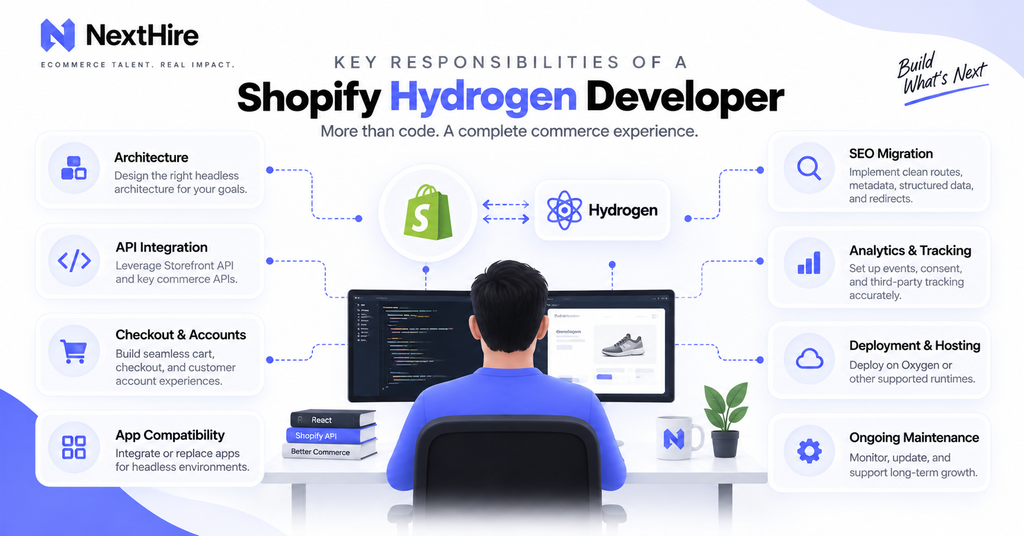
What Should a Shopify Hydrogen Developer Own?
The strongest candidate should be able to explain the whole storefront system, not only write React components.
Before hiring, ask how they would handle:
- Architecture: Why Hydrogen instead of Liquid, Hydrogen React, Next.js, or a custom Storefront API implementation?
- Data fetching and caching: Which requests should render server-side, which data can be cached, and how will freshness be managed?
- Checkout and customer accounts: How will cart state, authentication, account flows, and Shopify checkout work together?
- App compatibility: Which existing Shopify apps will work, which need API integration, and which must be replaced?
- SEO migration: How will routes, redirects, canonicals, structured data, metadata, sitemaps, and indexation be protected during launch?
- Analytics: How will Shopify analytics, customer events, consent, and third-party tracking be validated in the new storefront?
- Operations: Who owns deployments, monitoring, dependency updates, staging environments, and incident response after launch?
A developer who jumps directly to components without asking about these areas is treating a platform migration like a frontend redesign.
Budget for Headless Ownership, Not Just the Initial Build
The development quote is only one part of the decision.
A headless project can include discovery, UX, frontend engineering, CMS work, API integrations, app replacement, SEO migration, QA, analytics, monitoring, and ongoing maintenance.
The useful question is not, “How much does Hydrogen cost?” Hydrogen itself is open source. The useful question is, “What will our custom storefront cost to build and own?”
For a broader benchmark on Shopify engineering budgets and engagement models, see our guide to Shopify developer cost.
Tie the architecture decision to a measurable business case. Estimate the upside from conversion, content operations, new channels, or a high-value product experience before approving the rebuild.
A simple model is: expected incremental profit = incremental revenue × gross margin, minus additional annual technology and development cost.
If the business case is only “a faster modern stack,” the requirement is not specific enough.
What the 2026 Hydrogen Preview Changes in Your Hiring Brief
Shopify’s production Hydrogen documentation still describes the established React Router-based stack. The 2026 developer preview introduces a framework-agnostic model that can bring Hydrogen commerce primitives to other JavaScript frameworks and runtimes.
That does not mean every production store should build on preview software. Your developer should still answer three questions clearly:
- Are we building on the current supported production path or evaluating the developer preview?
- What future migration or compatibility implications does that choice create?
- Are we choosing Hydrogen because it fits the business requirements, or because the team prefers a particular frontend framework?
The developer should also understand Shopify Oxygen without assuming it is mandatory. Shopify supports Oxygen as its integrated Hydrogen hosting environment, while self-hosted Hydrogen can use other JavaScript runtimes as well.
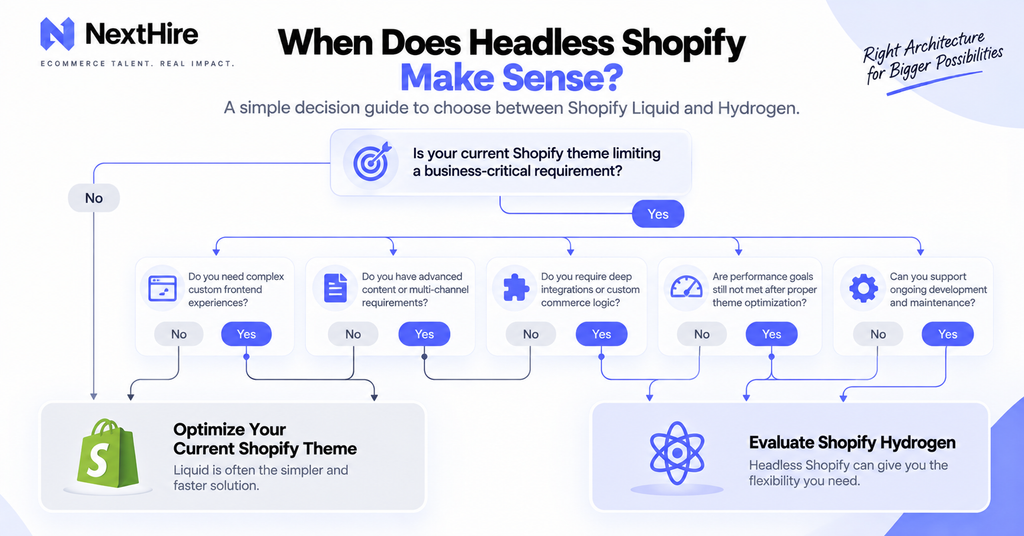
A Practical Headless Shopify Decision Checklist
Before hiring a Shopify Hydrogen developer, answer these questions with your product, marketing, and engineering stakeholders:
- Is a current theme limitation blocking a measurable business requirement?
- Have you already tested whether normal Shopify development can solve the problem?
- Are your revenue-critical apps and integrations headless-ready?
- Do you need a separate CMS, custom content model, or multi-channel frontend?
- Can you fund ongoing engineering after launch, not only the initial rebuild?
- Can your launch timeline absorb architecture, integration, migration, and QA work?
- Do you have a clear owner for SEO, analytics, deployment, and maintenance?
If most answers are no, improve the existing storefront first. If several answers are yes and connect to meaningful business outcomes, a headless discovery phase is worth considering.
FAQs About Hiring a Shopify Hydrogen Developer
What is a Shopify Hydrogen developer?
A Shopify Hydrogen developer specializes in building custom headless storefronts that use Shopify for commerce data and checkout while running a separately engineered frontend experience.
Do you need Shopify Plus to use Hydrogen?
No. Shopify’s current documentation says Oxygen is available at no extra charge on paid Shopify plans, including Basic, Grow, Advanced, and Plus. Whether you need Plus depends on your wider Shopify requirements, not Hydrogen alone.
Is Shopify Hydrogen better for SEO than Liquid?
Not automatically. Hydrogen gives you strong rendering control, but metadata, structured data, canonicals, redirects, sitemaps, and analytics still need correct implementation.
Can you migrate from Liquid to Hydrogen later?
Yes. Shopify provides a migration path from the Online Store to Hydrogen, including guidance for shared carts, checkout domains, route redirects, canonical links, and product feeds.
Many stores can therefore stay on Liquid until a clear architectural constraint appears.
Should You Hire a Shopify Hydrogen Developer?
Hire for the problem, not the technology label.
If your store needs a genuinely custom experience, deeper content architecture, complex integrations, or frontend control that Liquid cannot deliver cleanly, Hydrogen can be a strong fit. If the goal is simply a faster or better-looking Shopify store, fix the theme first.
When the headless case is clear, the developer should defend the architecture, map migration risks, and own the storefront after launch. You can hire Shopify developers through NextHire and match the role to the actual technical scope.